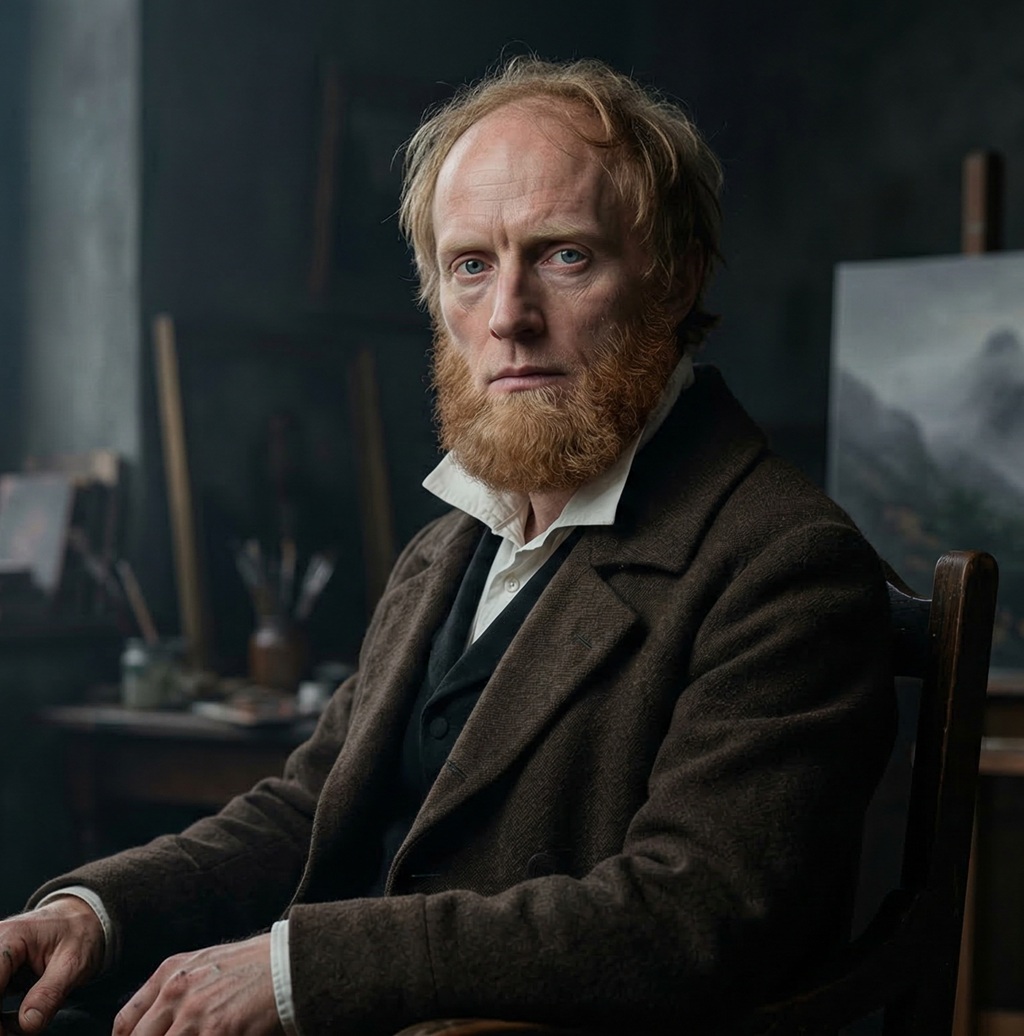
In March 1814, Caspar David Friedrich sat in Dresden over a letter to Ernst Moritz Arndt. Napoleon’s troops had withdrawn from Saxony, and Arndt, the leading publicist of the uprising against France, had sent him drawings; the subject was monuments to the fallen. Friedrich was working on a painting meant to show a monument to the Prussian general Scharnhorst, and he asked Arndt for an inscription of no more than twenty words. That no such monument had yet been built did not surprise him: “As long as we remain servants of princes, nothing great of this kind will ever happen.” And further: “Where the people have no voice, the people are not allowed to feel and honor themselves either.”
These sentences come from the man known today mainly as the painter of solitary figures facing fog, sea, and moon. They show that there is more in his quiet pictures than devotion to nature. Friedrich was no political thinker, and certainly no libertarian in today’s sense. But in an age of censorship he painted what he was not allowed to say out loud, and there is much to learn from that about liberty.
At a glance
- Life: September 5, 1774, in Greifswald, to May 7, 1840, in Dresden
- Work: Romantic painter, draftsman, and etcher; in Dresden from 1798, member of the Dresden Academy of Art in 1816 and associate professor there in 1824
- Major works: The Cross in the Mountains (Tetschen Altar, 1807/08), The Monk by the Sea (1808–1810), Tombs of Ancient Heroes (1812), Wanderer above the Sea of Fog (c. 1817), Two Men Contemplating the Moon (1819), Hutten’s Grave (1823), The Sea of Ice (1823/24)
- In one sentence: He poured the hopes of the Wars of Liberation and the disappointment of the Restoration into landscapes that leave every viewer alone with his own gaze.
From the Baltic to the Elbe
Friedrich grew up as the sixth of ten children of a soapmaker in Greifswald, then part of Swedish Pomerania. His mother died early, and a younger brother drowned trying to rescue him from the ice. After his first drawing lessons with the university drawing master Johann Gottfried Quistorp, he studied from 1794 to 1798 at the Copenhagen Academy, one of the most progressive in Europe. In the fall of 1798 he settled in Dresden, where he stayed until his death, interrupted by walking tours to Rügen, the Harz, the Giant Mountains, and Bohemia.
In Dresden he associated with Ludwig Tieck, Philipp Otto Runge, and Gerhard von Kügelgen, and later with the physician and painter Carl Gustav Carus and the Norwegian Johan Christian Dahl, who for a time lived in his house.
A picture that fit no category
Friedrich set off his first major controversy in 1808. In his studio he showed an altarpiece for the castle chapel of Count Thun in Tetschen that depicted no saint, but a summit cross in the evening light. In 1809 the chamberlain Friedrich Wilhelm Basilius von Ramdohr publicly protested that landscape painting was sneaking its way into the churches. Friedrich’s friends defended him, and the dispute made him famous.
Two years later he exhibited The Monk by the Sea and The Abbey in the Oakwood in Berlin. The Prussian crown prince bought both pictures, the Berlin Academy made Friedrich a member, and Heinrich von Kleist published a piece in his Berliner Abendblätter based on a draft by Clemens Brentano and Achim von Arnim. Its gist is that standing before this picture, one feels as if one no longer had eyelids.
The snow-covered monastery ruin in The Abbey in the Oakwood, modeled on Eldena near Greifswald, is read by the Sächsische Biografie, the biographical dictionary of Saxony, as a symbol of the Church as an institution losing its significance in favor of personal faith. That remains an interpretation, but it suits a painter who let neither the rules of the academy nor the expectations of the Church dictate to him what a picture may be.
The brush against Napoleon
With French rule over Germany, Friedrich’s art became political. As early as 1808 he refused to accept mail from France and asked his brother in Lyon not to write again until he had crossed the border. Megalithic tombs and other relics of a heroic past became ciphers for his convictions, which, because of censorship, he could only put into his pictures in coded form.
In 1812 he painted Tombs of Ancient Heroes: a rocky gorge with funerary monuments, one bearing the word “ARMINIUS” in gold letters, another a dedication to a fallen man “for liberty and justice.” When his friend Georg Friedrich Kersting joined the Lützow Rifles, a volunteer corps fighting Napoleon, in 1813, Friedrich and another friend paid for his equipment. He himself withdrew to the Elbe Sandstone Mountains during the occupation of Dresden in the summer of 1813. In those months he painted The Chasseur in the Forest: a lone French soldier before a snow-covered fir forest, with a raven on a tree stump. Art historians interpret the bird as a harbinger of misfortune announcing France’s defeat.
In March 1814 the Russian governor-general in Dresden opened an exhibition of patriotic art that included Friedrich’s pictures. This art belonged to a national movement sharply hostile to everything French, and its cult of Arminius seems strange from today’s perspective. Yet Friedrich’s letter to Arndt also shows what this movement meant to him: the hope that a people that had freed itself would in future have a say and no longer be merely the subjects of its princes.
A forbidden fashion
That hope was dashed. The Congress of Vienna restored the rule of the princes, and after the Carlsbad Decrees of 1819 the governments of the German Confederation persecuted students, professors, and publicists as “demagogues.” Friedrich Ludwig Jahn was imprisoned in a fortress, and Arndt faced disciplinary proceedings for years. Also banned was the Old German costume with beret and long coat that young patriots wore to show their convictions.
Friedrich kept painting it. In Two Men Contemplating the Moon from 1819, two figures in precisely this clothing stand on a forest path and gaze into the dusk. When the writer Karl Förster saw the picture in the studio in April 1820, Friedrich, according to Förster’s recollections, said ironically, “as if by way of explanation”: “They are up to demagogic intrigues.” The joke had a sting, because that was exactly the wording of the official charge on which people could be arrested at the time.
The famous Wanderer above the Sea of Fog, too, painted around 1817 and now in the Hamburger Kunsthalle, wears a frock coat that some art historians read as Old German costume or as the uniform of a volunteer rifleman. Who the man is remains unknown, and here too it is a matter of interpretation. What is certain is that Friedrich strikingly often turned his figures’ backs to the viewer. Together with Carus he developed the idea that this figure seen from behind invites the viewer to take its place and look for himself, without anyone explaining what he is supposed to see.
A tomb for the persecuted
Friedrich was at his most explicit in 1823, on the three hundredth anniversary of the death of the humanist Ulrich von Hutten, who was revered as a fighter against Rome and for the German cause. Hutten’s Grave shows a sarcophagus in a ruined Gothic church, and before it a man in the uniform of the Lützow corps wearing an Old German beret. Names are written in small letters on the sarcophagus: “Jahn 1813,” “Arndt 1813,” “Stein 1813,” “Görres 1821,” and “F. Scharnhorst.” They are men of the uprising of 1813, several of whom had meanwhile themselves become targets of the persecution of the “demagogues.” Scholars mostly read the picture as a political statement, a lament for the betrayed ideals of the Wars of Liberation. Grand Duke Carl August of Saxe-Weimar bought it in 1826, and today it hangs in Weimar.
From the same years comes The Sea of Ice, in which ice floes pile up over the wreck of a ship. Many interpreters have seen in it a symbol of the paralysis that followed Carlsbad. When the professorship of landscape painting at the Dresden Academy fell vacant in 1824, Friedrich was passed over. Whether his political stance played a role, or only the changing taste that was turning to the Nazarenes and the Düsseldorf School, is disputed to this day.
One’s own eye
What Friedrich understood by artistic freedom he set down in his late notes on a collection of paintings by contemporary artists, written between 1829 and 1831, in which he sharply criticized the Dresden Academy. The best-known sentence from them reads: “Close your bodily eye, so that you may see your picture first with the eye of the spirit.” For him, a picture arises from the painter’s inner vision, not from academic rules or commissions. From the second half of the 1820s his pictures met with growing incomprehension, and what kept him afloat above all were purchases by the Russian imperial family, arranged by the Russian poet Vasily Zhukovsky. After a stroke in the mid-1830s he could work only in sepia and watercolor. He died in Dresden in 1840, almost forgotten.
Rediscovered and appropriated
It was not until the Berlin Centennial Exhibition of 1906, prompted by the Norwegian art historian Andreas Aubert, that Friedrich returned to public awareness, with 93 works. After that he quickly became the “German” painter par excellence, and National Socialism made him the star witness for a völkisch, ethnic-nationalist art. In 1939 Kurt Karl Eberlein celebrated him in a “people’s book of German art.” This cult had little to do with Friedrich’s letter to Arndt, which wished for a voice of the people against the princes. The major exhibitions of 1974 in Hamburg and Dresden, which together drew almost half a million visitors, brought the artist himself back into focus. For his 250th birthday, the Hamburger Kunsthalle alone welcomed 335,000 visitors in 2023 and 2024, more than ever before in the museum’s history.
What friends of liberty find in him
Friedrich teaches no political theory, but his life and work show what a love of liberty looks like under censorship. Whoever may not speak openly speaks in pictures, in clothing, in names on a painted sarcophagus. This quiet form of dissent is no less serious than the loud one, and it only works if there is an audience able to read it.
His letter of 1814 also links having a say with self-respect: a people without a voice, Friedrich argues, may not honor itself either. As a painter, he thereby hit on something fundamental about the difference between subjects and citizens.
Perhaps his most lasting legacy is his visual language itself. The figures seen from behind do nothing for the viewer; they place him before a landscape and leave him alone with his gaze. Whoever stands before the Wanderer or The Monk by the Sea must decide for himself what he finds there, and this trust in the judgment of the individual is perhaps the most liberty-minded thing about his art.
A view no one prescribes
Caspar David Friedrich did not paint to please princes, academies, or critics, and in his last years he saw the public turn away from him. His hope for a people with a voice of its own was shaped by the national enthusiasm of his time, and posterity has harnessed him for purposes he could not have known. What remains is a body of work that has outlasted every appropriation, because it never lectures the viewer and trusts him to see with his own eyes.
Further reading
- Caspar David Friedrich: Die Briefe, ed. Herrmann Zschoche, ConferencePoint, Hamburg 2005 (in German)
- Caspar David Friedrich: Sämtliche Briefe und Schriften, ed. Johannes Grave, Petra Kuhlmann-Hodick, and Johannes Rößler, Munich 2024 (in German)
- Werner Hofmann: Caspar David Friedrich. Naturwirklichkeit und Kunstwahrheit, C. H. Beck, Munich 2000 (in German)
- Johannes Grave: Caspar David Friedrich, Prestel, Munich 2012 (in German)
This article is part of our series on thinkers, doers, and historical figures of liberty.
Sources
- Friedrich, Caspar David: Die Briefe, ed. Herrmann Zschoche, ConferencePoint, Hamburg 2005 (2nd edition 2006), in German; includes the letter to Ernst Moritz Arndt of March 12, 1814 (pp. 86 f.) and the letter to his brother Christian of November 24/25, 1808 (p. 47).
- Friedrich, Caspar David: Sämtliche Briefe und Schriften, ed. Johannes Grave, Petra Kuhlmann-Hodick, and Johannes Rößler, Munich 2024 (in German).
- Friedrich, Caspar David: Äußerungen bei Betrachtung einer Sammlung von Gemählden von größtentheils noch lebenden und unlängst verstorbenen Künstlern, ed. Gerhard Eimer and Günther Rath, Frankfurt am Main 1999 (in German).
- Caspar David Friedrich in Briefen und Bekenntnissen, ed. Sigrid Hinz, Berlin 1968 (Munich 1974), in German.
- Förster, Karl: Biographische und literarische Skizzen aus dem Leben und der Zeit Karl Förster’s, Dresden 1846, p. 157 (“Die machen demagogische Umtriebe”), in German.
- Kleist, Heinrich von (after Clemens Brentano and Achim von Arnim): “Empfindungen vor Friedrichs Seelandschaft,” in: Berliner Abendblätter, October 13, 1810 (in German).
- Carus, Carl Gustav: Lebenserinnerungen und Denkwürdigkeiten, ed. Elmar Jansen, Weimar 1966 (in German).
- Vogel, Gerd-Helge: Friedrich, Caspar David, in: Sächsische Biografie, ed. Institut für Sächsische Geschichte und Volkskunde, December 2, 2024, https://saebi.isgv.de/gnd/118535889 (in German)
- Börsch-Supan, Helmut; Jähnig, Karl Wilhelm: Caspar David Friedrich. Gemälde, Druckgraphik und bildmäßige Zeichnungen, Prestel, Munich 1973 (in German).
- Hofmann, Werner: Caspar David Friedrich. Naturwirklichkeit und Kunstwahrheit, C. H. Beck, Munich 2000 (in German).
- Grave, Johannes: Caspar David Friedrich, Prestel, Munich 2012 (new edition 2022), in German.
- Eberlein, Kurt Karl: Caspar David Friedrich der Landschaftsmaler. Ein Volksbuch deutscher Kunst, Bielefeld/Leipzig 1939 (in German; cited as evidence of the Nazi-era reception).
- University of Jena: interview with Johannes Grave on the edition of Friedrich’s writings, https://lichtgedanken.uni-jena.de/en/1342/friedrich-had-quite-a-sense-of-humour
- Hamburger Kunsthalle: press release of April 2, 2024, on the exhibition “Caspar David Friedrich. Kunst für eine neue Zeit” (335,000 visitors), https://drupal10.hamburger-kunsthalle.de/sites/default/files/2024-04/pm_c._d._friedrich-jubilaeumsausstellung_bilanziert_335.000_besucher_innen.pdf (in German)
- Staatliche Museen zu Berlin: exhibition “Empfindungen vor Friedrichs Seelandschaft,” https://www.smb.museum/ausstellungen/detail/empfindungen-vor-friedrichs-seelandschaft/ (in German)
- Wikipedia (German): articles “Caspar David Friedrich,” “Grabmale alter Helden,” “Huttens Grab,” “Zwei Männer in Betrachtung des Mondes,” “Der Wanderer über dem Nebelmeer,” “Demagogenverfolgung” (as a starting point and for locating the sources)