In April 1937, five Americans and Europeans met for thirteen sessions in the house of Leon Trotsky in Coyoacán, a district of Mexico City. In Moscow, the exiled revolutionary had been accused in show trials of instigating conspiracies against the Soviet Union, and an independent commission under the 78-year-old philosopher John Dewey wanted to know what truth there was to the charges. The commission’s secretary was a journalist from the state of Washington who had no sympathy for Trotsky’s politics.
Suzanne La Follette was an individualist who distrusted the state, and in Coyoacán the question was whether a state may pass judgment on people without anyone examining its evidence. She had developed the basic idea behind this stance eleven years earlier in a book on the liberty of women that few people know today.
At a glance
- Life: June 24, 1893, on the family farm in southeastern Washington State, to April 23, 1983, in Palo Alto, California
- Work: editor at The Freeman alongside Albert Jay Nock (1920 to 1924), founder of the New Freeman (1930 to 1931), secretary of the Dewey Commission (1937), managing editor of the new Freeman (from 1950) and of National Review (1955 to 1959)
- Major works: Concerning Women (1926), Art in America (1929)
- In one sentence: She understood the emancipation of women as equal liberty for all and distrusted any protection that turns adults into wards.
From the Wheat Farm to the Newsroom
Suzanne La Follette was born the fourth of seven children on her family’s wheat and fruit farms on the Snake River. When she was about twelve, the family moved to Pullman, where she finished high school. Her father, William La Follette, represented Washington in the House of Representatives as a Republican from 1911 to 1919, and his cousin was Robert La Follette, the best-known progressive of his day. In the nation’s capital, the daughter worked for a time in her father’s office and in Robert La Follette’s Senate office while she completed her studies at Trinity College.
In 1919 she joined the weekly The Nation, and a year later Albert Jay Nock brought her to the newly founded Freeman. Nock was a sharp critic of the state, and the magazine was close to Henry George’s land reform doctrine. The Freeman ceased publication in early 1924, and two years later came the book that has kept her name alive.
A Book for Woman as a Person
Concerning Women was published in 1926 by Albert & Charles Boni in New York. As its epigraph, La Follette chose a sentence by Mary Wollstonecraft: “Let there be, then, no coercion established in society, and the common law of gravity prevailing, the sexes will fall into their proper places.” The writer Jeff Riggenbach calls the work the first book since Wollstonecraft’s A Vindication of the Rights of Woman of 1792 to lay the foundation for an individualist feminism.
Right at the start, La Follette draws a distinction that carries the entire book. For her, society is the whole of the people who live together, while the state represents the organized interest of a ruling group. Her concept of the state explicitly follows Franz Oppenheimer, who had explained the state as arising from conquest and the economic exploitation of the conquered. Anyone who wants to restrict women for the good of the state, and equally anyone who wants to free them for the good of the state, confuses the two, in her view.
She also rejected a line of reasoning that was popular among women’s rights advocates at the time. Many demanded more rights for women because this would benefit children and the future of the nation. La Follette considered that an argument from expediency and countered it with an argument from justice: “It is for the sake of humanity, and not for the sake of children, that women ought to have equal status with men.” (Chapter I) She did not deny that children would benefit, but for her that was beside the point. Nor did she care for reformers who spoke of woman as a passive being, something to be acted upon or held back.
The Protection That Confines
In the 1920s, large parts of the women’s movement put their hopes in laws that applied only to women: shorter working hours, bans on night work, minimum wages. La Follette looked at their effects and concluded: “Better nothing, perhaps, than protection which creates new disabilities.” (Chapter V)
Where women’s working hours are shortened by law, some factories simply hire men or children instead. A ban on night work takes from waitresses precisely the hours after the theaters let out, when tips are highest, and she could see no reason why night work should be more harmful for women than for men. Minimum wages rest on theoretical notions of what is enough to live on and have nothing to do with the actual value of the work. Regulations against the hazards of industry, she wrote, citing the Women’s Bureau, the federal agency for women in the workforce, often missed the actual hazards and barred women from entire occupations.
Behind this lies an idea she found in John Stuart Mill. All these measures, she wrote, were “so many attempts to mind some one else’s business” (Chapter V). Whoever decides for someone else never knows that person’s circumstances and temperament as well as the person does, and a general rule never affects two people in the same way. Consistent with this, she also refused simply to reverse women’s old disadvantages in marriage law, because that would only have put women in a position of privilege, and for her equal liberty meant equal rules.
Marriage as a Free Contract
La Follette devotes a long chapter to marriage. She observed that the marriage law of her time was gradually becoming the same for both sexes and losing its double standard for men and women. That was not enough for her, because it left a prior question open: whether a third party has any right at all to decide how adults arrange their personal relationships. She names this third party: it is the state. Her verdict is plain: “Marriage under conditions arbitrarily fixed by an external agency is slavery.” (Chapter IV) The personal bonds between spouses, their affection and their care for the children they share, were for her matters that the two people involved must settle themselves.
Liberty That Includes Everyone
La Follette states the main thesis of her book herself. The final emancipation of woman, she argues, does not depend solely on the removal of the barriers that subordinate her to man. That is only a necessary step. What is decisive is the abolition of all restrictions on natural human rights that subject the great majority to a privileged group. In Chapter VI she writes: “It is impossible for a sex or a class to have economic freedom until everybody has it.”
This freedom, she says, is the freedom to produce and, as a consequence, the freedom to exchange, the laissez-faire, laissez-passer of the Physiocrats, the eighteenth-century French economists who argued for free production and free trade. Like Nock and Henry George, she saw the greatest obstacle in the monopoly of land and in protective tariffs that exact tribute from consumers. Classical liberals still answer the land question in different ways, but La Follette looked for the core of unfreedom in privileges granted by the state, and for the solution in the open market.
In 1926 she still saw the Russian Revolution as the proclamation of the idea that liberty is above all an economic question. Eleven years later she helped examine what truth there was to the Moscow charges against one of that revolution’s leaders.
Coyoacán
In 1929 Harper & Brothers published her history of American art, Art in America. In 1930 she founded the New Freeman, for which Nock wrote a column and which had to fold after about fifteen months during the Depression. In 1935 she received a Guggenheim Fellowship for research in art.
The Dewey Commission consisted mostly of socialists, progressives, and liberals who opposed Stalin without being Trotskyists. From April 10 to 17, 1937, the subcommission, made up of La Follette along with Dewey, Otto Rühle, Benjamin Stolberg, and Carleton Beals, questioned Trotsky in his house. The transcripts appeared that same year as The Case of Leon Trotsky, and the final report followed in 1938 under the terse title Not Guilty.
The Later Years
After the Second World War, La Follette returned to magazine work. In 1950, together with Henry Hazlitt and John Chamberlain, she founded a new biweekly under the old name The Freeman and ran it as managing editor before the magazine passed to the Foundation for Economic Education in 1956. In late 1955, William F. Buckley brought her to the newly founded National Review as managing editor, where she worked until her retirement in 1959. In his memoirs, John Chamberlain called her a libertarian rather than a conservative in the conventional sense.
In 1964 she ran in Manhattan as the Conservative Party candidate for a seat in the House of Representatives and lost. The New York Times obituary records a remark of hers from that year: she had not moved, she said, the world had moved past her to the left. She died on April 23, 1983, in Palo Alto at the age of 89.
What friends of liberty can learn from her
Her first lesson concerns what equal rights mean. For La Follette, they meant equal liberty and equal rules, not special care. Laws meant to shield a group treat its members as minors and often harm the very people they are meant for, because they close doors to them.
Just as important is her insistence that rights hold for the sake of the person. Anyone who justifies women’s rights by their benefit to children, nation, or state makes them dependent on that benefit and invites cutting them back as soon as the benefit is calculated differently. La Follette grounded them in justice and so made them independent of any calculation.
Finally, she was independent enough to contradict her allies in the women’s movement and to examine the case against a man whose politics she did not share.
Liberty Without a Guardian
Sharon Presley brought La Follette back into the conversation with a biographical essay in 1981, and La Follette’s book can be read free online today. Its central idea is this: a person is free only when allowed to take responsibility for his or her own life, and any protection the state grants also gives the state power over those it protects. Suzanne La Follette defended this idea in 1926 against large parts of her own movement, and it deserves to be linked with her name once more.
Further reading
- Suzanne La Follette: Concerning Women, Albert & Charles Boni, New York 1926 (full text at Project Gutenberg)
- Commission of Inquiry into the Charges Made against Leon Trotsky in the Moscow Trials: Not Guilty, Harper & Brothers, New York 1938
- Jeff Riggenbach: “The Life and Work of Suzanne La Follette,” Mises Daily, June 24, 2011
- Alice S. Rossi (ed.): The Feminist Papers. From Adams to de Beauvoir, Columbia University Press, New York 1973
This article is part of our series on thinkers, doers, and historical figures of liberty.
Sources
- La Follette, Suzanne: Concerning Women, Albert & Charles Boni, New York 1926; full text: Project Gutenberg no. 68226, https://www.gutenberg.org/ebooks/68226 (reprint Arno Press, New York 1972).
- La Follette, Suzanne: Art in America, with an introduction by Walter Pach, Harper & Brothers, New York 1929.
- La Follette, Suzanne: “Beware the State,” in: Alice S. Rossi (ed.): The Feminist Papers. From Adams to de Beauvoir, Columbia University Press, New York 1973.
- Commission of Inquiry into the Charges Made against Leon Trotsky in the Moscow Trials: The Case of Leon Trotsky. Report of Hearings on the Charges Made against Him in the Moscow Trials, Harper & Brothers, New York 1937; online: https://www.marxists.org/archive/trotsky/1937/dewey/
- Commission of Inquiry into the Charges Made against Leon Trotsky in the Moscow Trials: Not Guilty. Report of the Commission of Inquiry, Harper & Brothers, New York 1938.
- Riggenbach, Jeff: “The Life and Work of Suzanne La Follette,” Mises Daily, June 24, 2011, https://mises.org/mises-daily/life-and-work-suzanne-la-follette
- Presley, Sharon: “Suzanne La Follette: The Freewoman,” Libertarian Review, January 1981.
- Bird, David: “Suzanne La Follette Is Dead at 89; Writer, Editor and Early Feminist,” The New York Times, April 27, 1983 (quoted in Spartacus Educational).
- Chamberlain, John: A Life with the Printed Word, Regnery, Chicago 1982.
- Spartacus Educational (John Simkin): Suzanne La Follette, https://spartacus-educational.com/Suzanne_La_Follette.htm
- John Simon Guggenheim Memorial Foundation: fellow profile of Suzanne La Follette (1935), https://www.gf.org/?p=9472
- Wikipedia (en): Suzanne La Follette, https://en.wikipedia.org/wiki/Suzanne_La_Follette; William La Follette, https://en.wikipedia.org/wiki/William_La_Follette; Dewey Commission, https://en.wikipedia.org/wiki/Dewey_Commission (starting point and cross-check)
- Find a Grave: Clara Suzanne LaFollette, https://www.findagrave.com/memorial/105387752 (date and place of death)
- Philosophy Kitchen (University of Turin): “Suzanne La Follette (1893-1983). Tra femminismo e pensiero libertarian,” https://ojs.unito.it/index.php/philosophykitchen/article/view/9380
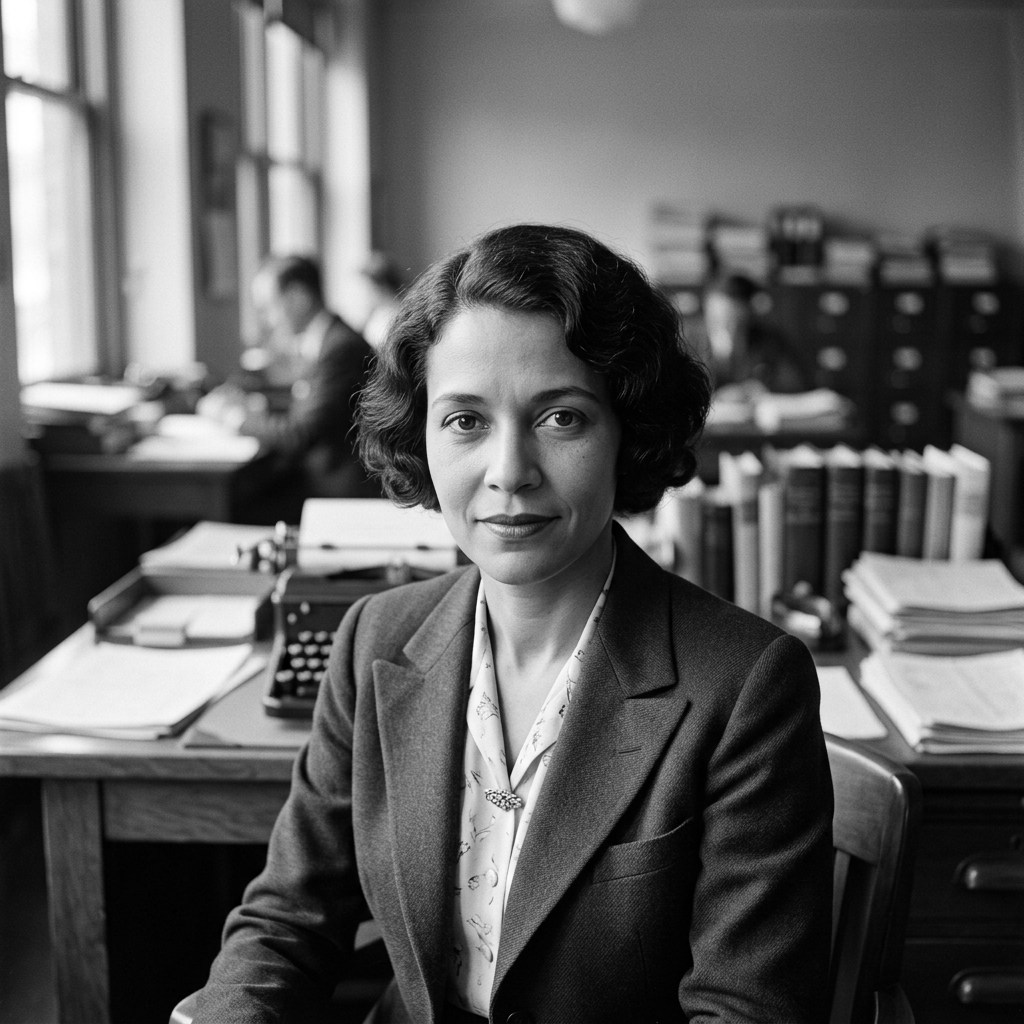
Featured image: Suzanne La Follette (AI illustration)