What prompted this
Recently someone shared an observation with me that many content creators in the field of economic policy will probably recognize: a carefully researched video about monetary policy that refers to Argentina’s president Javier Milei appears to be getting far less reach than comparable content, even among subscribers. The suspicion is obvious: are pro-liberty perspectives being systematically disadvantaged? And if so, on what legal basis?
The regulatory reality: the Digital Services Act
Since February 17, 2024, the Digital Services Act (DSA) has applied throughout the EU. It is a regulation with far-reaching consequences for all online platforms that offer their services in the EU, regardless of where the company is headquartered.
The financial leverage
The numbers are clear: violations of the DSA can be punished with fines of up to 6% of global annual turnover. For Meta, that means potential penalties in the billions. In addition, periodic penalty payments of up to 5% of daily turnover can be imposed until violations are remedied. In December 2025, the European Commission already imposed a fine of 120 million euros on X (formerly Twitter) for transparency shortcomings.
For comparison: the maximum fines under the GDPR, the EU’s General Data Protection Regulation, are 4% of annual turnover, so the DSA goes even further. Smaller providers can already face fines of up to 300,000 euros.
In Germany, the Bundesnetzagentur (the Federal Network Agency) is responsible for oversight as the “Digital Services Coordinator” (DSC). For very large online platforms (VLOPs) with more than 45 million monthly users in the EU, among them YouTube, Facebook, Instagram, TikTok, and X, the European Commission is directly responsible.
What platforms actually have to do
The DSA obliges platforms to take a wide range of measures:
For all platforms:
- Notice and complaint procedures for “illegal content”
- Transparency reports on moderation measures
- Central points of contact for authorities
- A ban on manipulative “dark patterns”
Additionally, for very large online platforms (VLOPs):
- Annual risk assessments of “systemic risks”
- Risk mitigation measures
- Independent audits
- Data access for vetted researchers
- Transparency about algorithms and recommender systems
The problem of vague terms
This is where the real problem begins: what exactly is a “systemic risk”? What is “harmful content”? The DSA remains deliberately vague.
“Illegal content,” but which content?
The DSA does not itself define what illegal content is. Instead, it refers to national law and EU law. Article 3(h) of the DSA merely says: “any information that […] is not in compliance with Union law or the law of any Member State.”
Clearly illegal are, for example:
- Hate speech and incitement to hatred (Volksverhetzung under German law)
- Child sexual abuse material
- Terrorist content
- Serious insults
- Copyright infringements
But: what about criticism of economic policy? Skepticism toward central bank policy? Questioning government measures?
Disinformation: an elastic term
Things get especially critical when it comes to “disinformation.” Here the legal situation is clear: disinformation is not illegal per se in the EU. False statements of fact are not protected by freedom of expression, but they benefit from the “legality of the lie”: they are prohibited only when they infringe on the rights of others (for example insult or defamation).
Nevertheless, under Article 34 of the DSA, very large platforms must assess “systemic risks” that may arise from the dissemination of disinformation. They must then take measures for “risk mitigation.”
The problem: who defines what disinformation is? A video that expresses doubts about the effectiveness of expansionary monetary policy? A post that questions the debt sustainability of modern welfare states? Criticism of the European Commission’s views on economic policy?
Codes of conduct as “soft law”
The EU has also established two voluntary codes of conduct:
- The Code of Conduct on Countering Illegal Hate Speech Online (since 2016, updated 2025)
- The Code of Practice on Disinformation (since 2018, updated 2022)
These codes are voluntary, but platforms that sign them must comply with them, and their compliance is checked by independent auditors. In addition, the codes serve as a benchmark for whether platforms are meeting their DSA obligations on risk mitigation.
Worth noting: X (Twitter) withdrew from the disinformation code in 2023. The European Commission then opened several proceedings against X.
The structural incentive toward self-censorship
Even without explicit censorship orders, a massive incentive toward over-compliance arises:
- An existential financial threat: with Meta’s annual revenue of about 134 billion dollars (2023), a 6% fine would amount to roughly 8 billion dollars. Sums like that motivate extreme caution.
- Unclear legal situation: what exactly counts as a “systemic risk” or “disinformation” is not precisely defined. When in doubt, platforms would rather moderate too much than too little.
- A reversed burden of proof in practice: platforms must demonstrate that they have taken “appropriate measures” to mitigate risks. What is “appropriate” is decided by the European Commission in case of conflict.
- Algorithmic risk avoidance: if content on certain topics (monetary policy, public finances, economic liberalism) could potentially be classified as “controversial” or “polarizing,” it is tempting for platforms to reduce its reach preemptively.
Concrete cases show the pattern
The enforcement of the DSA so far is revealing:
Against X (Twitter):
- Proceedings over the alleged spread of disinformation after October 7, 2023
- A fine of 120 million euros for transparency shortcomings in advertising (December 2025)
- A demand for access to internal documents about algorithms
Against Meta (Facebook/Instagram):
- Allegation: inadequate notice mechanisms for illegal content
- Allegation: overly complicated complaint procedures for users
- Allegation: obstructed data access for researchers
Against TikTok:
- Proceedings over “addictive design”
- Allegation: inadequate protection of minors
- Allegation: lack of transparency in advertising
What stands out: the proceedings focus on transparency, procedures, and “risks,” not on specific illegal content. The message: it is not only what gets moderated that matters, but how the platforms design their systems.
The international dimension
Shortly after the EU fined X in December 2025, the US government reacted sharply: it spoke of “censorship” and imposed entry bans on one of the architects of the EU’s digital laws as well as on other Europeans.
This reaction shows that the DSA is increasingly becoming a geopolitical instrument. The question is not only whether certain content is legal or illegal, but who has the power to define the rules for the digital public sphere.
The questions that need to be asked
On the transparency of terms: Why is there no precise definition of what counts as a “systemic risk” in economic policy debate? Is criticism of MMT (Modern Monetary Theory) disinformation? Are concerns about debt sustainability “harmful”?
On proportionality: If a serious, fact-based video about monetary policy gets less reach, which specific “risks” justify that? Who carried out this risk assessment? By what criteria?
On democratic legitimacy: Should unelected compliance officers at platforms, under the threat of existential fines, decide which economic policy positions reach a broad public?
On asymmetry: Is there empirical data on whether pro-government, interventionist, or pro-EU perspectives are systematically favored? The burden of proof lies with the platforms, but they publish no comparative data.
On the power to define: Who decides what “disinformation” is? If a position is held by mainstream economists but libertarian economists disagree, who is right? And more importantly: who gets to decide?
The fundamental problem
Even if there is no deliberate political discrimination, a structural problem remains:
- Algorithms are programmed and trained by people who were socialized in particular political and academic milieus.
- When “mainstream” and “quality” become technical categories, that has political consequences.
- When interventionist positions are considered “serious” while free-market approaches are classified as “controversial,” the space for debate shifts, even without explicit censorship.
- The high fines create a massive incentive to moderate too much rather than too little when in doubt.
A form of indirect censorship?
Direct censorship, meaning an explicit ban on criticizing the state or the EU, does not exist in the DSA. It would be incompatible with Article 11 of the EU Charter of Fundamental Rights (freedom of expression and information).
But if platforms, under the threat of fines in the billions, are obliged:
- to assess “systemic risks” (without a clear definition)
- to combat “disinformation” (without a legal basis for prohibiting it)
- to take “appropriate measures” (without clarity about what is “appropriate”)
- to design their algorithms so that they “mitigate” risks
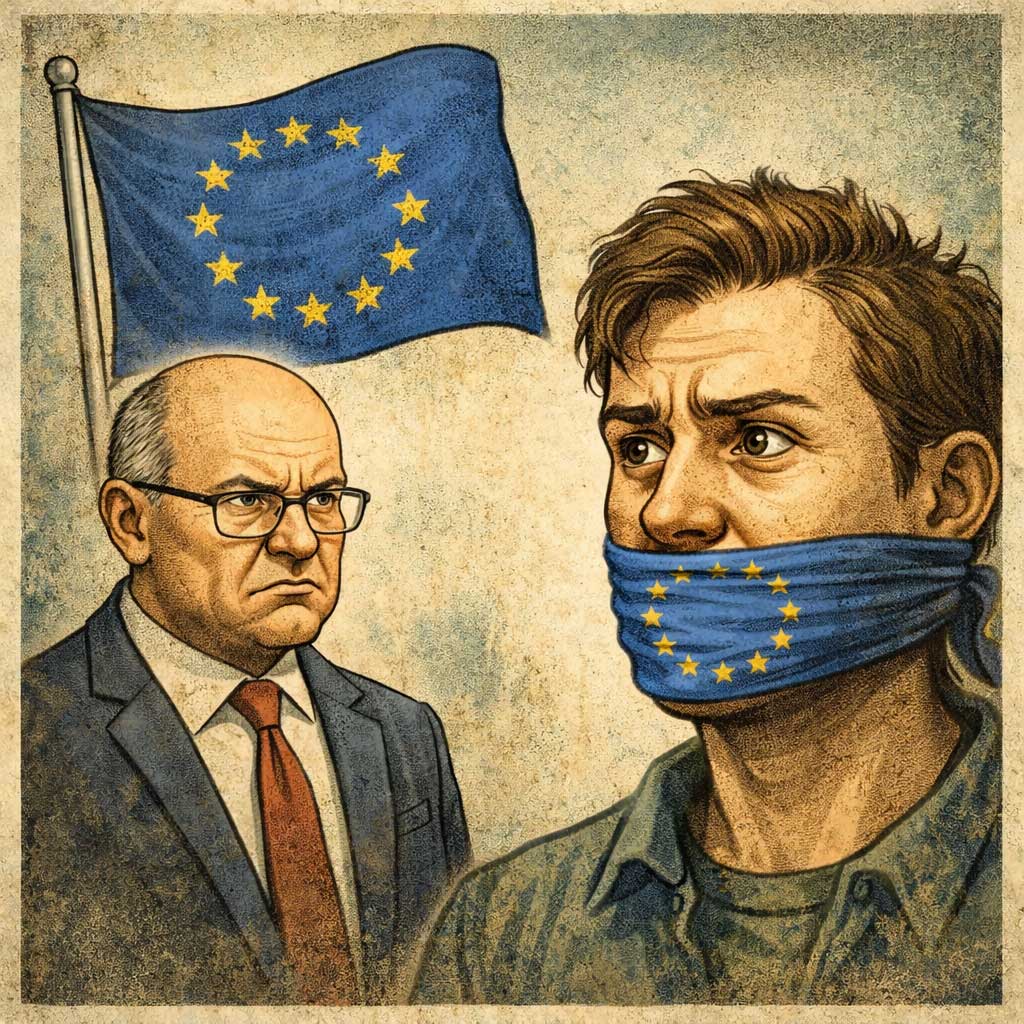
…then the result is an indirect steering effect that can come close to censorship in its effect, without formally being censorship.
A legal scholar would speak of an “indirect interference with fundamental rights.” An economist would speak of “regulatory over-compliance.” The libertarian calls it by its name: censorship through the back door.
What should be done
- Precise definitions: the DSA framework needs clear, justiciable definitions of what counts as a “systemic risk” in political and economic policy debate.
- Transparency reports: platforms should be required to break down how different political perspectives fare in their systems, with comparable metrics.
- Independent audits: algorithms and moderation decisions should be open to review by independent bodies, not only for compliance with the DSA but for systematic bias.
- Legal recourse: there must be simple legal remedies against restrictions on reach when these are not based on clearly illegal content.
- Protection of fundamental rights: giving Article 11 of the Charter (freedom of expression) more weight against vague obligations to minimize risk.
Conclusion: the burden of proof
We do not have to prove that systematic discrimination exists. The platforms have to prove that it does not.
They have all the data. They know their algorithms. They know the criteria by which content is rated, recommended, or restricted. If they claim there is no bias in favor of pro-government positions, let them prove it.
As long as they do not, the well-founded suspicion remains: for all its legitimate goals, the Digital Services Act creates a regulatory framework that structurally disadvantages perspectives critical of the state, pro-liberty perspectives, and free-market perspectives. Not through an explicit ban, but through incentive structures, vague terms, and the threat of existential fines.
This may not be censorship in the formal sense. In its effect, however, it comes dangerously close.
Sources:
- Digital Services Act (Regulation (EU) 2022/2065)
- European Commission: DSA Enforcement Framework
- Bundesnetzagentur: information on the DSA (in German)
- Heinrich Böll Foundation: “Disinformation: How the Digital Services Act Obligates Platforms, and Where It Still Falls Short” (in German)
- Various reports on ongoing DSA proceedings against X, Meta, and TikTok
Disclaimer: This expanded article is based on publicly available legal texts and documentation from the European Commission. It does not claim to prove systematic discrimination, but analyzes the incentive structures and room for interpretation that the DSA creates. All legal assessments are personal expressions of opinion within the freedom of expression protected by Article 11 of the Charter of Fundamental Rights.