How socialism learned to tread softly, and why of all people it is the ordinary taxpayer who funds his own opponents.
A coat of arms that gives everything away
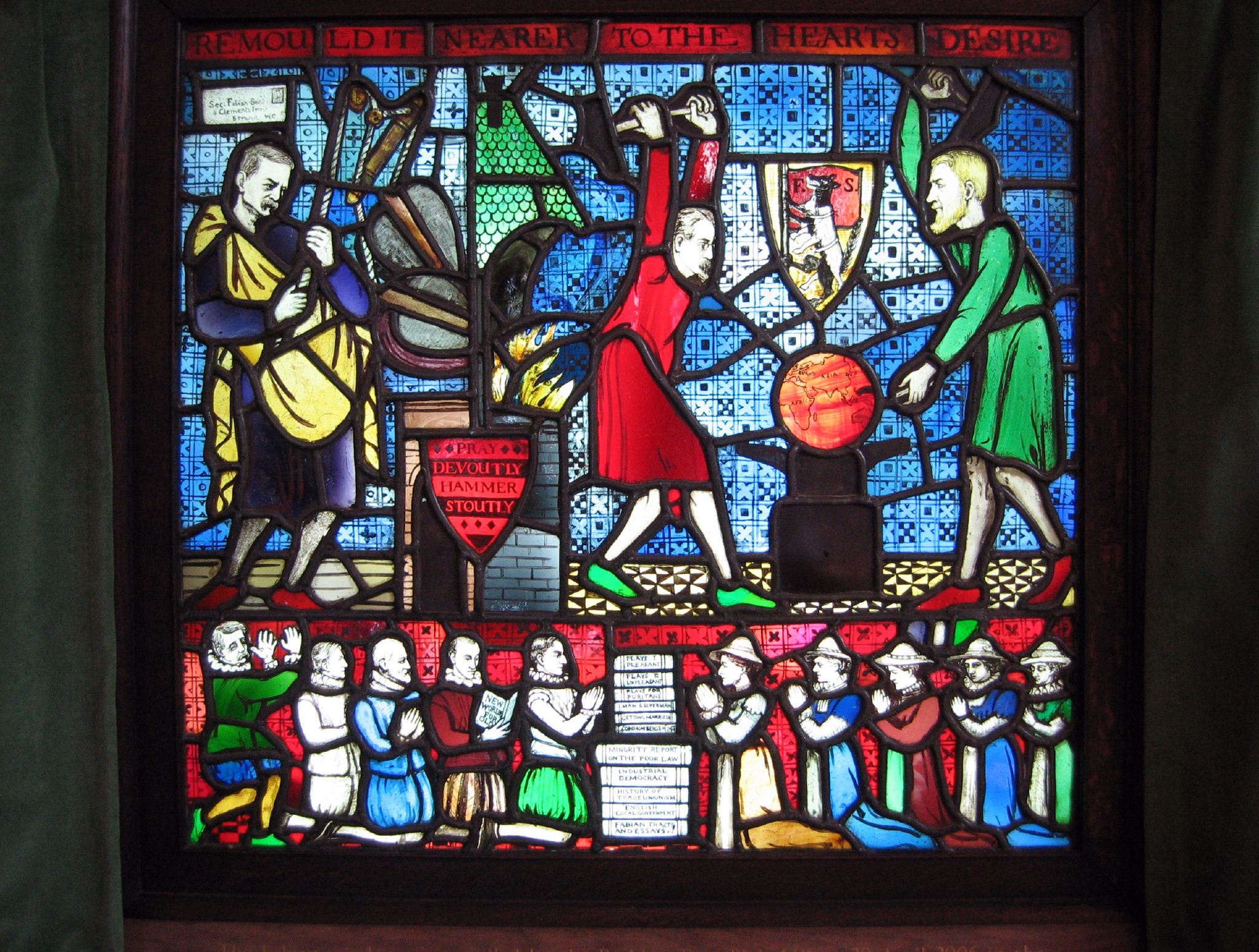
At the London School of Economics hangs a remarkable stained-glass window. It was made in 1910 to a design by George Bernard Shaw and shows two men, Sidney Webb and Shaw himself, striking with hammers at a globe that lies on an anvil. Above them runs a line from Edward FitzGerald’s Rubaiyat: “Remould it nearer to the heart’s desire.” Beside the forge, a banner urges them: “Pray devoutly, hammer stoutly.” And directly above the globe, between the two smiths, a shield bearing the initials F.S. hangs in plain view: a wolf in sheep’s clothing, standing upright, the fleece thrown over its back.
The lower half of the picture completes the scene: there Fabians kneel in a pose of devout worship, though not before an altar but before a pile of Fabian writings, from Shaw’s plays to the Webbs’ standard works on trade unions and the Poor Law. The society prays to its own tracts, while the wolf watches over everything.
Let that sink in. The Fabian Society, the socialist think tank founded in 1884 that did so much to shape the British Labour Party and the modern welfare state, wrote its own deception into its coat of arms and hung it in the most prominent spot in the picture. This is no insinuation by malicious critics. It is self-disclosure.
The Fabians named themselves after the Roman general Quintus Fabius Maximus, “the Delayer,” who defeated Hannibal not in open battle but by evasion, attrition, and waiting. That was exactly their program: no revolutionary storming of the bastions of bourgeois society, but the patient, inconspicuous penetration of its institutions. They called it “permeation.” You found a university (the LSE), you place your people in ministries, newsrooms, and professorships, you write the reports on which politicians base their decisions. The revolution does not take place in the streets but in the faculty appointments process.
Who were the Fabians?
Anyone who looks at the founding generation notices one thing first: there was not a single worker among them. The Fabian Society arose in London in 1884 as an offshoot of an ethical and utopian discussion circle called the “Fellowship of the New Life,” and its leading minds were without exception members of the educated middle class: the civil servant Sidney Webb and his wife Beatrice, the daughter of a wealthy industrialist, the playwright George Bernard Shaw, the writer H.G. Wells, the social psychologist Graham Wallas, the theosophist Annie Besant. They were statisticians, men of letters, officials, and salon intellectuals, people who knew the factory worker mainly as an object of study, as a column of figures in a social survey.
Their tools matched: not strikes but tracts (the famous “Fabian Essays” of 1889), lecture tours, statistics, and networks. In 1895 the Webbs used an inheritance to found the London School of Economics, with the explicit aim of training a new administrative elite in their spirit. In 1913 the weekly “New Statesman” followed as their journalistic flagship. University, press, bureaucracy: the triangle in which control over the public narrative is produced to this day had been fully occupied by the Fabians more than a hundred years ago.
Their view of humanity, moreover, was anything but squeamish. A number of leading Fabians, among them Shaw and the Webbs, openly sympathized with eugenics, the idea that the state should breed the “quality” of the population. Shaw mused about weeding out the unproductive, and Beatrice Webb classified the poor into deserving and undeserving cases. And when the Webbs toured the Soviet Union in the 1930s, at the height of Stalin’s terror and the famine in Ukraine, they published a monumental work of praise titled “Soviet Communism: A New Civilisation?”. In the second edition they struck the question mark. The self-appointed champions of the little man found the country in which the little man starved by the millions to be splendidly administered.
The Labour Party: the parliamentary vehicle
The Fabians understood early on that ideas need a vehicle. In 1900 they were among the founding organizations of the Labour Representation Committee, from which the Labour Party emerged in 1906. The trade unions supplied the muscle, the Fabians the brains. When the party adopted a program in 1918, Sidney Webb personally wrote the famous “Clause IV,” the commitment to bringing the means of production into common ownership, which was printed on every Labour membership card until the 1990s.
The harvest came in 1945. The government of Clement Attlee, himself a Fabian like much of his parliamentary party, nationalized coal, steel, the railways, and the Bank of England, and built the National Health Service and a comprehensive welfare state. Not a shot had been fired, not a barricade raised. Socialism had not come through the front door of revolution but through the service entrance of administration, exactly as the coat of arms had promised. The final twist is telling as well: when the Fabian window resurfaced after decades in which it had been lost, it was Tony Blair who ceremonially unveiled it at the LSE in 2006. They are proud of the wolf there.
The worker as a pretext
At this point a heretical question is worth asking: was it ever about the worker? The history of socialism is the history of academics, men of letters, and sons of the middle class who spoke in the name of a class to which they did not belong and whose actual wishes they mostly despised. Marx lived on Engels’s factory money, Lenin was the son of a nobleman and a professional revolutionary, and the Fabians were salon intellectuals. In this worldview the real worker served as raw material: available in large numbers, economically dependent, with little formal education and therefore, so the calculation went, malleable. One only had to tell him long enough that he was being exploited and that rule by experts would be his liberation.
Except the raw material did not play along. Wherever the worker could choose freely, he chose a raise over world revolution, a home of his own over the collective, getting ahead over overthrow. The prophesied revolutions in the developed industrial countries never came; where socialism won, it won in agrarian countries through coups and civil war, not through the uprising of the proletariat. Ludwig von Mises named the core of this finding early on: anti-capitalism is not a cry of the exploited but a resentment of intellectuals, who are offended that the market pays an entrepreneur or a soccer player more than an essayist.
And here lies a bitter historical irony that one has to face: the only movement that truly succeeded in mobilizing the German worker on a mass scale was, of all things, the national variety of socialism. The NSDAP, the Nazi party, carried the worker in its name (National Socialist German Workers’ Party), courted him with full employment, “Strength Through Joy,” the Volkswagen, and social benefits, and replaced class struggle with race struggle: instead of “the bourgeoisie,” the envy it stoked was directed against “rapacious capital” and the Jews. Hayek devoted an entire chapter of “The Road to Serfdom” to this kinship, on the socialist roots of National Socialism, and Mises analyzed it in “Omnipotent Government”: both systems stripped owners of their power, directed the economy centrally, and subordinated the individual to the collective; they only argued over whether the collective should be called class or nation. That the masses could be mobilized precisely where the little man was promised not expropriation but spoils speaks volumes about what to make of the story of the revolutionary subject.
Western socialists, however, did not draw from this double failure, the revolution that never came and the catastrophe of totalitarianism, the conclusion that they should bury their ideas. They drew the Fabian conclusion: if the worker will not march, then you march without him. Not through the streets but through the corridors.
From London to Frankfurt: Gramsci, Dutschke, and the long march
What the Fabians demonstrated in practice, the Italian communist Antonio Gramsci later supplied as theory. His diagnosis: the workers simply will not make a revolution; they flatly refuse to be expropriated and made happy. So one must first conquer “cultural hegemony,” control over the meaning of concepts, values, and what is taken for granted. Whoever defines what counts as decent, modern, and scientific no longer needs barricades.
In Germany, Rudi Dutschke, a leader of the West German student movement, translated this strategy in 1967 into a catchy formula: the “long march through the institutions,” an allusion to Mao’s Long March. After the student revolt in the streets had failed and the worker stubbornly refused to discover his class consciousness (he would rather have an Opel Kadett and a vacation in Rimini), the generation of ’68 moved to where society is really rebuilt: into the schools, the universities, the newsrooms, the churches, the trade unions, the parties, and the ministerial bureaucracy.
From their point of view, the results are impressive. The Frankfurt street fighter Joschka Fischer, who in the seventies was still taking on police officers, became Germany’s foreign minister. An entire generation of activists became professors, heads of broadcasters and theaters, foundation board members, and state secretaries. The march arrived long ago. Today it sits in the front row, draws a civil servant’s salary with a pension, and still considers itself the resistance.
The business model: the taxpayer funds his own re-educators
And this brings us to the real scandal, which goes far beyond the history of ideas. For the march through the institutions has a business model, and that business model is compulsory funding by precisely those little people in whose name one supposedly fights.
The skilled worker, the cashier, the master craftsman: in Germany they all hand over roughly half of what they earn in taxes and social contributions. A considerable share of these funds flows into a bloated apparatus of government and government-adjacent bodies in which the heirs of the long march are comfortably housed: party-affiliated foundations, federal programs, commissioners, advisory boards, institutes, and NGOs whose “N” stands for “non-governmental” but whose budgets consist largely of tax money.
Take a concrete example: the Rosa Luxemburg Foundation, the foundation affiliated with Die Linke (the Left Party), which is the legal successor of the SED, the Socialist Unity Party that walled in East Germany for forty years. This foundation is funded almost entirely by the federal government, year after year with sums in the tens of millions. With this money it supports publications, events, scholarships, and projects that are devoted, among other things, explicitly to “antifascism,” the combat term under which East Germany once sold its Wall as the “anti-fascist protective rampart.” Anyone who moves in the orbit of antifa groups will find there a well-developed ecosystem of conferences, pamphlets, speaker fees, and meeting spaces, paid for by the taxpayer.
Then there are federal programs such as “Demokratie leben!” (“Live Democracy!”), through which well over a hundred million euros are distributed year after year to a web of associations and initiatives that have made the “fight against the right” their cause and like to stretch the term “right” so far that even the law-abiding citizen who calls for tax cuts or criticizes energy policy fits inside it. The activist who chants “All of [city name] hates the police” at a demonstration not infrequently does so with a livelihood that depends directly or indirectly on public funding pots.
Imagine the reverse: a federal program worth more than a hundred million euros that funds libertarian associations campaigning for tax cuts, private property, and stripping the state of its power. Unthinkable. The state feeds only what feeds it. And movements that demand more state, more redistribution, and more control are, from the apparatus’s point of view, an investment in its own growth.
The irony: anti-capitalism as a system of patronage
Here we come full circle to the wolf in sheep’s clothing. The rhetoric is that of the sheep: one speaks for the weak, the workers, the tenants, the left-behind. The practice is that of the wolf: one lives off them. The roofer who stands on the scaffolding in wind and rain finances, with his taxes and contributions, salaried positions, project funds, and panel discussions for people who then explain to him that he is privileged, that his consumption harms the climate, and that his unease about all of this is, when in doubt, “right-wing.”
Frédéric Bastiat coined the fitting term for this arrangement as early as 1850: legal plunder. The state, he wrote in 1848, is “the great fictitious entity by which everyone seeks to live at the expense of everyone else.” The Fabians perfected this fiction, Gramsci gave it a theoretical foundation, Dutschke gave it its marching orders, and the present has turned it into a comprehensive system of patronage. The old socialist wanted to nationalize the means of production. The new one has done something cleverer: he has nationalized himself.
The result is a class that Ludwig von Mises would have foreseen precisely: people whose income depends not on persuading customers who pay voluntarily, but on tax coercion working and the funding pots staying full. Anyone who lives this way has a tangible material interest in the state growing, in new problems being found that require new programs, and in every criticism of this system being branded an attack on democracy itself. For this class, anti-capitalism is not a conviction that costs anything. It is a source of income.
What follows from this?
The first step is to see through the game and call it by its name. Anyone who says “civil society” should be asked what percentage of their budget comes from tax money. Anyone who says “independent” should disclose their grant notices. And anyone who speaks in the name of the little man should explain why the little man has to pay him through payroll deductions instead of being allowed to support him voluntarily.
The second step is the only clean solution: separation of opinion and state, as thorough as the separation of church and state. Civic education, activism, the cultivation of worldviews: all of this is legitimate, but it belongs in the sphere of voluntary action. Whoever has followers should live off them. The Fabians knew why they put the wolf in sheep’s clothing on their coat of arms. It is time the taxpayer stopped paying for the wolf’s costume as well.