Summary
In August 1948 the Soviet Union declared modern genetics abolished. It was not refuted by a laboratory; it was banned by a party. The agronomist Trofim Lysenko, backed by Stalin personally, had genetics declared a “bourgeois pseudoscience,” its teaching prohibited, and its advocates denounced, dismissed, and imprisoned. The same logic is returning today, for feeling is taking the place of biological fact, and there is a demand that this feeling be treated as science. A feeling, however, is not a measurement but a statement about an inner state. The sociology of self-perception can describe how people feel, but it cannot decree what a sex is. Sex in humans is binary because reproduction knows two and only two types of germ cells, and the claim that there are any number of sexes is therefore not a scientific thesis but an untestable stipulation. This essay reconstructs the Lysenko case, lays bare its method, and shows that today’s subordination of biology to identity doctrine follows the same pattern. The libertarian objection is not directed against individual people but against a principle: no power may dictate what is to count as true, and no one may be forced to declare a feeling a fact.
1. The Lysenko Case: When the Party Gave Orders to Science
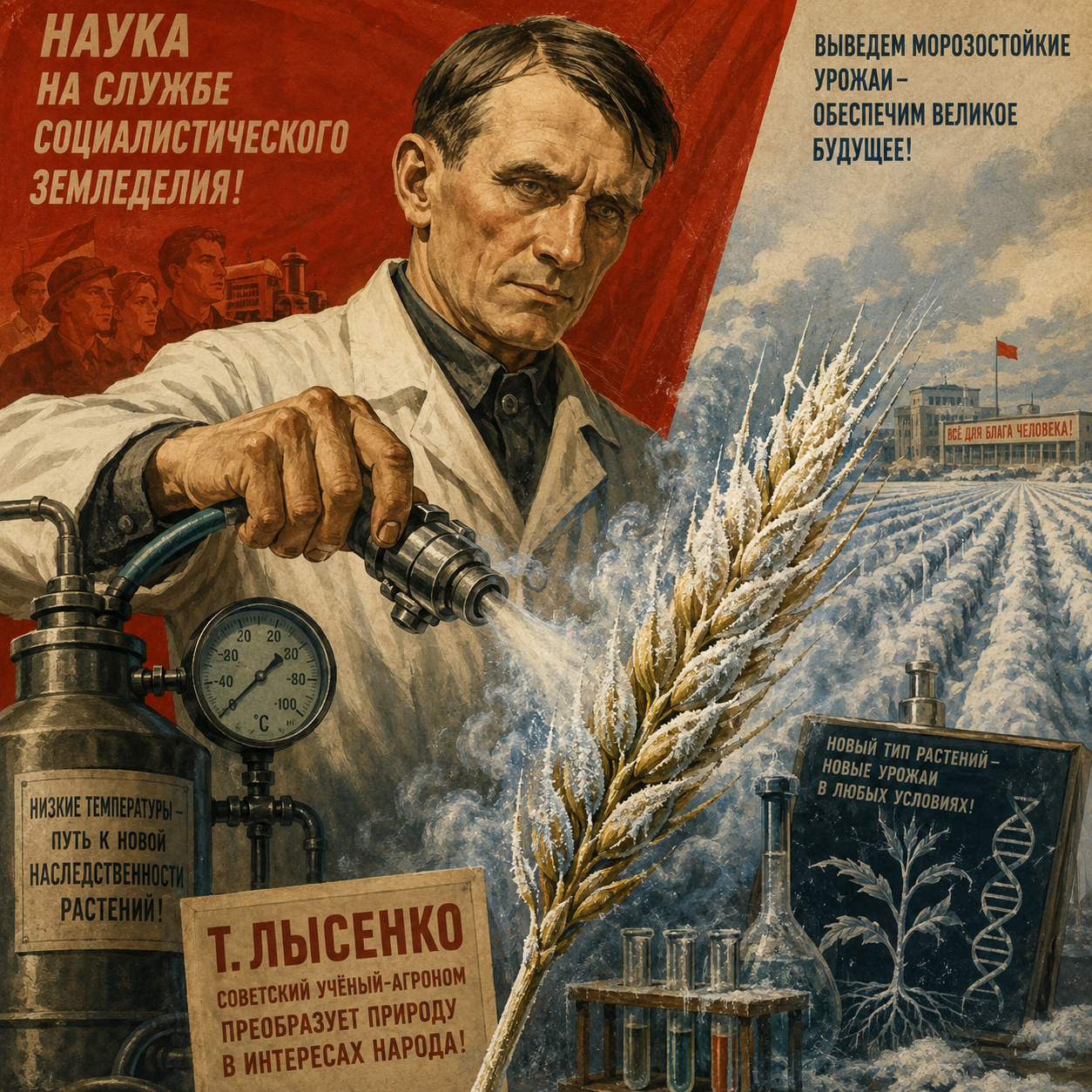
Trofim Denisovich Lysenko was not a geneticist but an agronomist with the unerring instinct of a courtier. He promised what a starving planned economy wanted to hear: dramatically rising harvests through simple interventions such as chilling seed. His claims did not withstand scrutiny, since he rejected statistical methods and followed no scientific procedural discipline, but that is precisely what made him politically useful.[1] He dressed up his doctrine as a continuation of the work of the plant breeder Ivan Michurin, even though Michurin’s work had little in common with his theses, and called the whole thing “Michurinist biology.”
The core of this doctrine was Lamarckism: the inheritance of acquired characteristics. Plants, so the idea went, could be permanently reshaped by environmental stimuli, and this imprint would pass on to their offspring. Lysenko denied that genes and chromosomes existed as independent carriers of heredity and rejected August Weismann’s germ plasm theory, according to which acquired changes to the body do not, in fact, act back on the germ cells.[2] What empirical research had long confirmed was now considered “idealist” and “reactionary” because it did not fit into dialectical materialism. The decisive standard was no longer whether a thesis corresponded to reality but whether it served the doctrine.
The matter became political in 1947, when Lysenko wrote to Stalin and branded genetics a tool of eugenics, racism, and Western capitalism. Stalin replied approvingly, stating that Michurin’s concept was the only scientific one and that the future belonged to Michurin.[3] From July 31 to August 7, 1948, the Lenin Academy of Agricultural Sciences, known as VASKhNIL, then held its session. Stalin personally edited Lysenko’s opening speech, and by the end of the week classical genetics had been demoted to the opposing camp of the “only correct” doctrine, and its teaching had been banned in schools and universities, a ban that remained in force until the early 1960s.[4]
The human costs were real. Nikolai Vavilov, the most important Soviet geneticist and the builder of a seed collection respected worldwide, had already been arrested in 1940 and died of starvation in Saratov prison in early 1943.[5] Others were forced into ritualized self-criticisms in which they publicly recanted their own research. The plant physiologist Dmitry Sabinin, whose book was withdrawn from publication in 1948, took his own life in 1951. Anyone who contradicted Lysenko was regarded not as mistaken but as “bourgeois” or “fascist,” and both labels could be fatal.[6]
2. The Method Behind the Madness: Why Ideology Hates Empirical Evidence
One misunderstands Lysenkoism if one sees it merely as a particularly large scientific error. Errors are part of science, for they get corrected. What was peculiar about Lysenkoism was not the error but its immunization against correction. Karl Popper supplied the decisive criterion: a statement is scientific insofar as it can fail against experience, that is, insofar as it is falsifiable. A doctrine, by contrast, that treats every contradiction not as a testable objection but as treason has left the ground of science, no matter how scientific its vocabulary sounds.[7]
Friedrich August von Hayek described the same process from the other side. In his critique of “scientism” he showed how ideologies borrow the prestige of science in order to clothe their own stipulations in its authority.[8] Lysenko spoke the language of biology, but he was not doing biology; he was doing politics in a lab coat. And Ludwig von Mises had already shown that an order which does not permit dissenting knowledge robs itself of the very information it would need in order to function. Socialism failed not least because it forbade the free inquiry on which it would have depended.
This leads to a diagnosis that reaches beyond the specific case. Wherever the goal of inquiry is no longer open but politically fixed in advance, science turns into its opposite. Contemporary philosophy of science has even coined its own term for this and speaks of “medical Lysenkoism” when the politicization of a field replaces open inquiry with a predefined ideological goal.[9] Lysenko’s name has thus long since become a code word, and not in libertarian pamphlets but in the medical literature.
3. The Return of the Pattern: From Class to Sex
Historical Lysenkoism operated with the category of class. Truth was whatever served the proletariat; falsehood was whatever was attributed to the bourgeoisie. This linking of knowledge to camp membership has not disappeared; it has merely changed its vehicle. Herbert Marcuse, the intellectual architect of the shift from class struggle to culture war, replaced the exhausted revolutionary subject of the proletariat with new agents of liberation. Where class once stood, identity categories stand today, and “bourgeois consciousness” has been replaced by “privileged” consciousness. The structure, however, remains: there are oppressors and oppressed, the oppressed are right by virtue of their position, and whoever disagrees has either bad intentions or a false consciousness.
It is precisely at this point that the new struggle touches biology, and here one must be precise. Human sex is not a matter of feeling but a matter of reproduction. There are two and only two types of germ cells, the large egg cell and the small sperm cell, and the entire architecture of human reproduction depends on this division. There is no third type of germ cell, and consequently there is no third sex. The normal case of reproduction requires a man and a woman; this is not a cultural convention but the order typical of the species, without which there would be no next generation. Rare disorders of sex development are exactly that, namely deviations from this order that require medical description, and not additional sexes that abolish it.
The ideological counterthesis puts feeling in place of this fact. Sex, it holds, is not found but felt, not anchored in the body but freely declarable, and consequently there could in principle be any number, indeed an infinite number, of sexes, depending on how a person happens to feel. Here lies the decisive error, for a feeling is not science. It is a statement about one’s own inner life, honest or dishonest, lasting or fleeting, but in no case a measurement of reality. Psychology and sociology can investigate how widespread such a feeling is and what it feels like, but from the fact that someone feels something it never follows that the world is the way he feels it to be. Whoever makes self-perception the judge of what a sex is confuses the description of a wish with the establishment of a fact, and in doing so commits, in a new field, exactly Lysenko’s error: the environment, here the inner world of experience, is supposed to triumph over biological constitution.
The claim that there are infinitely many sexes also fails Popper’s test. A thesis that rests on mere feeling and cannot be refuted by any observation, because every new self-report only confirms it and never tests it, is not falsifiable and therefore not a scientific statement. It is a statement of faith in the garb of science, and it demands not testing but assent. This very shift from testing to assent is the signature of Lysenkoism.
4. When Politics Rewrites the Diagnosis
How far ideology already reaches into science itself is shown by the handling of the medical diagnosis. For a long time, a pronounced and persistent conflict between felt sex and bodily sex was regarded as a condition requiring treatment. The tenth revision of the International Classification of Diseases, ICD-10, listed it under the name “transsexualism” in the chapter on mental and behavioral disorders, and the American diagnostic manual DSM-5 still recognizes “gender dysphoria” today.[10] So a diagnostic code very much exists, for it was the professional consensus for decades that the discrepancy between feeling and body is a clinically relevant condition.
What is remarkable is how this consensus has changed. The eleventh revision, ICD-11, in force since 2022, changed the name to “gender incongruence” and moved the condition out of the chapter on mental disorders into a new chapter on conditions related to sexual health. The World Health Organization justifies this by saying that it is not a mental illness and that classifying it as such creates stigma.[11] What matters is what triggered this reclassification. It was not a new biological discovery, not an experiment that would have refuted earlier assumptions, but the declared will to accommodate the concerns of activists and a particular interpretation of human rights. The professional literature names this driving force openly: organizations demanded removal from the list of disorders, and this demand was granted.[12]
One need not deny that reducing stigma can be a respectable goal in order to recognize the significance of what happened. A medical classification was rewritten not by evidence but by political pressure. The moment it is no longer the clinical finding that decides the classification but social acceptability, the very door that Lysenko pushed open has been opened again. It is the same movement, only in milder form: it is not the laboratory that writes science, but politics that dictates to science what it must say.
5. The Mechanics of Enforced Conformity: Denunciation, Recantation, Loss of Livelihood
The deepest correspondence lies not in the content but in the means of enforcement. Lysenkoism did not win through the better experiment but through three instruments, and all three are recognizable today.
The first is denunciation. Whoever deviates is not refuted but labeled. “Bourgeois” and “fascist” were the deadly words of 1948, and today’s equivalents are milder in their consequences but identical in function, for they too are meant not to examine the opponent but to exclude him from the circle of those worth hearing. The second is forced recantation. The theatrical self-criticisms of Soviet geneticists, in which they disowned their own work, are echoed in the public apologies and statements of distance with which researchers and clinicians today try to save their careers. The third is the loss of livelihood. Back then it meant the camp and death; today it means dismissal, retracted publications, and professional ostracism, a gentler but effective variant of the same mechanism.
This is exactly where the circle closes with Marcuse’s theory of “repressive tolerance,” the doctrine that one may withdraw tolerance from certain positions because one believes one knows the truth. But whoever thinks he knows what may be thought reproduces exactly the authority that the Enlightenment set out to oppose. Lysenkoism was this authority in its most brutal form, for it occupied the very concept of science and turned it into a weapon against knowledge.
The Strong Objection
This position deserves its strongest rebuttal, not its caricature. The most serious objection runs as follows: no one disputes the biology of reproduction. One merely distinguishes bodily sex from gender identity as a psychological and social reality, and this distinction is well established in science. Whoever speaks of gender identity does not deny chromosomes but describes a second level, a person’s lived self-understanding, which is highly real to him and sometimes associated with great suffering.
In addition, the objection continues, depathologization is not an ideological encroachment but scientific progress in the best sense. The removal of homosexuality from the lists of diseases was also demanded by activists at the time and is rightly regarded today as the correction of an error, not its repetition. And finally, the weightiest point: Lysenko had at his disposal the apparatus of violence of a totalitarian state that banned curricula and shot people. No Western state today prohibits the teaching of germ cell biology, and social ostracism is not a Gulag. Even historians of science caution against hastily elevating Lysenkoism into a universal symbol of every politicization of science.[13] Whoever equates every inconvenient academic fashion with Stalin’s terror, the objection concludes, trivializes the terror and exaggerates the fashion.
The Reply
These objections are serious, and yet they do not hold. The distinction between bodily sex and lived self-understanding is admissible as a description, as long as it remains what it is, namely a statement about experience. The dispute only begins where experience turns into a claim on reality, that is, where it is demanded that the feeling be treated as the true sex, that the bodily fact be declared secondary, and that stating it be sanctioned. At that moment the line has been crossed, for then it is no longer argument that decides but power. A feeling remains a feeling, however genuine it may be, and no demand, however insistent, turns it into a biological category.
The reference to homosexuality misses the point. Homosexuality is an observable fact of behavior and inclination that no one disputes and that forces no one to affirm an untruth. The demand to recognize any number of sexes as scientific reality, by contrast, requires everyone else to hold something to be true, against their own perception and against biology, that cannot be tested. The one expands the space of what may be said and lived; the other narrows it, for it makes stating a fact an offense.
And the reference to the absence of violence does not lead out of the parallel but into its core. What matters is not the severity of the punishment but the replacement of refutation by sanction. Whether the sanction is called execution or dismissal is an enormous moral difference, but the epistemological process is the same: an empirical question is decided not by testing but by exclusion. That is precisely why today’s professional literature uses the term Lysenkoism for mild, democratic conditions as well, for the principle has no threshold above which it only becomes dangerous; it is the same from the very beginning.
Here also lies the reason why this is a libertarian critique and not merely a conservative one. The conservative often laments that the wrong doctrine is prevailing. The libertarian laments something else, namely that any power at all claims to dispose of truth and to force the individual into assent. Today this happens predominantly in the name of a left-wing identity doctrine; tomorrow it could happen in the name of a right-wing one, and the principle would remain reprehensible. The evil is the coercion, not the address to which it is directed, and precisely because this is so, the libertarian must not evade the issue at this point but must defend the plain fact that there are two sexes and that no one has the right to compel a person to assert the opposite.
Conclusion: Freedom of Research Is Human Freedom
Lysenkoism is the object lesson in what happens when a society allows politics to end the contest of arguments. It loses not only the truth but also the ability to correct itself, and in the end it was not only the fields that starved in the Soviet Union but an entire discipline. Popper’s open society lives by the opposite attitude, by the willingness to expose one’s own thesis to failure, and Hayek’s insight into the limits of our knowledge turns this into a political demand: precisely because no one possesses the truth with certainty, no one may be given the power to fix it bindingly.
The defense of biology against ideology is therefore not a culture-war reflex but reason acting in self-defense. Whoever defends the right to call the sexes two and to justify this in a testable way is defending not an opinion but the procedure by which we can distinguish between feeling and reality at all. This very procedure is the invisible infrastructure of liberty. A society that demands of its citizens that they declare a feeling a fact has already traveled some distance down the road to serfdom, and it will leave that road only if enough people find the courage to state the plain, unfashionable, biological fact, no matter who wants to pin a label on them for it.
Sources
- S. Borinskaya, A. Ermolaev, E. Kolchinsky: Lysenkoism Against Genetics: The Meeting of the Lenin All-Union Academy of Agricultural Sciences of August 1948, Its Background, Causes, and Aftermath, in: Genetics 212/1 (2019). https://academic.oup.com/genetics/article/212/1/1/6087971 ↩
- Lyssenkoismus, Wikipedia (in German; on the rejection of the modern genetics of Mendel, Weismann, and Morgan). https://de.wikipedia.org/wiki/Lyssenkoismus ↩
- Borinskaya et al. (2019), on Lysenko’s letter to Stalin and Stalin’s approving reply of October 31, 1947. https://www.ncbi.nlm.nih.gov/pmc/articles/PMC6499510/ ↩
- M. D. Gordin: Lysenkoism, in: Encyclopedia of the History of Science (on Stalin’s personal editing of the speech and on the teaching ban). https://ethos.lps.library.cmu.edu/article/id/560/ ↩
- Borinskaya et al. (2019), on Nikolai Vavilov’s arrest in 1940 and his death from starvation in Saratov prison in early 1943. https://www.ncbi.nlm.nih.gov/pmc/articles/PMC6499510/ ↩
- Lyssenkoismus, Wikipedia (in German; on the forced “self-criticisms,” the dismissal of geneticists, the defamation of the opposing doctrine as “bourgeois science,” and the suicide of the plant physiologist Dmitry Sabinin). https://de.wikipedia.org/wiki/Lyssenkoismus ↩
- Karl R. Popper: Logik der Forschung (1934; English: The Logic of Scientific Discovery, 1959) and Die offene Gesellschaft und ihre Feinde (1945; English original: The Open Society and Its Enemies), on falsifiability as the criterion of demarcation for science. ↩
- F. A. von Hayek: The Counter-Revolution of Science. Studies on the Abuse of Reason (1952), on the critique of scientism. ↩
- S. K. Baker: Medical Lysenkoism, in: Journal of Evaluation in Clinical Practice (on the replacement of the open goal of inquiry by a predefined ideological goal and on tying scientific progress to falsifiability). https://www.ncbi.nlm.nih.gov/pmc/articles/PMC12381549/ ↩
- Gender dysphoria and ICD-11, Wikipedia (on the ICD-10 category “transsexualism” F64.0 in the chapter on mental disorders, the ICD-11 categories HA60/HA61, and the DSM-5 diagnosis of gender dysphoria). https://en.wikipedia.org/wiki/Gender_dysphoria ↩
- World Health Organization (WHO): Gender incongruence and transgender health in the ICD (on the move from the chapter on mental and behavioral disorders to the chapter on sexual health and on the justification of avoiding stigma). https://www.who.int/standards/classifications/frequently-asked-questions/gender-incongruence-and-transgender-health-in-the-icd ↩
- G. M. Reed et al.: Disorders related to sexuality and gender identity in the ICD-11, in: World Psychiatry 15 (2016), on the explicit consideration of human rights concerns; see also the discussion in Auctores, Sexual Disorders in ICD-11 (on the documented pressure from organizations for removal from the list of disorders). https://www.ncbi.nlm.nih.gov/pmc/articles/PMC5032510/ ↩
- H. Kragh: The Universe, the Cold War, and Dialectical Materialism (2012), with the cautionary note against hastily elevating Lysenkoism into a general symbol of the relationship between ideology and science. https://arxiv.org/pdf/1204.1625 ↩