
Summary
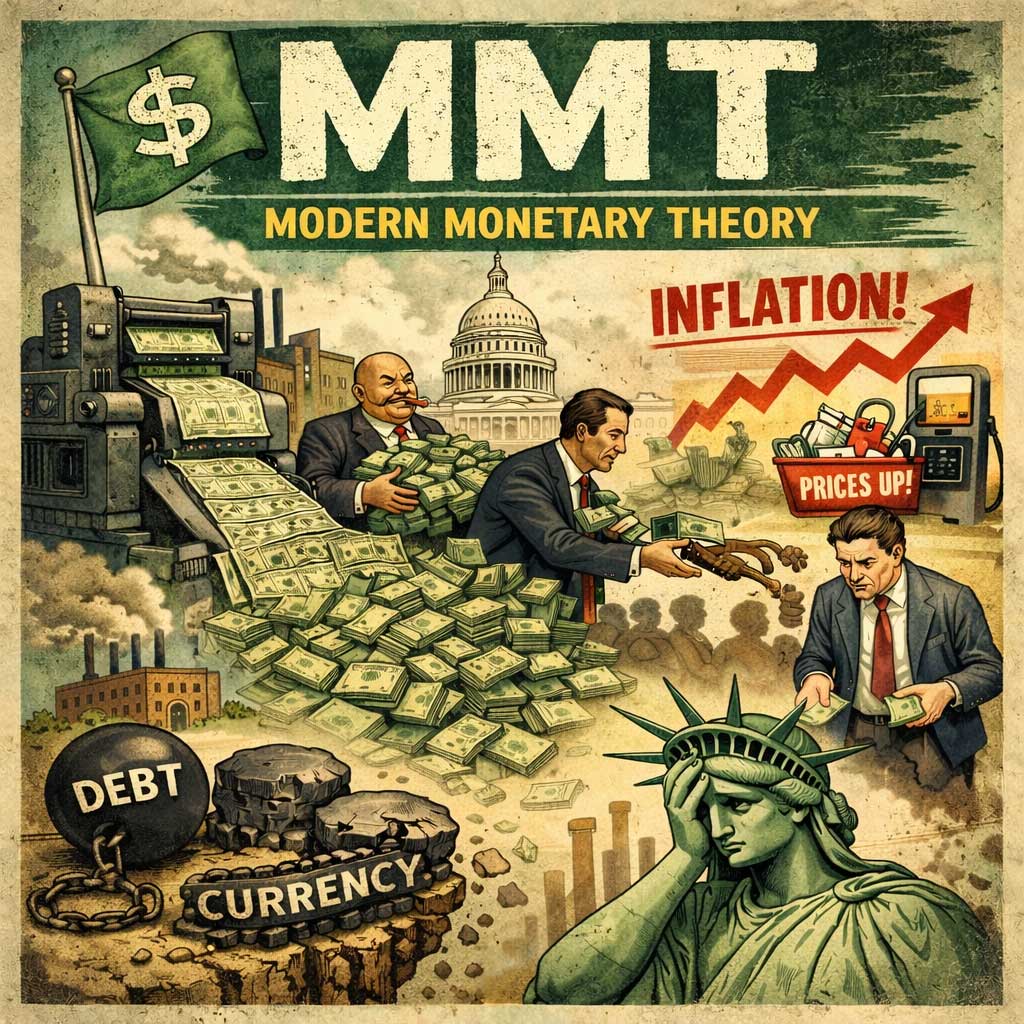
Modern Monetary Theory (MMT) promises a way out of fiscal constraints: states with their own currency cannot go bankrupt and are supposed to achieve full employment through unlimited money creation. This paper shows that MMT is neither modern (kings have used currency debasement for centuries), nor monetary (it is primarily about fiscal policy), nor a coherent theory. From the standpoint of the Austrian School of economics, MMT reveals fundamental errors: it ignores the capital structure of production, misunderstands the role of scarcity and economic calculation, and systematically underestimates the risks of inflation. The empirical evidence is overwhelming: from the Weimar Republic to Zimbabwe to Venezuela, government money creation to finance deficits has always led to hyperinflation and economic collapse. MMT does not apply to Germany in any case, since Germany is no longer a nation with its own sovereign currency. Yet the euro, which rules out MMT, is a disaster in its own right: a 50% loss of purchasing power since 2002, more than 1 trillion euros in Target2 claims, liability for hundreds of billions in other countries’ debts, and the expropriation of German savers through the zero interest rate policy of the European Central Bank (ECB). Germany suffers from a double bondage: unable to pursue MMT, but just as unable to protect itself from euro inflation and an EU transfer union. In the end, MMT is political propaganda that spreads dangerous illusions about the limits of state power.
I. Introduction: The Promise of Painless Government Finance
In recent years, an economic theory has drawn growing attention that must seem to most people like the fulfillment of an ancient dream: Modern Monetary Theory (MMT) promises that states with their own currency can never become insolvent, that government debt is essentially meaningless, and that full employment can be achieved through unlimited government spending without inflationary consequences. Prominent advocates such as Stephanie Kelton, L. Randall Wray, and Warren Mosler have popularized these ideas, and politicians such as Alexandria Ocasio-Cortez and Bernie Sanders have taken them up.
The promise is tempting: no painful tax increases, no cuts to social spending, no limits on government investment in infrastructure, health care, or education. The state, so the argument goes, could simply print money to finance all of its plans. Inflation would only be a problem once the economy had already reached full employment, and even then it could simply be fought with tax increases.
To anyone familiar with the Austrian School of economics, the tradition of Carl Menger, Ludwig von Mises, Friedrich August von Hayek, and Murray Rothbard, these promises sound not like economic wisdom but like a dangerous fraud. In fact, MMT is nothing more than a new edition of old inflationist errors in new clothing. This article will show why MMT is neither modern, nor monetary, nor a coherent theory, and why putting it into practice must lead to economic chaos.
II. The Basic Tenets of Modern Monetary Theory
A. The State as Currency Monopolist
MMT starts from the observation that modern states hold a monopoly on issuing their own currency. Unlike a private household or business, which must take in money before it can spend it, a currency-sovereign state, MMT says, can create money without limit. By MMT logic, the state must in fact spend money first before it can collect any taxes at all, since citizens need the state’s money to pay their tax bills.
This view is based on chartalism (by Georg Friedrich Knapp, 1905), which holds that money does not get its value from an intrinsic value (as with gold) but from the fact that the state accepts it as payment for taxes. The tax obligation, on this view, creates the demand for the state’s money.
B. Government Debt as Private Wealth
A central idea of MMT is that government deficits by definition lead to private surpluses. When the state spends more than it takes in, this money flows into the private sector and becomes financial assets there. Stephanie Kelton argues that governments do not need to “finance” their spending, because as issuers of the currency they create money and cannot run out of it.
On this view, government bonds are not real debt but merely an instrument for absorbing excess liquidity from the private sector. The state could never become insolvent as long as its debt is in its own currency.
C. Inflation as the Only Limit
MMT advocates concede that there is a limit to government spending, but they say this limit is real, not financial. As long as there is “slack” in the economy, meaning unused resources (unemployed workers, underused factories), the state could mobilize these resources through additional spending without causing inflation.
Only once full employment had been reached and all real resources were fully used would additional money creation lead to inflation. But even then, they argue, the state would have a simple tool for fighting inflation: tax increases that drain purchasing power from the private sector.
D. The Job Guarantee as an Automatic Stabilizer
As the core element of their economic policy, MMT economists propose a government job guarantee. The state would offer every unemployed person a job at a fixed minimum wage. This, they say, would create a “buffer” of workers that shrinks in booms (when the private sector hires these workers away) and grows in recessions. At the same time, it would set a nominal price anchor that prevents inflation.
III. The Basic Errors: An Austrian Critique
A. MMT Is Not Modern
The first claim that must be rejected is the supposed “modernity” of this theory. As Jeff Deist of the Mises Institute aptly puts it: “MMT is not modern. Kings have used seigniorage and currency debasement for centuries to fund their endeavors, always at the expense of their subjects.”
The idea that rulers can finance themselves by creating money is as old as money itself. Roman emperors reduced the silver content of their coins, medieval princes used the “right of coinage” to finance their wars, and the assignats of the French Revolution were nothing other than an early attempt at unlimited paper money creation, with catastrophic results.
The Greenbackers of nineteenth-century America held positions almost identical to those of today’s MMT advocates. MMT merely recycles old inflationist errors and packages them in new academic terminology.
B. MMT Is Not Monetary
Despite its name, MMT is not primarily a monetary theory but a theory of fiscal policy. Its focus is on government spending and tax policy, not on monetary policy in the classical sense. As Deist observes: “It is primarily a fiscal approach to state finance, focused on tax policy as the economic accelerator and brake.”
MMT’s roots lie in early twentieth-century chartalism, which predates the founding of the US central bank, the Federal Reserve (1913). MMT advocates the direct monetization of government deficits: the central bank is simply supposed to finance government spending. This has nothing to do with the complex coordinating function of genuine monetary policy.
C. MMT Is Not a Coherent Theory
Most serious of all, however, is that MMT is not a real economic theory but a political justification for unlimited government spending. A theory should explain how economic processes work, show causal relationships, and allow predictions. MMT does none of this. It is rather a normative doctrine meant to justify a desired outcome (more government spending).
Jeff Deist of the Mises Institute writes: “MMT should be viewed as a form of political propaganda rather than any kind of real economics or public policy. And like all propaganda, it must be fought with appeals to reality.”
IV. The Fundamental Theoretical Errors from an Austrian Perspective
A. Ignoring the Capital Structure
Perhaps MMT’s most serious error is its complete disregard for the time structure of production in the economy. Since Böhm-Bawerk and Mises, the Austrian School has stressed that production takes time and that the economy consists of a complex structure of production stages staggered over time, from raw materials through intermediate goods to consumer goods.
Patrick Newman, in his paper “Modern Monetary Theory: An Austrian Interpretation of Recrudescent Keynesianism,” argues persuasively:
In his view, MMT fails to understand capital-based macroeconomics and how government policy affects the temporal structure of production, and it neglects the importance of profit and loss accounting compared with government allocation of resources.
When the state lays claim to resources by creating money, it distorts the price signals that show entrepreneurs where scarce resources can be used most productively. The capital structure is distorted, and malinvestment results. Unlike traditional Keynesian policy, which pumps credit into the private sector through the banking system, MMT’s direct government money creation leads to an even more fundamental problem: permanent economic stagnation instead of cyclical booms and busts.
B. Disregard for Economic Calculation
In his work on economic calculation under socialism, Ludwig von Mises showed that rational economic calculation is possible only through market prices. These prices arise through voluntary exchange in markets based on private property. When the state redistributes resources through money creation, no real economic calculation takes place: there are no profits and losses to show whether resources are being used efficiently.
MMT implicitly assumes that government planners know better than the market how resources should be allocated. The job guarantee is a perfect example: the state is supposed to employ millions of people without the mechanism of profit and loss that normally shows whether this work is of value to society. The result can only be waste of resources on a grand scale.
C. A False Understanding of Scarcity
MMT acts as if the fundamental economic problem, scarcity, could be solved by creating money. But as Mises stressed, money is not wealth, only a medium of exchange. When the state prints more money, it creates no new real goods and services. It merely redistributes the existing goods, in favor of those who receive the new money first (the Cantillon effect).
Robert Murphy explains this using the MMT claim that “slack” in the economy can be eliminated through money creation:
“According to Mises’s theory of the business cycle, the existence of ‘idle capacity’ in the economy doesn’t just fall out of the sky, but is instead the result of the malinvestments made during the preceding boom.”
Unemployment and unused capacity are not simply “there”; they are the symptom of earlier misallocation. More money creation does not solve this problem but worsens it through further distortions.
D. The Illusion of Painless Inflation Control
MMT claims that inflation can easily be fought with tax increases. This reveals a fundamental misunderstanding of political economy. Once a government has established massive spending programs (job guarantees, infrastructure projects, social benefits), it becomes politically almost impossible to cut them or to raise taxes sharply when inflation sets in.
The assumption that politicians would suddenly take unpopular measures in an inflationary environment contradicts all historical experience. It is far more likely that they would play down inflation, look for scapegoats (greedy corporations, foreign speculators), and respond with price controls, which only make the problem worse.
E. Time Preference and Capital Accumulation
Newman points out that massive government spending raises society’s time preference: people become more present-oriented and save less. This reduces capital accumulation and leads to lower productivity and a lower standard of living:
“Increase in government spending increases time preferences… Increase in government spending leads to general waste… Higher taxes to combat inflation also increases time preferences.”
If people expect the state to provide for everything, why should they save for the future? This erosion of the culture of saving undermines the foundation of economic growth.
V. Empirical Evidence: The Catastrophic Failure of Unlimited Money Creation
A. The Weimar Republic (1921-1923)
After the First World War, Germany had to make immense reparation payments. The government chose to finance them by creating money, exactly as MMT recommends. The money supply exploded, and the mark lost its value.
At the peak of the hyperinflation in November 1923, one US dollar was worth 4.2 trillion marks. People carried their money in wheelbarrows to buy food before prices rose even further the next day. Some employers paid wages twice a day because by evening the money was already worthless.
The social consequences were devastating: the middle class was ruined, savings were wiped out, and the economic instability contributed to the political radicalization that ultimately made Hitler’s rise possible.
B. Zimbabwe (2000-2009)
Zimbabwe under Robert Mugabe offers an almost textbook example of MMT in practice. After controversial land reforms, agricultural production collapsed. The government responded with massive money creation to finance its spending, including military interventions in the Congo.
The monthly inflation rate reached an unfathomable 79.6 billion percent in November 2008. Annual inflation stood at 89.7 sextillion percent. The Reserve Bank of Zimbabwe printed banknotes of 100 trillion Zimbabwe dollars, which were not even enough for a bus ride.
The consequences were catastrophic:
- Food production fell by 45%
- Industrial production collapsed by more than 50%
- Unemployment rose to 80%
- Life expectancy fell dramatically
- The middle class fled the country en masse
In the end, the government had to abandon the Zimbabwe dollar in 2009 and allow foreign currencies. Despite the reintroduction of a national currency in 2019, inflation returned and exceeded 500% a year in 2020.
C. Venezuela (2013-Present)
Venezuela, once one of the wealthiest countries in Latin America thanks to its oil reserves, offers the most recent example of an MMT disaster. When oil prices fell, the Maduro government financed its massive social spending by printing money.
The results:
- Inflation rose to more than 130,000% a year in 2018
- The cumulative price increase since 2016 exceeds 53 million percent
- In March 2019, a teacher’s monthly wage could buy only a dozen eggs and a pound of cheese
- Prices in stores were adjusted several times a day
- Millions of Venezuelans fled the country
Venezuela shows that even a resource-rich country with enormous oil reserves cannot prosper through money creation. As the Wall Street Journal reported in 2019, the main cause of the hyperinflation was the central bank printing money to finance huge public spending deficits.
D. The Universal Pattern
All hyperinflations follow the same pattern:
- An economic or political crisis leads to government deficits
- The government can no longer finance itself by conventional means
- The central bank monetizes the deficits by creating money
- The first signs of inflation are ignored or played down
- Loss of confidence in the currency accelerates inflation
- Flight into foreign currencies or real assets
- Complete collapse of the currency and the economy
MMT advocates such as Richard Murphy argue that these examples are irrelevant because the conditions for MMT were not met there. But that is exactly the point: the “conditions” for painless, unlimited money creation exist nowhere, because they contradict the basic laws of economics.
VI. Why States Can Go Bankrupt After All
A. Currency Collapse Is De Facto Insolvency
MMT claims that a state cannot go bankrupt in its own currency. Technically that may be true: it can always print more money. But when that currency becomes worthless, the state is insolvent in fact. The citizens of Venezuela or Zimbabwe would take little comfort in the fact that their governments were “not bankrupt” while their savings were being wiped out.
B. Lost Confidence Cannot Be Restored
Money works only on the basis of trust. Once that trust has been destroyed, it is extremely hard to restore. Since 1980, Zimbabwe has introduced five different currencies, and all of them ended in hyperinflation. Why? Because people have learned not to trust the government.
C. The Illusion of Monetary Sovereignty
MMT speaks of “monetary sovereignty” as if it were absolute. In reality, it is a matter of degree, and fragile. Even the United States, with the dollar as the world currency, enjoys only a temporary privilege that can fade through a loss of confidence. Smaller countries have hardly any real monetary sovereignty, because their citizens switch to foreign currencies at the first signs of inflation.
VII. Naivety About Political Economy
A. The Assumption of Benevolent Planners
MMT implicitly assumes that government decision-makers always act in the public interest and are technocratically competent. Public choice theory and the Austrian critique of socialism have shown how naive this assumption is. Politicians have interests of their own: reelection, power, patronage. Under MMT policy, the temptation to buy voters with printed money would be overwhelming.
B. The Impossible Calculation
How is an MMT regime supposed to determine when “full employment” has been reached and inflation threatens? There are no objective criteria. In practice, every government would claim that there was still “slack” in order to justify its spending. Then, when inflation set in, it would be blamed on outside factors: “greedy corporations,” “speculators,” “foreign influences.”
C. The Political Cycle
Even if one government honestly tried to implement MMT “correctly,” what happens when the government changes? The new government would exploit the established system to finance its own programs. MMT creates incentives for excessive spending and removes the disciplining effect of tight budgets.
VIII. The Austrian Alternative: Sound Money and Limited Government
The Austrian School offers a radically different vision: instead of unlimited government money creation, we need sound money and strict limits on state power.
A. The Virtues of the Gold Standard
Mises, Hayek, and Rothbard argued for a return to backed money, or at least to strict rules limiting money creation. Gold as money has the advantage that it cannot be multiplied at will. This forces governments into fiscal discipline and protects citizens from expropriation through inflation.
B. Free Banking
Going further still, some Austrians, such as Rothbard, propose abolishing central banks and introducing “free banking,” a system in which private banks compete without a state monopoly. This would make it impossible for the state to abuse monetary power.
C. Limited Government and Balanced Budgets
The state should be strictly bound to balanced budgets. Deficits should be allowed only in genuine emergencies (defense against invasion). The temptation to finance spending by creating money is too great to be left to politicians.
IX. The Special Case of the Euro: Why MMT Does Not Apply to Germany
A particularly revealing weakness of Modern Monetary Theory shows up when one tries to apply it to Germany or other eurozone countries. Here it becomes clear how limited the scope of this supposedly “modern” theory really is.
A. Germany Is Not Currency-Sovereign
The central precondition for MMT is “monetary sovereignty”: a state must control its own currency and be able to issue it at will. MMT advocates themselves concede that their theory applies only to such countries:
- The United States, with the dollar and the Federal Reserve
- The United Kingdom, with the pound and the Bank of England
- Japan, with the yen and the Bank of Japan
- Canada, Australia, Sweden, etc.
Germany is not one of them. Since the introduction of the euro, Germany no longer has a currency of its own. The Deutsche Bundesbank, Germany’s central bank, cannot simply print euros to finance the federal government. That power lies with the European Central Bank (ECB) in Frankfurt, which acts independently of national governments and is responsible for the entire eurozone.
B. The Eurozone as an Anti-MMT System
The architecture of the European Monetary Union was deliberately designed to make impossible exactly what MMT demands:
- Ban on monetary financing of governments: Article 123 of the Treaty on the Functioning of the European Union expressly prohibits the ECB from buying government bonds directly from governments. This is meant to prevent governments from financing their deficits with the printing press.
- Independent central bank: The ECB is independent of national governments and has a clear mandate: price stability (inflation close to 2%). It cannot be instructed by individual governments to finance their spending.
- Stability pact: The Maastricht Treaty and the Stability and Growth Pact set limits on national deficits (3% of GDP) and total debt (60% of GDP). These rules are the exact opposite of MMT’s “deficits don’t matter.”
- No-bailout clause: Article 125 TFEU in principle prohibits the EU or other member states from being liable for a country’s debts. Each country is supposed to be responsible for its own debts.
The eurozone was thus deliberately designed according to German ordoliberal principles, as a counter-model to inflationist policy. Germany sacrificed its own monetary sovereignty to protect itself from exactly the policy that MMT advocates.
C. Greece: Empirical Proof That Eurozone Countries Can Go Bankrupt
MMT claims that currency-sovereign states cannot go bankrupt. For eurozone countries the opposite is true, as the Greek sovereign debt crisis dramatically proved.
The chronology of the Greek disaster:
- 2009: After a change of government, it comes to light that Greece had concealed its deficits for years. The true deficit is more than 12% of GDP, not below 3% as claimed.
- 2010: Interest rates on Greek government bonds explode to more than 10%, then 15%, then 20%. The market loses confidence in Greece’s ability to pay.
- 2010-2012: Greece can no longer refinance itself on the capital market. The country faces insolvency; it is de facto bankrupt.
- Bailout packages: Only massive aid packages from the EU, the ECB, and the IMF (the “Troika”) totaling more than 300 billion euros prevent a formal sovereign default.
- Brutal austerity measures: In return, Greece has to implement draconian austerity: pension cuts, salary cuts in the civil service, tax increases, privatizations.
- Social catastrophe: Unemployment rises to more than 27% (youth unemployment more than 50%), GDP collapses by 25%, and hundreds of thousands lose their livelihoods.
Why couldn’t Greece simply “print money”?
That is exactly the point: Greece no longer had a drachma it could have devalued. It had no access to the printing press. The ECB is not the “Greek central bank”; it is responsible for 20 countries and does not take instructions from Athens. Greece was in debt in a currency it did not control, and so it went bankrupt in fact.
MMT advocates would say: “Yes, but Greece is not currency-sovereign, so MMT does not apply there.” Exactly! But that is precisely the decisive point: MMT does not apply to Germany, France, Italy, Spain, or any other eurozone country either. They are all in the same position as Greece; in theory, all of them can go bankrupt.
D. The Irony: Germany Could Implement MMT If It Left the Euro
Technically, Germany could of course return to the deutsche mark and then pursue MMT policy. The Bundesbank could then print unlimited deutsche marks to finance the federal government. But that is exactly what Germany does not want, and for good reason.
The hyperinflation of 1923 is deeply rooted in Germany’s collective memory. After 1945, the Bundesbank was deliberately created as an independent institution to prevent politicians from abusing the printing press for their own ends. The culture of stability is a core element of German economic policy.
The euro was attractive to Germany because it anchored this culture of stability at the European level, with an independent central bank, an inflation target, and fiscal rules. Germany deliberately gave up monetary sovereignty to protect itself from inflationist policy.
E. Italy, Spain, France: All in the Same Boat
It is not only Germany that cannot apply MMT; not a single eurozone country can. This means:
- Italy, with a government debt ratio of more than 140% of GDP, cannot simply print lire to pay its debts.
- Spain could not simply print pesetas during its banking crisis.
- France cannot finance its growing deficits by issuing francs.
All these countries must submit to the fiscal rules of the eurozone, or break them and risk conflict with Brussels and Berlin. The ongoing tensions between Italy and the European Commission over budget deficits show exactly this: Italy cannot simply do what MMT recommends, because it is not currency-sovereign.
F. The Limited Reach of MMT
This analysis shows how narrowly limited MMT’s applicability really is. Developed economies to which MMT does NOT apply:
- The entire eurozone (20 countries, about 350 million people)
- All countries with currency boards or fixed exchange rates
- All countries with significant debt in foreign currency
- Smaller countries whose currencies are not accepted internationally
Developed economies to which MMT could apply in theory:
- USA
- UK
- Japan
- Canada
- Australia
- Switzerland
- Sweden
- Norway
So the supposedly “modern” theory applies to a fraction of the developed world, and even there, as we have seen, putting it into practice would be catastrophic.
G. ECB Bond Purchases: Hidden MMT?
Some argue that the ECB is already practicing a form of MMT through its massive bond purchase programs (quantitative easing). Since the 2008 financial crisis, and even more so since the euro crisis and COVID-19, the ECB has bought government bonds worth trillions of euros.
But there are decisive differences from MMT:
- Secondary market: The ECB buys bonds on the secondary market from banks and investors, not directly from governments. This is an important legal and practical difference.
- Temporary: The programs are officially limited in time and declared emergency measures, not permanent government financing.
- Inflation target: The ECB justifies its policy with its inflation target of just under 2%, not with full employment or government financing.
- Independence: The ECB decides its own policy; it does not take instructions from governments.
- Disputed: This policy is extremely controversial in Germany. The Federal Constitutional Court, Germany’s highest court, has examined several times whether the ECB is exceeding its mandate. The Bundesbank has repeatedly protested against expansionary ECB policy.
The German critics of this policy, from Bundesbank presidents to economists such as Hans-Werner Sinn, have warned of exactly what MMT openly advocates: monetary financing of governments and inflation.
H. The Euro Disaster: Germany as Paymaster and Victim of Inflation
The analysis so far might give the false impression that the euro is a positive development because it prevents MMT. That would be a fatal error. The euro is an economic policy disaster for Germany, and an object lesson in how supranational institutions sacrifice national interests.
The Loss of Deutsche Mark Stability
The deutsche mark was one of the most stable currencies in the world. The Bundesbank, led by presidents such as Karl Otto Pöhl and Hans Tietmeyer, pursued a strict policy of stability. The deutsche mark was recognized internationally as a “hard currency,” a symbol of German economic strength and monetary discipline.
Since the introduction of the euro, the currency has lost about 50% of its purchasing power. What 100 euros could buy in 2002 costs roughly 200 euros today. The promised “community of stability” turned out to be a community of inflation.
The ECB is far more inflationary than the Bundesbank ever was:
- Zero interest rate policy since 2014: Savers were expropriated. German savings lost a great deal of value.
- Negative interest rates: At times, savers had to pay banks to hold their money.
- Quantitative easing: Trillions of euros in bond purchases that massively inflated the money supply.
- 2% inflation target: The ECB deliberately aims for an annual loss of the money’s value, something the Bundesbank would have fought.
German savers and retirees were systematically expropriated. The famous German culture of saving (life insurance policies, passbook savings accounts, home savings contracts) was destroyed by zero interest rates. Millions of Germans have lost wealth through this policy.
Germany as Europe’s Paymaster
The euro was sold to Germany as the “deutsche mark for all of Europe.” The promise: all countries would adopt German stability criteria. The reality: Germany became the paymaster of a transfer union.
Target2 balances: the hidden trillion
Target2 balances are a complex but crucial subject. Put simply: the Deutsche Bundesbank has at times held claims on other eurozone central banks of more than 1 trillion euros, an unimaginable sum.
What does that mean? German goods and services were exported to Italy, Spain, and Greece. Instead of these countries paying for them with real money, claims arise in the Target2 system. Economists such as Hans-Werner Sinn have pointed out that these claims are practically uncollectible: if the euro collapsed, they would be worthless.
So Germany delivered real goods and received paper claims in return that will probably never be settled. A gigantic transfer that appears in no official statistics as “aid to southern Europe.”
The endless bailout funds
Since the euro crisis of 2010, Germany has been forced into a liability union:
- EFSF (European Financial Stability Facility): A temporary bailout fund for which Germany, as the largest economy, guarantees the lion’s share.
- ESM (European Stability Mechanism): A permanent bailout fund with a volume of 700 billion euros. Germany is liable for about 27%, roughly 190 billion euros.
- Greek bailout: More than 300 billion euros in aid, a large part of it backed by German guarantees.
- Coronavirus recovery fund: 750 billion euros in EU debt, the first joint borrowing. Germany pays the largest share and is liable for repayment.
- ECB bond purchases: The ECB has bought government bonds worth more than 5 trillion euros. In the event of defaults, the Bundesbank is liable for about 26%, a risk of hundreds of billions of euros.
The promise of Maastricht, “no liability for other states” (the no-bailout clause), has been systematically broken. In practice, Germany is liable for the debts of southern Europe.
The transfer union through the back door
What was officially conceived as a “stability union” has long since become a transfer union:
- Italian, Spanish, and Greek government bonds are kept artificially high in price by ECB purchases. Without this support, interest rates would be far higher; this difference is an implicit transfer.
- The zero interest rate policy harms German savers and benefits heavily indebted southern countries.
- EU structural funds, cohesion funds, agricultural subsidies: Germany is a net contributor to the tune of more than 20 billion euros a year (some calculations go as high as 40 billion).
All told, Germany makes hundreds of billions of euros in direct and indirect transfers, money taken from German taxpayers, workers, and savers.
The EU’s Regulatory Mania as a Brake on Growth
Besides the monetary catastrophe, the EU has saddled Germany with a suffocating regulatory apparatus. Brussels bureaucrats produce an excess of rules that weigh especially heavily on the German economy:
- Flood of bureaucracy: From the General Data Protection Regulation (GDPR) to countless product rules to energy efficiency directives, German companies are drowning in EU regulation.
- Competitive disadvantages: While Germany implements rules strictly, southern European countries often ignore EU regulations. German conscientiousness becomes a disadvantage.
- Stifled innovation: New technologies are held back by overcautious EU regulation. The precautionary principle becomes a principle of prevention.
- Energy policy madness: EU climate regulation and Germany’s energy transition (the Energiewende) make electricity massively more expensive. German industrial companies are moving away.
- Migration crisis: EU rules oblige Germany to admit and provide for migrants, while countries such as Poland or Hungary refuse; Germany bears the burden.
The Mittelstand, Germany’s small and medium-sized businesses and the backbone of its economy, suffers especially under this regulatory burden. While large corporations can afford compliance departments, small and medium-sized companies are being crushed.
The Broken Promise
The euro was sold to Germany as:
- A community of stability on the German model
- Protection against inflation
- Economic integration without a transfer union
- A boost for Germany’s export economy
The reality:
- A 50% loss of purchasing power since 2002
- Germany is liable for hundreds of billions in other countries’ debts
- Savers are expropriated through zero interest rates
- Target2 claims of more than 1 trillion euros (worthless in a crisis)
- Endless bailout funds and corona bonds
- Regulatory mania from Brussels
The Bitter Irony
So Germany has in fact ended up with the worst of both worlds:
On the one hand: No possibility of MMT policy (because it is not currency-sovereign). That is good, because it prevents inflationist excesses.
On the other hand:
- Loss of the stable deutsche mark
- Imported inflation through ECB policy
- Liability for other countries’ debts
- Transfers to southern Europe
- Expropriation of German savers
- EU regulatory chaos
Germany cannot practice MMT itself, but it suffers from the inflationary consequences of ECB policy, which in effect monetizes southern European deficits. The ECB practices an “MMT lite”: not officially on the instructions of governments, but with the result that heavily indebted states are artificially propped up.
What Would the Alternative Be?
From a libertarian perspective, there are several options:
1. Return to the deutsche mark: In theory, Germany could leave the euro and return to the deutsche mark. An independent Bundesbank with a strict stability mandate would protect German savers and prevent inflation. The deutsche mark would probably appreciate strongly, which would lower import prices.
2. Gold standard: Even more radical would be tying the currency to gold. This would make government manipulation of money impossible and guarantee genuine price stability. The objection that this is “impractical” has been raised many times, but history shows that gold standards worked for centuries. Is it really less practical than the current system of zero interest rates, trillions in bailout funds, and creeping expropriation?
3. Free banking: The most radical option would be to abolish central banks in favor of a free banking system in which private banks compete to offer different currencies. This may seem utopian, but it would end the political abuse of money.
4. Currency competition: At the very least, foreign currencies could be allowed as legal tender. If citizens could choose between the euro, the Swiss franc, the dollar, or gold, this would discipline the ECB.
The question remains open: which road leads to liberty? Back to a national currency with a strictly independent central bank? A gold standard that rules out government manipulation? Or an entirely new system of free, competing currencies?
One thing, however, is certain: the euro as it stands has failed, for Germany, for liberty, and for economic reason.
X. Conclusion: MMT as a Road to Serfdom, and the Euro as a False Way Out
Modern Monetary Theory is the latest example of an old temptation: the illusion that economic laws can be suspended by acts of political will. It promises something that does not exist: a free lunch financed by the printing press.
The Austrian School has analyzed and refuted the errors of this way of thinking for more than a century:
- Money is not wealth, only a medium of exchange. Increasing it creates no real goods.
- Scarcity cannot be printed away. Every use of resources by the state comes at the expense of private use.
- Prices are information signals that are distorted by money creation, which leads to malinvestment.
- Profit and loss are essential for rational calculation; government allocation without these signals is arbitrary.
- The capital structure is disrupted by monetary expansion, which leads to boom-bust cycles or permanent stagnation.
The empirical evidence is overwhelming: every attempt to finance government deficits through unlimited money creation has ended in inflation or hyperinflation, with devastating social consequences. From the Weimar Republic to Zimbabwe to Venezuela, history teaches the same lesson.
MMT is not only economically flawed but also politically dangerous. It supplies the ideological justification for unlimited government spending and therefore for unlimited state power. As Hayek warned in The Road to Serfdom, economic control is not merely control of a sector of human life that can be separated from the rest; it is the control of the means for all our ends.
A society that implemented MMT would not create prosperity for all but a new form of totalitarianism: a world in which the state, through its control over money, dictates every economic decision. The “job guarantee” would become universal dependence on the state, and “functional finance” would become the arbitrary rule of bureaucrats.
The Euro: Not a Solution, but a Different Problem
The analysis of the eurozone shows that Germany is indeed protected from MMT, but at a devastating price. The euro has not brought Germany stability, but rather:
- A 50% loss of purchasing power instead of deutsche mark stability
- Expropriation of savers through the zero interest rate policy
- More than 1 trillion euros in Target2 claims (practically worthless)
- Hundreds of billions in liability for other countries’ debts
- The role of Europe’s paymaster
- Regulatory mania from Brussels
Germany thus suffers from a double bondage: on the one hand, it cannot practice MMT (because it is not currency-sovereign); on the other, it suffers from the inflationary and fiscal consequences of the euro’s design. In effect, the ECB practices an “MMT lite” to prop up southern European deficits, except that Germany is liable for it without being able to control the policy.
The Path to Freedom
The defenders of liberty must expose MMT for what it is: neither modern, nor monetary, nor a theory, but political propaganda for state power and a planned economy. The path to freedom does not lead through the printing press but through sound money, limited government, and free markets.
In concrete terms, this means:
- Rejecting MMT in all its forms, whether openly advocated or disguised as “quantitative easing”
- Criticizing the euro as a failed experiment that harms Germany
- Returning to the principles of sound money, whether through a return to national currencies with strictly independent central banks, a gold standard, or free currency competition
- Limiting state power through strict budget rules and a ban on monetary financing of governments
- Protecting private property from expropriation through inflation
The question of the ideal monetary system remains open for discussion: is it a return to the deutsche mark with an independent Bundesbank? A gold standard that rules out government manipulation? Or a system of free, competing currencies along Hayekian lines? Each of these options has advantages and disadvantages, but all of them are superior to the status quo.
What is beyond question, however, is this: both MMT and the euro in its current form are wrong turns. They lead not to prosperity and liberty but to inflation, transfers, regulation, and ultimately serfdom. The true path to freedom requires the courage to question both systems at their foundations.
Bibliography
Primary Literature on Modern Monetary Theory
Kelton, Stephanie (2020): The Deficit Myth: Modern Monetary Theory and the Birth of the People’s Economy. New York: PublicAffairs.
Mitchell, William; Wray, L. Randall; Watts, Martin (2019): Macroeconomics. London: Red Globe Press.
Mosler, Warren (1995-present): Various works on MMT. Available at: http://moslereconomics.com
Wray, L. Randall (2015): Modern Money Theory: A Primer on Macroeconomics for Sovereign Monetary Systems. 2nd edition. New York: Palgrave Macmillan.
Knapp, Georg Friedrich (1905): Staatliche Theorie des Geldes. Leipzig: Duncker & Humblot (in German; English translation: The State Theory of Money, 1924).
Lerner, Abba P. (1943): “Functional Finance and the Federal Debt.” In: Social Research, vol. 10, no. 1, pp. 38-51.
Austrian Critiques of MMT
Murphy, Robert P. (2020): Understanding Money Mechanics. Auburn: Mises Institute. Available at: https://mises.org/online-book/understanding-money-mechanics
Murphy, Robert P. (2019): “The Upside-Down World of MMT.” Mises Institute. Available at: https://mises.org/wire/upside-down-world-mmt
Newman, Patrick (2020): “Modern Monetary Theory: An Austrian Interpretation of Recrudescent Keynesianism.” In: Atlantic Economic Journal, vol. 48, no. 1, pp. 23-31.
Deist, Jeff (2020): “MMT: Not Modern, Not Monetary, Not a Theory.” Mises Institute. Available at: https://mises.org/power-market/mmt-not-modern-not-monetary-not-theory
Salerno, Joseph (2019): “A Note from Dr. Joe Salerno on MMT.” Mises Institute. Available at: https://mises.org/power-market/note-dr-joe-salerno-mmt
Classic Works of the Austrian School
Mises, Ludwig von (1912/1953): The Theory of Money and Credit. Yale University Press.
Mises, Ludwig von (1949/2008): Human Action: A Treatise on Economics. Auburn: Mises Institute.
Mises, Ludwig von (1920): “Economic Calculation in the Socialist Commonwealth.” In: Archiv für Sozialwissenschaft und Sozialpolitik, vol. 47.
Hayek, Friedrich August von (1931): Prices and Production. London: Routledge.
Hayek, Friedrich August von (1944): The Road to Serfdom. Chicago: University of Chicago Press.
Rothbard, Murray N. (1963): America’s Great Depression. Princeton: Van Nostrand.
Rothbard, Murray N. (1962/2009): Man, Economy, and State with Power and Market. Auburn: Mises Institute.
Rothbard, Murray N. (2008): What Has Government Done to Our Money? Auburn: Mises Institute.
Further Criticism of MMT
Palley, Thomas I. (2019): “What’s Wrong with Modern Monetary Theory (MMT): A Critical Primer.” FMM Working Paper No. 44.
Summers, Lawrence (2019): “The Left’s Embrace of Modern Monetary Theory Is a Recipe for Disaster.” Washington Post, March 4, 2019.
Krugman, Paul (2019): “Running on MMT (Wonkish).” The New York Times, February 25, 2019.
Coats, Warren (2019): “Modern Monetary Theory: A Critique.” Cato Journal, vol. 39, no. 3, Fall 2019.
Empirical Studies on Hyperinflation
Cagan, Phillip (1956): “The Monetary Dynamics of Hyperinflation.” In: Milton Friedman (ed.): Studies in the Quantity Theory of Money. University of Chicago Press.
Fischer, Stanley; Sahay, Ratna; Végh, Carlos A. (2002): “Modern Hyper- and High Inflations.” Journal of Economic Literature, vol. 40, no. 3, pp. 837-880.
Hanke, Steve H.; Krus, Nicholas (2013): “World Hyperinflations.” In: Randall Parker and Robert Whaples (eds.): The Handbook of Major Events in Economic History. Routledge.
Sargent, Thomas J. (1982): “The Ends of Four Big Inflations.” In: Robert E. Hall (ed.): Inflation: Causes and Effects. University of Chicago Press.
Case Studies
Zimbabwe: Hanke, Steve H.; Kwok, Alex K.F. (2009): “On the Measurement of Zimbabwe’s Hyperinflation.” Cato Journal, vol. 29, no. 2, pp. 353-364.
Venezuela: Hausmann, Ricardo; Muci, Francisco (2019): “Don’t Blame Washington for Venezuela’s Oil Woes.” Foreign Policy, January 16, 2019.
Weimar: Fergusson, Adam (1975): When Money Dies: The Nightmare of Deficit Spending, Devaluation, and Hyperinflation in Weimar Germany. London: William Kimber.
Online Resources
Mises Institute: https://mises.org (extensive collection of Austrian analyses of MMT)
Cato Institute: https://www.cato.org (critical perspectives on MMT)
Fraser Institute: https://www.fraserinstitute.org (economic analyses of MMT)
