On January 1, 1833, a boy of about sixteen arrived at the farm of Edward Covey, a tenant farmer on Maryland’s Eastern Shore who had a reputation for breaking young slaves and to whom the boy had been hired out for a year. In the first six months hardly a week passed without Covey whipping him. On one of the hottest days of August 1833, the boy fought back. As he later wrote, the two wrestled for nearly two hours, and in the six months he remained with Covey afterward, Covey never laid a hand on him again.
Twelve years later, the former slave introduced his account of that day with one of the best-known sentences in American literature: “You have seen how a man was made a slave; you shall see how a slave was made a man.” At the time, the boy’s name was Frederick Bailey. As Frederick Douglass, he became one of the best-known speakers against slavery in America, and for friends of liberty he is a key witness, because he could describe from his own experience what it means not to belong to oneself.
At a glance
- Life: born in February 1818 in Talbot County, Maryland; died February 20, 1895, in Washington, D.C.
- Work: abolitionist speaker from 1841, editor of the North Star in Rochester from 1847, U.S. Marshal for the District of Columbia from 1877 to 1881, U.S. minister to Haiti from 1889 to 1891
- Major works: Narrative of the Life of Frederick Douglass (1845), My Bondage and My Freedom (1855), Life and Times of Frederick Douglass (1881), the speech What to the Slave Is the Fourth of July? (1852)
- In one sentence: He stated every person’s right to himself and to the fruits of his labor more clearly than almost any philosopher, because for twenty years he had been denied both.
An alphabet as a way out
Douglass knew neither his birthday nor, with any certainty, his father; he later chose February 14 as his birthday himself. As a child he was sent to Baltimore, to the household of Hugh Auld, whose wife began teaching him the alphabet. Her husband forbade it at once, because reading would make a slave discontented and worthless to his master. Douglass drew the opposite conclusion: “From that moment, I understood the pathway from slavery to freedom.” (Narrative, chapter VI.)
He kept learning in secret. He gave bread to hungry white boys in the street and in return received, as he wrote, “that more valuable bread of knowledge.” At about twelve he got hold of the Columbian Orator, a collection of speeches and dialogues that he read whenever he had the chance.
The wages that were not his
Later Douglass returned to Baltimore and learned caulking, sealing the seams of ships’ hulls, at a shipyard. Soon he was earning a dollar and a half a day and bringing his master six to seven dollars a week. He captured what that meant in a sentence that would sit well in a textbook on property rights: “I contracted for it; I earned it; it was paid to me; it was rightfully my own” (Narrative, chapter X). And yet every Saturday night he had to hand over every cent to Hugh Auld.
Without using the technical term, Douglass is describing the link between self-ownership and ownership of the fruits of one’s own labor that has stood at the center of liberal thought since John Locke. Slavery, as the Stanford Encyclopedia of Philosophy summarizes his view, took from the enslaved their bodies, the labor of those bodies, and the wealth they created. Whoever takes from another person the wages that person agreed to and earned is disposing of part of that person’s life, and a mild manner does not change that.
The first dollars of his own
On September 3, 1838, Douglass escaped. Dressed as a sailor, he traveled north by train, with a ticket Anna Murray had obtained and with the borrowed protection papers of a free Black sailor. He reached New York without incident, and there he and Anna Murray married on September 15. Shortly afterward the couple moved to New Bedford, Massachusetts, and Frederick Bailey became Frederick Douglass.
He could find no work there as a caulker, because the white tradesmen refused to work alongside him. So he sawed wood, shoveled coal, and rolled oil casks, and he wrote, “There was no work too hard, none too dirty,” because it was the first work whose reward was entirely his own. The work was hard in Baltimore and in New Bedford alike; the only thing that had changed was who owned the money at the end of the week.
A voice no one could ignore
On August 11, 1841, Douglass spoke at an abolitionist convention on the island of Nantucket, and only reluctantly, because the thought of speaking before white people weighed on him. Afterward the Massachusetts Anti-Slavery Society hired him as a lecturer. In 1845 he published his life story with the real names of his former masters, making himself easier to find as a fugitive slave. He then spent almost two years traveling through Great Britain and Ireland. From Belfast, on New Year’s Day 1846, he wrote to William Lloyd Garrison, the leading figure among American abolitionists: “I breathe, and lo! the chattel becomes a man.” (printed in the Liberator of January 30, 1846)
British supporters, the sisters Anna and Ellen Richardson of Newcastle, bought him from Hugh Auld for 150 pounds sterling; the deed of manumission was recorded in Baltimore County in December 1846. Back in America, Douglass founded his own newspaper in Rochester, New York, The North Star, whose first issue appeared on December 3, 1847.
I am myself
In September 1848, ten years after his escape, Douglass wrote an open letter to his former master, Thomas Auld, and printed it in his newspaper. In it he explained why he had left: “I am myself; you are yourself; we are two distinct persons, equal persons. What you are, I am.” (The letter appears in the appendix of My Bondage and My Freedom, 1855.) By nature, he goes on, neither of the two is bound to the other.
Few nineteenth-century texts capture the principle of self-ownership so concisely. Douglass derived equality from it: if two people are equal persons, neither can be the property of the other, and whoever flees slavery takes nothing but what already belongs to him.
What to the slave is the Fourth of July?
On July 5, 1852, Douglass spoke before the Rochester Ladies’ Anti-Slavery Society about Independence Day. He paid lengthy tribute to the founders of the republic and the principles of the Declaration of Independence, and then asked what this holiday meant to the American slave. His answer: “a day that reveals to him, more than all other days in the year, the gross injustice and cruelty to which he is the constant victim.” In saying this, Douglass by no means rejected the ideals of 1776. He took them at their word and confronted a nation that spoke of equal rights while holding millions of people in chains with its own principles.
Garrison regarded the American Constitution as a pact with slavery and wanted the North to separate from the South. Douglass long shared this view, but in 1851 he concluded that the Constitution, properly read, was an antislavery document. Among those who had persuaded him were the reformer Gerrit Smith and the lawyer Lysander Spooner, author of The Unconstitutionality of Slavery (1845). He wanted to hold the republic to its own promise instead of giving up on it. During the Civil War he recruited Black volunteers for the Union army, and in 1863 his sons Lewis and Charles joined the 54th Massachusetts Infantry Regiment.
Let him stand on his own legs
As the end of slavery came into view, many well-meaning white people asked, in the words Douglass gave their question, “What shall we do with the Negro?” Douglass answered on January 26, 1865, in Boston. From the beginning, he said, he had had only one answer to that question: “Do nothing with us! Your doing with us has already played the mischief with us.” What he asked for was the opportunity to stand up for himself: “give him a chance to stand on his own legs! Let him alone!” (What the Black Man Wants.)
When a Black man was on his way to school, to work, or to the ballot box, he said, no one should stand in his way. He demanded justice, not charity, and first of all the right to vote. For him, equal rights before the law were the precondition for people taking their lives into their own hands, and property and one’s own labor remained the foundation of true liberty even after emancipation.
Beginning in 1859, and over several decades, he gave a lecture on Self-Made Men, people who had risen by their own efforts, more than fifty times. In it he praised work and perseverance, and no one could accuse him of preaching to others what he had not lived himself. He was also an early advocate of women’s right to a political voice: in 1848 he attended the women’s rights convention at Seneca Falls and spoke there in favor of women’s suffrage.
What friends of liberty can learn from him
Douglass shows that self-ownership is not a philosophers’ thought experiment. Whoever denies that a person belongs to himself can, in the end, justify any kind of control over others. With the force of lived experience, his books refute every doctrine that treats people as means to the ends of others.
He also shows that education liberates, and that those who rule know this very well. The slaveholders banned reading for good reason, and Douglass learned to read for equally good reason. His “Let him alone” remains a rejection of paternalistic care: whoever has equal rights needs no special treatment to shape his own life. In 2018 the lawyer Timothy Sandefur interpreted him as a classical liberal in a biography published by the Cato Institute, and as early as 2012 the political scientist Nicholas Buccola had described his political thought as liberal.
No one’s property
Frederick Douglass won the right to himself step by step: with his fists against Covey, with an escape on borrowed papers, and finally with books and speeches that forced a nation to look. When he died in Washington in February 1895, he had held high offices in the republic whose laws had once made him a piece of property. The core of his thought had remained the same as in the letter to his former master: what you are, I am. Every order can be measured by this sentence, including one’s own: does it apply to everyone, or only to some?
Further reading
- Frederick Douglass: Narrative of the Life of Frederick Douglass, an American Slave, Boston 1845 (freely available at Project Gutenberg)
- Frederick Douglass: My Bondage and My Freedom, New York 1855 (includes the letter to Thomas Auld)
- Timothy Sandefur: Frederick Douglass. Self-Made Man, Cato Institute, Washington 2018
- David W. Blight: Frederick Douglass. Prophet of Freedom, Simon & Schuster, New York 2018
This article is part of our series on thinkers, doers, and historical figures of liberty.
Sources
- Douglass, Frederick: Narrative of the Life of Frederick Douglass, an American Slave, Anti-Slavery Office, Boston 1845, ch. VI, VII, X, XI; full text: https://www.gutenberg.org/files/23/23-h/23-h.htm
- Douglass, Frederick: Letter to William Lloyd Garrison, Belfast, January 1, 1846, in: The Liberator, January 30, 1846; excerpt quoted in Christine Kinealy, Frederick Douglass and Ireland. In His Own Words, at RTÉ: https://www.rte.ie/culture/2018/0913/993490-when-frederick-douglass-came-to-ireland-in-his-own-words
- Douglass, Frederick: Letter to Thomas Auld, September 1848, in: The North Star, September 8, 1848; reprinted in the appendix of My Bondage and My Freedom: https://etc.usf.edu/lit2go/45/my-bondage-and-my-freedom/1509/letter-to-his-old-master-to-my-old-master-thomas-auld
- Douglass, Frederick: What to the Slave Is the Fourth of July?, speech in Rochester, July 5, 1852: https://teachingamericanhistory.org/document/what-to-the-slave-is-the-fourth-of-july/
- Douglass, Frederick: My Bondage and My Freedom, Miller, Orton & Mulligan, New York 1855.
- Douglass, Frederick: What the Black Man Wants, speech in Boston, January 26, 1865: https://teachingamericanhistory.org/document/what-the-black-man-wants/ ; dating: https://frederickdouglasspapersproject.com/s/digitaledition/item/18468
- Douglass, Frederick: Self-Made Men, lecture from 1859 on: https://frederickdouglasspapersproject.com/s/digitaledition/item/10401
- Douglass, Frederick: My Escape from Slavery, The Century Magazine, November 1881: https://www.owleyes.org/text/my-escape-from-slavery/read
- Douglass, Frederick: Life and Times of Frederick Douglass, Park Publishing, Hartford 1881.
- Stanford Encyclopedia of Philosophy: Frederick Douglass, https://plato.stanford.edu/entries/frederick-douglass/
- National Park Service, Frederick Douglass National Historic Site: https://www.nps.gov/frdo/learn/historyculture/frederickdouglass.htm
- National Park Service, Women’s Rights National Historical Park: Frederick Douglass, https://www.nps.gov/wori/learn/historyculture/frederick-douglass.htm
- National Park Service: Bill of Sale for Frederick Douglass, https://www.nps.gov/museum/exhibits/douglass/exb/powerIdea/FRDO3861.html
- National Archives: Frederick Douglass’s sons in the Civil War, https://www.archives.gov/education/lessons/blacks-civil-war/douglass-sons.html
- University of Rochester, River Campus Libraries: The North Star, https://rbscp.lib.rochester.edu/3476
- Blight, David W.: Frederick Douglass. Prophet of Freedom, Simon & Schuster, New York 2018.
- Buccola, Nicholas: The Political Thought of Frederick Douglass. In Pursuit of American Liberty, NYU Press, New York 2012.
- Sandefur, Timothy: Frederick Douglass. Self-Made Man, Cato Institute, Washington 2018, https://www.cato.org/books/frederick-douglass
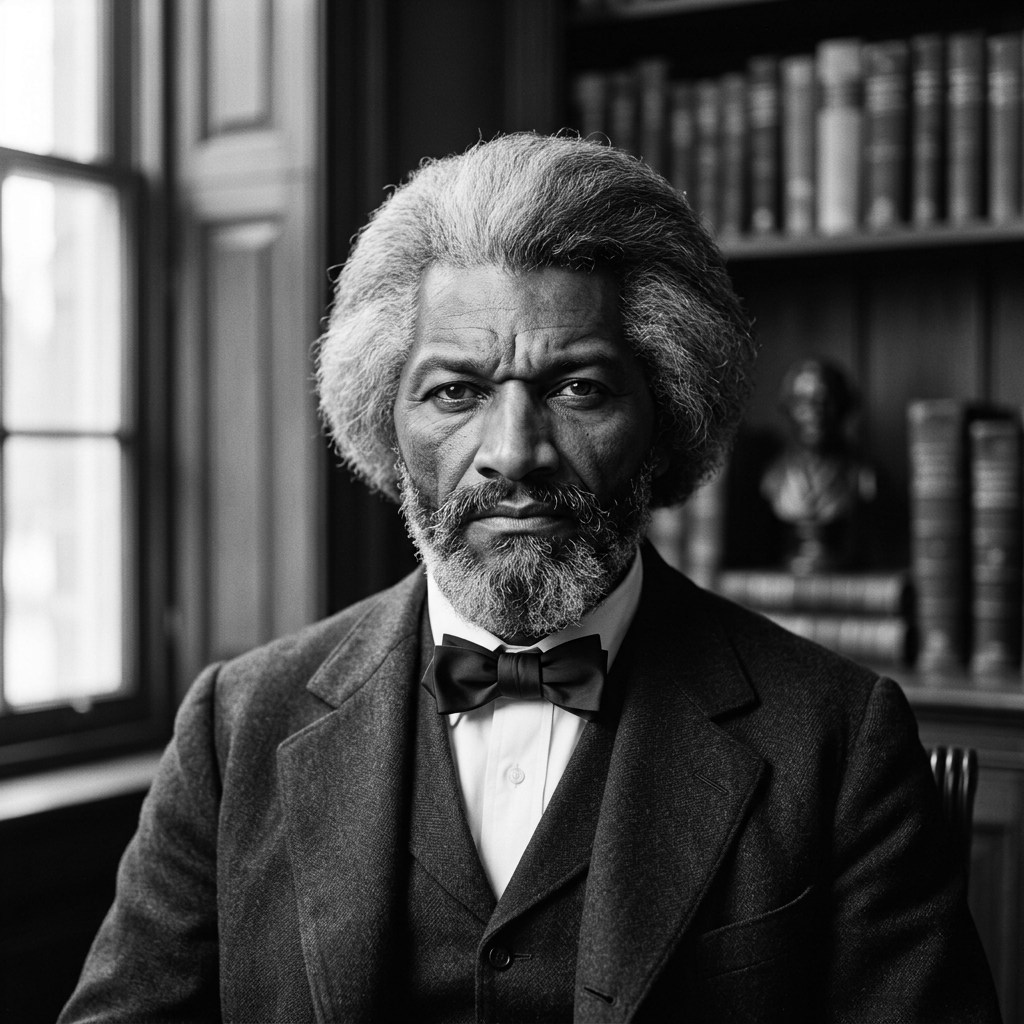
Featured image: Frederick Douglass (AI illustration)