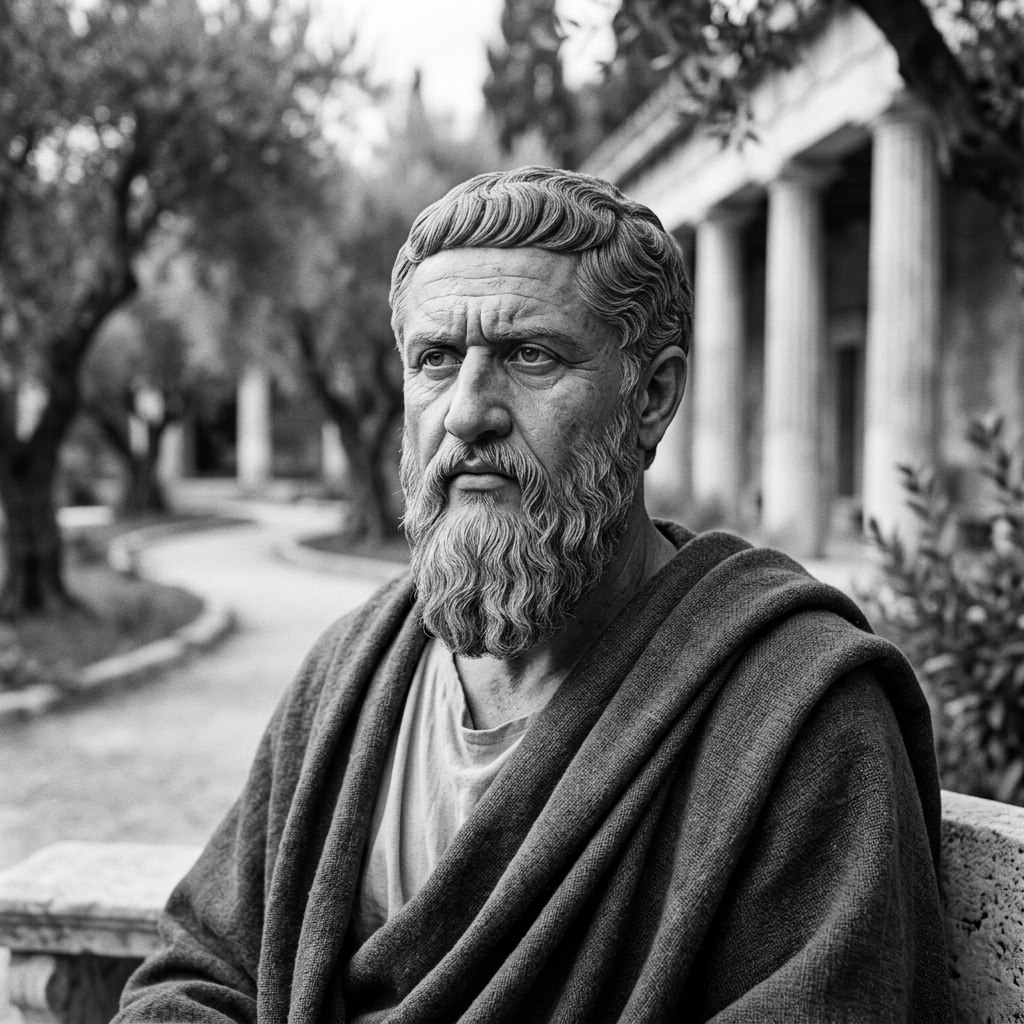
In 399 BC, an Athenian jury sentenced the philosopher Socrates to death for impiety and corrupting the young. His student Plato built him a monument in the Apology, and it contains the sentence with which Socrates defends his way of life: to discourse daily about virtue is “the greatest good of man,” and “the unexamined life is not worth living” (Apology 38a, translated by Benjamin Jowett).
Decades later, the same Plato wrote a law against impiety in his last great work, the Laws. Anyone who denies the gods is sent to a house of correction, and anyone convicted again after serving that term is to die (Laws 909a). Between these two texts lies a thinker’s life that shows how close the sharpest insight into the dangers of power and the wish for all-knowing authorities can come to each other.
At a glance
- Life: 428/427 to 348/347 BC, Athens
- Background: son of Ariston and Perictione, from an aristocratic Athenian family
- Work: student of Socrates, founder of the Academy in Athens (around 387 BC), teacher of Aristotle, three journeys to the court of Syracuse
- Major works: Apology, Republic (Politeia), Statesman (Politikos), Laws (Nomoi)
- Citation: Plato is cited by the page numbers of Henri Estienne’s Geneva edition (1578), for example “Republic 473c”
- In one sentence: He recognized that no one can bear unchecked power, and yet in his ideal state he entrusted it to an elite.
An Aristocrat between Oligarchs and Democrats
Plato grew up in the Athens of the Peloponnesian War. When the city surrendered in 404 BC, power passed to the so-called Thirty, a small clique of oligarchs led by Critias that also included Charmides; both were relatives of Plato. In the Seventh Letter, whose authenticity is strongly disputed among scholars, the author describes how he at first hoped these men would lead the state to justice. Instead, they soon made the previous order look like a golden age (324c–e). The letter credits the returning democrats with moderation, but then influential men brought charges against Socrates (325b–c). It ends with the conclusion that all existing states are badly governed (326a).
Around 387 BC, Plato traveled to Sicily, to the court of the tyrant Dionysius I, and after his return founded the school in Athens that became famous as the Academy. Aristotle belonged to it for about twenty years. In the 360s, Plato sailed to Syracuse twice more to give the young ruler Dionysius II a philosophical education. The project failed, and during his last stay he was in effect held captive. Almost all of his works are dialogues, mostly led by Socrates, which is why Plato’s own views have to be inferred from the course of the conversations.
The Ring of Gyges
In the second book of the Republic, Glaucon, Plato’s older brother, asks a question that still occupies every political philosophy: Is a person just because justice is good, or only because he fears punishment? To make his point, he tells the story of the shepherd Gyges, who finds a ring that can make him invisible, murders the king, and seizes power. No one, Glaucon says, would remain just if he could do wrong without being discovered (359c–360d).
In the rest of the dialogue, Socrates is to show that justice is good for the soul itself. For political thought, however, the challenge alone is valuable, because it shows that power without visibility and without accountability creates exactly the temptation the ring embodies.
The City of Philosophers
Plato develops his answer through the image of a city. Because people are by nature gifted in different ways, each is to pursue one occupation (370a–b), and justice means that each class does its own work. Philosophers are to rule, because only they know the good: until “philosophers are kings, or the kings and princes of this world have the spirit and power of philosophy,” cities “will never have rest from their evils” (473c–d, Jowett).
The guardians, that is, rulers and soldiers, own nothing beyond the bare necessities: no gold, no silver, no houses of their own. The reasoning is remarkable: if they had land and money of their own, they would become “enemies and tyrants instead of allies of the other citizens” (417a, Jowett). Plato thus saw clearly that power and self-enrichment go together, and for that reason he wanted to keep the rulers poor. Those who earn a living, farmers and craftsmen, keep their property.
For the guardians there is no family either. Women and children are held in common (457c–d), and pairings are steered by “some ingenious kind of lots,” so that the less worthy blame their own ill luck rather than the rulers (460a, Jowett). Women are to receive the same education and the same duties as men (451c–457b), an astonishing demand for the fourth century BC, even though Socrates at the same time claims that men are superior in almost everything (455c).
The order is held together by a founding myth, according to which gold has been mixed into the souls of the rulers, silver into those of the guardians, and iron and bronze into those of the farmers and craftsmen. Plato himself calls it a lie, one of the “needful falsehoods” (414b–415d, Jowett). Added to this is strictly controlled poetry: what the young hear about gods and heroes is selected, and in Book X imitative poetry is banished from the city, except for hymns to the gods and praise of good people (607a).
In fairness, it must be said that scholars still argue about how literally all this is meant. Plato has Socrates explain that they described the perfectly just and the perfectly unjust man to have a standard to measure themselves by, “but not with any view of showing that they could exist in fact” (472d, Jowett), and at the end of Book IX we read that “in heaven there is laid up a pattern of it,” for anyone who wants to set his own house in order by it (592b, Jowett).
When Liberty Tips Over
In Books VIII and IX, Plato describes how constitutions decay. Democracy appears there as a state “full of freedom and frankness” (557b, Jowett), in which everyone may live as he likes. It is precisely from this, Plato says, that its downfall grows: “The excess of liberty, whether in States or individuals, seems only to pass into excess of slavery” (564a, Jowett). Demagogues take from the propertied and distribute the spoils to the people, and in the end the “protector of the people” asks for a bodyguard and becomes a tyrant (565a–566b, Jowett). The tyrant, in turn, is himself a slave to his desires, full of fear and remorse, and never tastes “true freedom or friendship” (576a, Jowett; 577c–580c). One need not share Plato’s contempt for democracy to take seriously his observation that in this account the tyrant comes to power with the applause of the people, as their protector.
The Late Plato: Laws Instead of Sages
The Laws, a conversation among three old men about founding a colony on Crete, show a changed Plato. The ideal state remains the ideal, but the Athenian now explains that one will probably have to settle for the second-best constitution (739a–e). The reason is an insight one would rather expect from Montesquieu or Lord Acton: no mortal soul, young and accountable to no one, can bear the highest power without being filled with arrogance and injustice (691c–d), and no human being can wield unaccountable power over all human affairs without becoming overbearing and unjust (713c).
From this follows the rule of law. Where the law is powerless, Plato sees the state close to ruin; but where it is master over the officials and they are its servants, there lies the state’s salvation (715d). If there were a human being of perfect insight, he would need no laws, for no law is mightier than knowledge. But since no such person exists anywhere, one chooses the second best, law and order (875a–d). Added to this is the idea of the mixed constitution: a state needs elements of monarchy and of democracy in order to combine liberty with wisdom (693d–e).
What friends of liberty can learn from him
The insight of the Laws that power corrupts, no matter who wields it, is the same idea on which the separation of powers, constitutional constraints, and accountability rest. Anyone who defends these institutions today can invoke Plato, even if he himself drew only a half-hearted conclusion from it.
Just as instructive is his reasoning for denying the guardians property. That rulers who are allowed to enrich themselves become opponents of their own citizens is a warning that also applies to today’s political sinecures and government stakes in companies. Plato, however, concluded from this that the rulers’ property should be abolished, rather than their power limited.
What has the strongest effect to this day is the Socratic attitude that Plato handed down: the persistent testing of every claim, even against the opinion of the majority, and the insight that the tyrant, who outwardly may do anything, remains a prisoner within.
Where it does not fit
The core of Plato’s political thought remains incompatible with liberty. The idea that an elite knows the good and may prescribe it to everyone else runs through both great political works. In the Republic, this elite is given the right to lie, control over poetry and education, and the steering of marriage and reproduction. The citizens’ consent is produced by a myth that no one votes on.
The more moderate Laws, too, regulate life down to the smallest detail. No one may own wealth of more than four times his landed property (744e), gold and silver in private hands are forbidden, and so are loans at interest (742a–c). No citizen may become a merchant or retailer; that is reserved for foreigners (919d–920a), and anyone under forty may not travel abroad at all (950d). On the very charge for which Socrates died, the late Plato shows no leniency: those who deny the gods are put in a house of correction, where they are admonished by members of the Nocturnal Council, and anyone who relapses after his confinement receives the death penalty (908a–909a).
Plato did not question slavery. The Republic merely demands that Greeks not enslave Greeks (469b–c), and the Laws treat slaves as difficult but self-evident property (776b–778a). In his will, preserved by Diogenes Laertius, Plato freed a slave woman named Artemis and bequeathed four household slaves (III 41–43).
In 1945, in The Open Society and Its Enemies, Karl Popper read Plato’s political program as totalitarian. His most important objection still hits home: Plato asked who should rule, and in doing so asked the wrong question. What matters, Popper argued, is how to design institutions so that bad rulers do as little damage as possible and can be removed without bloodshed. Ronald B. Levinson defended Plato against Popper in 1953, and the philosopher Eric Brown sees totalitarian features in Plato’s ideal state but points out that its rulers are meant to despise power and the citizens to consent to them, which sets it apart from real dictatorships. This hardly touches Popper’s objection, because it is aimed at any order that depends on the good will of its rulers.
The Wrong Question and the Right One
Plato saw almost everything that speaks against his own state. He knew that power corrupts, that rulers enrich themselves, that the liberty of the many is exploited by demagogues, and that even the wise need laws above them as long as they are human. That he nevertheless held on to the hope that the right people only had to come to power is the real reason to read him closely today. The question “Who should rule?” is asked anew in every election and every crisis. Plato’s work shows where it leads when the answer is a person rather than a limit.
Further reading
- Plato: Der Staat (Politeia), translated by Friedrich Schleiermacher, in: Sämtliche Werke, vol. 2, Rowohlt, Reinbek 1994 (in German); in English: Republic, translated by Benjamin Jowett, Project Gutenberg
- Plato: Nomoi (Gesetze), in: Sämtliche Werke, vol. 4, Rowohlt, Reinbek 1994 (in German)
- Karl R. Popper: Die offene Gesellschaft und ihre Feinde, vol. 1: Der Zauber Platons, Mohr Siebeck, Tübingen 2003 (in German); in English: The Open Society and Its Enemies, vol. 1: The Spell of Plato, Routledge, London 1945
- Eric Brown: “Plato’s Ethics and Politics in The Republic,” Stanford Encyclopedia of Philosophy
This article is part of our series on thinkers, doers, and historical figures of liberty.
Sources
- Plato: Republic, translated by Benjamin Jowett, Project Gutenberg, https://www.gutenberg.org/ebooks/1497 (passages quoted: 414b–415d, 417a, 460a, 472d, 473c–d, 557b, 564a, 565a–566b, 576a, 592b). German edition: Der Staat (Politeia), translated by Wilhelm Siegmund Teuffel (Books I–V) and Wilhelm Wiegand (Books VI–X), 1855/56, after: Platon, Sämtliche Werke, vol. 2, Berlin [1940]; zeno.org, http://www.zeno.org/Philosophie/M/Platon/Der+Staat (in German; passages cited: 359c–360d, 370a–b, 414b–415d, 417a, 451c–457b, 457c–d, 460a, 469b–c, 472d, 473c–d, 557b, 564a, 565a–566b, 576a, 577c–580c, 592b, 607a).
- Plato: Der Staat, translated by Friedrich Schleiermacher, in: Sämtliche Werke, vol. 2, Rowohlt, Reinbek 1994 (in German).
- Plato: Apology, translated by Benjamin Jowett, Project Gutenberg, https://www.gutenberg.org/ebooks/1656 (38a). German edition: Des Sokrates Verteidigung (Apologie), translated by Friedrich Schleiermacher (1805), after: Sämtliche Werke, vol. 1, Berlin [1940]; http://www.zeno.org/Philosophie/M/Platon/Des+Sokrates+Verteidigung (in German; 38a, 24b).
- Plato: Laws (Nomoi), translated by R. G. Bury, Loeb Classical Library, Cambridge (Mass.) 1967/68; Perseus Digital Library, http://www.perseus.tufts.edu/hopper/text?doc=Perseus:text:1999.01.0166 (691c–d, 693d–e, 702b–d, 713c, 715d, 739a–e, 742a–c, 744e, 776b–778a, 875a–d, 908a–909a, 919c–920a, 950d, 961a–b).
- Plato: Nomoi, in: Sämtliche Werke, vol. 4, Rowohlt, Reinbek 1994 (in German).
- Plato (authenticity disputed): Seventh Letter, translated by R. G. Bury, Loeb; Perseus, http://www.perseus.tufts.edu/hopper/text?doc=Perseus:text:1999.01.0164 (324c–326b).
- Diogenes Laertius: Lives of the Eminent Philosophers, Book III 41–43 (Plato’s will), translated into English by R. D. Hicks (1925); https://en.wikisource.org/wiki/Lives_of_the_Eminent_Philosophers/Book_III
- Aristotle: Politics II, 1261b, translated by H. Rackham, Loeb; Perseus, http://www.perseus.tufts.edu/hopper/text?doc=Perseus:text:1999.01.0058
- Richard Kraut: “Plato,” Stanford Encyclopedia of Philosophy (revised 2026), https://plato.stanford.edu/entries/plato/
- Eric Brown: “Plato’s Ethics and Politics in The Republic,” Stanford Encyclopedia of Philosophy (revised 2017), https://plato.stanford.edu/entries/plato-ethics-politics/
- Christopher Shields: “Aristotle,” Stanford Encyclopedia of Philosophy, https://plato.stanford.edu/entries/aristotle/
- Thomas Brickhouse, Nicholas D. Smith: “Plato,” Internet Encyclopedia of Philosophy, https://iep.utm.edu/plato/
- Karl R. Popper: The Open Society and Its Enemies, vol. 1: The Spell of Plato, Routledge, London 1945; German: Die offene Gesellschaft und ihre Feinde, vol. 1: Der Zauber Platons, Mohr Siebeck, Tübingen 2003 (chapters 6 and 7).
- On Popper’s question “Who should rule?”: review in the Review of Austrian Economics 12/1 (1999), https://departments.gmu.edu/rae/archives/VOL12_1_1999/harperbr.pdf ; “Popper’s Theory of Democracy,” https://articles.skeptics.nz/2023/10/24/poppers-theory-of-democracy
- Ronald B. Levinson: In Defense of Plato, Harvard University Press, Cambridge (Mass.) 1953.
- Wikipedia (English): “Stephanus pagination,” https://en.wikipedia.org/wiki/Stephanus_pagination (citation system)
Featured image: Plato (AI illustration)