On the steps in the middle of the picture, a half-naked man lies sprawled across, as if the whole learned assembly above him were of little concern to him. He is called Diogenes, and the fact that a painter gave the mocker among the philosophers such a visible place, and in the pope’s palace at that, already says a good deal about the wall Raphael painted in the Vatican between 1509 and 1511. Dozens of scholars of antiquity stand there in a vast hall, reading, calculating, and talking with one another.
The young man from Urbino owed the commission to Julius II. In November 1507 the pope had moved into the upper floor of the palace, because he did not want to live in the apartments of his predecessor Alexander VI, and he had brought in several well-known painters to decorate it. Raphael joined them in 1508, and his first fresco pleased Julius so much that he handed the rooms over to him alone. Raphael did not paint a program of liberty. What he left behind is a picture of free conversation, an art that was cleverly organized and widely spread, and a letter in which he reproached the pope for what even his predecessors had destroyed of Rome’s heritage.
At a glance
- Life: 1483 in Urbino to April 6, 1520, in Rome
- Work: painter, draftsman, and architect of the High Renaissance; from 1508 in Rome in the service of Julius II and Leo X, from 1514 architect of St. Peter’s, from 1515 superintendent of the marbles and stones of Rome
- Major works: frescoes of the Stanza della Segnatura with the School of Athens (1509–1511), Stanza di Eliodoro and Stanza dell’Incendio (until 1517), tapestry cartoons for the Sistine Chapel (1514–1516), Transfiguration (completed 1520), letter to Leo X on ancient Rome (1519, with Baldassare Castiglione)
- In one sentence: He painted a space for reason in which it comes into its own through conversation, and he made sure that his pictures had an effect far beyond that room.
A painter’s son from Urbino
Raffaello Santi was the son of the painter Giovanni Santi, who served the Duke of Urbino. His mother died in 1491, his father in 1494. According to Vasari’s biography, the boy was then apprenticed to Pietro Perugino; whether he really was Perugino’s pupil is not entirely certain, but how strongly Perugino shaped his early pictures is beyond dispute.
From 1504 on he spent time in Florence again and again, studied Leonardo da Vinci and Michelangelo, and painted mainly Madonnas and portraits. He received large fresco commissions only in Rome, where he went in 1508 and where he stayed until his death.
Philosophers in conversation
The walls of the Stanza della Segnatura follow the order in which books were shelved at the time, the four faculties of the university. Theology received the Disputa, poetry the Parnassus, jurisprudence the cardinal virtues and the giving of the laws, and philosophy the picture we call the School of Athens. Opposite the assembly of the Doctors of the Church, the pagan thinkers thus got a wall of their own, just as large.
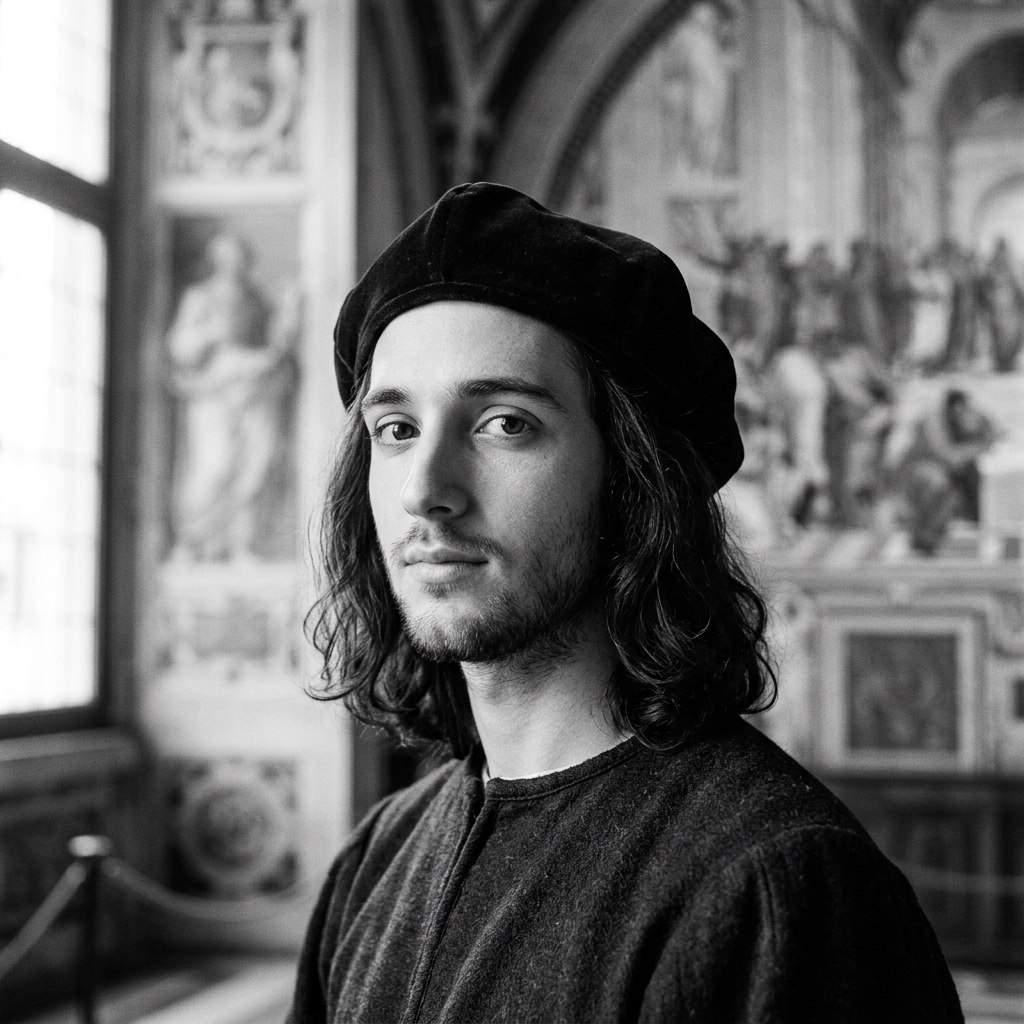
In the middle, Plato and Aristotle stride forward beneath high arches whose architecture recalls Bramante’s plans for the new St. Peter’s Basilica. Plato carries his Timaeus and points upward; Aristotle holds his Ethics and stretches his flat hand out over the ground. The gestures are usually read as two paths to knowledge, the world of ideas and the observation of nature; other interpreters see in Aristotle’s hand the right measure between extremes. All around, the Vatican Museums identify Pythagoras writing, Euclid working out a problem for his pupils with a compass, and Zoroaster with the celestial globe.
No one in this picture has the last word. There is no teacher at a lectern and no judge to settle the dispute, and the groups talk, point, and listen, each at its own question. One can see in it the conviction that truth is found in the exchange of reasons and that it needs many voices for this, including dissenting ones. Raphael never stated any such intention; it remains an interpretation, but the picture goes a long way toward meeting it.
Who is who
Raphael did not give the work the name School of Athens. Giorgio Vasari, his first biographer, described it as a scene in which theologians reconcile philosophy and astrology with theology, and he spoke of Evangelists. As late as 1798, the preparatory cartoon was recorded as Paul preaching on the Areopagus.
The same goes for the famous portraits. Vasari reports that the man with the compass bears the features of the architect Bramante, and that at the right edge Raphael painted himself in a black beret. Vasari does not say that Plato has Leonardo’s face; that is a long tradition and remains an interpretation. The brooding man in the foreground, who writes while leaning on a marble block and is usually called Heraclitus, is missing from the large preparatory cartoon in Milan’s Ambrosiana and was added only later. Tradition sees him as Michelangelo, who at the same time was painting the ceiling of the Sistine Chapel next door, while some scholars more cautiously call him simply the Thinker. That artists of Raphael’s own day appear among the sages of antiquity is often read as a tribute to painting, which was then struggling to be counted among the liberal arts of the educated mind rather than among the crafts.
In the service of two popes
His largest commissions came from the pope. Until 1514 he painted the Stanza di Eliodoro, whose program, according to the Vatican Museums, is meant to show the miraculous protection God grants to the threatened Church. In the Expulsion of Heliodorus from the Temple, Julius II watches from his sedan chair as a horseman sent by God throws down a temple robber. In the Stanza dell’Incendio, created for Leo X by 1517, the frescoes were meant to express the claims to power of the resurgent papacy and the primacy of the Church over secular authority.
These pictures are depictions of power, of the kind painters of his time created for their patrons everywhere. Yet he did not depend on a single master. His most important patron besides the pope was the banker Agostino Chigi, one of the richest men of the Renaissance, for whose chapels and villa on the Tiber he worked.
A workshop for a wealth of commissions
One man alone could not handle so many commissions. Raphael therefore built up a workshop in which pupils and assistants worked from his designs, and for the Vatican Loggias with their dozens of small vault paintings he also recruited young painters. His way of working with carefully executed cartoons allowed him to leave the execution to others while keeping the invention in his own hands.
Vasari portrays him as a master who helped every painter who asked him for a drawing, and who never went to court without some fifty painters accompanying him; he lived “not like a painter, but like a prince” (in Gaston de Vere’s translation). That is the eulogy of an admirer. His account of the will sounds more sober: the greater part of the estate went to his pupils Giulio Romano and Giovanni Francesco Penni, and after Raphael’s death the two completed his work in the Vatican.
Pictures that learned to travel
In 1510 the engraver Marcantonio Raimondi came to Rome from Bologna. He had previously copied woodcuts by Albrecht Dürer in Venice, and by 1515 he had produced a large number of engravings after Raphael’s designs. Raphael designed the Massacre of the Innocents specifically to be reproduced as an engraving.
Vasari relates that Raphael, following the example of Dürer’s engravings, wanted to show what his art could achieve in this medium. He exchanged works with Dürer, and a drawing bearing Dürer’s inscription of 1515 is now in the Albertina in Vienna. Raphael entrusted the prints to his assistant Baviera, and from this, according to Vasari, came an abundance of engravings where before there had been scarcity. What until then only those who traveled to Rome had known now reached all of Europe on paper. Raphael thanked the engraver in his own way: in the Expulsion of Heliodorus he gave one of the men carrying the papal chair Marcantonio’s features.
A letter for the stones of Rome
After Bramante’s death, Raphael became architect of St. Peter’s in 1514, and on August 27, 1515, Leo X appointed him superintendent of all marbles and stones. He was to procure building material for the church and at the same time secure ancient inscriptions and fragments, and out of this grew the plan to survey ancient Rome and to draw every important building in plan, exterior, and interior view. As a preface to it, in the fall of 1519, a letter to the pope was written, which Raphael composed with his friend Baldassare Castiglione, the author of the Cortegiano. The ideas come from Raphael, the literary form probably from Castiglione, among whose works the letter long circulated until the scholar Daniele Francesconi demonstrated Raphael’s share in 1799.
The text is remarkably frank. The authors lament that earlier popes, too, had ancient buildings torn down merely to obtain pozzolana, volcanic sand for mortar, and that statues were burned into lime, so that the new Rome, with its palaces and churches, however beautiful it may be, “tutta è fatta di calce di marmi antichi,” is built entirely of the lime of ancient marbles. They ask Leo X to make sure that the little that remains of this ancient mother of Italy’s glory is not destroyed by the malicious and the ignorant (Mantua manuscript, pp. 3 f., our translation). And they remind him that war brings the ruin of all sciences and arts, whereas peace and concord bring the happiness of nations.
Here writes a man who knew that power can devour a culture’s heritage just as well as it can foster it, and who wanted to tell this to the most powerful man in his city. What was later called historic preservation found one of its earliest justifications in this letter. Raphael did not live to complete the plan.
What remains of Raphael
As the popes’ painter, Raphael made their claim to power visible, and anyone who declares him a champion of liberty has to overlook the Stanza di Eliodoro. The School of Athens gives shape to the idea that knowledge arises from the conversation of many, and that Plato and Aristotle, mathematicians and mockers can hold their place side by side without anyone appointing an umpire. His workshop and his work with Marcantonio show how far an artist could go who organized his work cleverly, had several patrons, and had his inventions reproduced instead of locking them away in a single palace. And the letter to Leo X reminds us that a culture’s memory must also be defended against those who consider themselves its guardians.
A tomb in the Pantheon
Raphael died on April 6, 1520, a Good Friday, at the age of 37; the Transfiguration, his last great panel painting, was finished. At his own wish he was buried in the Pantheon. Pietro Bembo, as Vasari reports, wrote him a couplet, which the Albertina in Vienna renders roughly like this: while Raphael lived, Nature feared his victory; when he died, she feared she would die with him. That he rests in an ancient temple that had long since become a church suits a painter who gave the philosophers of the pagans a place of honor in the pope’s house.
Further reading
- Raphael and Baldassare Castiglione: Lettera a Leone X, critical edition by Francesco Paolo Di Teodoro, Olschki, Florence 2020
- Giorgio Vasari: Das Leben des Raffael, newly translated by Victoria Lorini, edited by Alessandro Nova, Wagenbach, Berlin 2004 (in German)
- Henry Keazor: Raffaels Schule von Athen. Von der Philosophenschule zur Hall of Fame, Wagenbach, Berlin 2021 (in German)
This article is part of our series on thinkers, doers, and historical figures of liberty.
Sources
- Raphael and Baldassare Castiglione: letter to Pope Leo X (draft, 1519), manuscript in Castiglione’s hand, Archivio di Stato di Mantova, Archivio Castiglioni, Acquisto 2016, b. 2, n. 12; excerpts from the archive’s explanatory sheet, https://archiviodistatomantova.cultura.gov.it/fileadmin/risorse/Patrimonio_scan/Lettera_di_Baldassarre_Castiglione_a_papa_Leone_X.pdf
- Francesco Paolo Di Teodoro (ed.): Lettera a Leone X di Raffaello e Baldassarre Castiglione, Olschki, Florence 2020
- Raphael: School of Athens, fresco, Stanza della Segnatura, Vatican, 1509–1511; preparatory cartoon (charcoal and white lead, 285 × 804 cm), Pinacoteca Ambrosiana, Milan
- Giorgio Vasari: Vita di Raffaello da Urbino, in: Le vite de’ più eccellenti pittori, scultori e architettori, 2nd edition, Florence 1568; in English: Lives of the Most Eminent Painters, Sculptors and Architects, vol. 4, translated by Gaston du C. de Vere, London 1912–15, https://www.gutenberg.org/ebooks/28420
- Giorgio Vasari: Das Leben des Raffael, newly translated by Victoria Lorini, edited by Alessandro Nova, Wagenbach, Berlin 2004 (in German)
- Albertina, Vienna: press kit for the exhibition “Raffael” (gallery texts and biography) (in German), https://www.albertina.at/site/assets/files/1499/pressemappe_raffael.pdf
- Musei Vaticani: Scuola di Atene, https://www.museivaticani.va/content/museivaticani/en/collezioni/musei/stanze-di-raffaello/stanza-della-segnatura/scuola-di-atene.html
- Musei Vaticani: Stanza di Eliodoro and Cacciata di Eliodoro dal Tempio, https://www.museivaticani.va/content/museivaticani/it/collezioni/musei/stanze-di-raffaello/stanza-di-eliodoro/stanza-di-eliodoro.html
- Veneranda Biblioteca Ambrosiana / Electa: press kit “Il Raffaello dell’Ambrosiana. In principio il Cartone,” 2019, https://www.electa.it/content/uploads/2018/10/CARTELLA-STAMPA_-Il-Raffaello-dellAmbrosiana.pdf
- Finestre sull’Arte: Raphael was the first superintendent in history. The letter to Leo X, https://www.finestresullarte.info/en/works-and-artists/raphael-was-the-first-superintendent-in-history-the-letter-to-leo-x
- Treccani, Dizionario Biografico degli Italiani: Raimondi, Marcantonio, https://www.treccani.it/enciclopedia/marcantonio-raimondi_(Dizionario-Biografico)/
- The National Gallery London: Raphael, https://www.nationalgallery.org.uk/artists/raphael
- Henry Keazor: Raffaels Schule von Athen. Von der Philosophenschule zur Hall of Fame, Wagenbach, Berlin 2021 (in German)
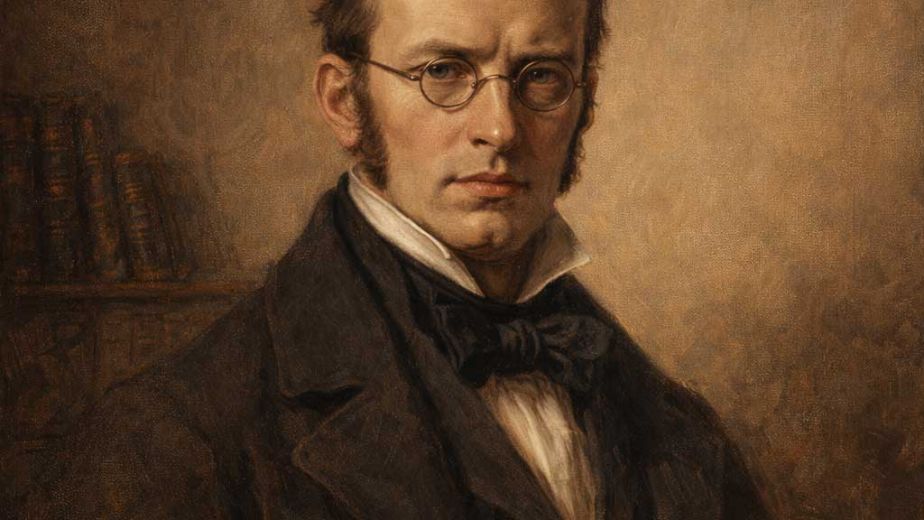
Featured image: Raphael (AI illustration)