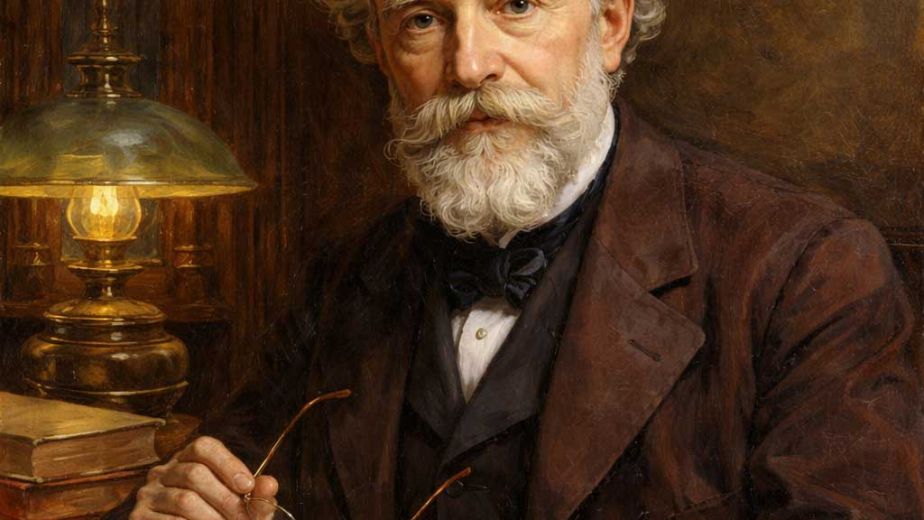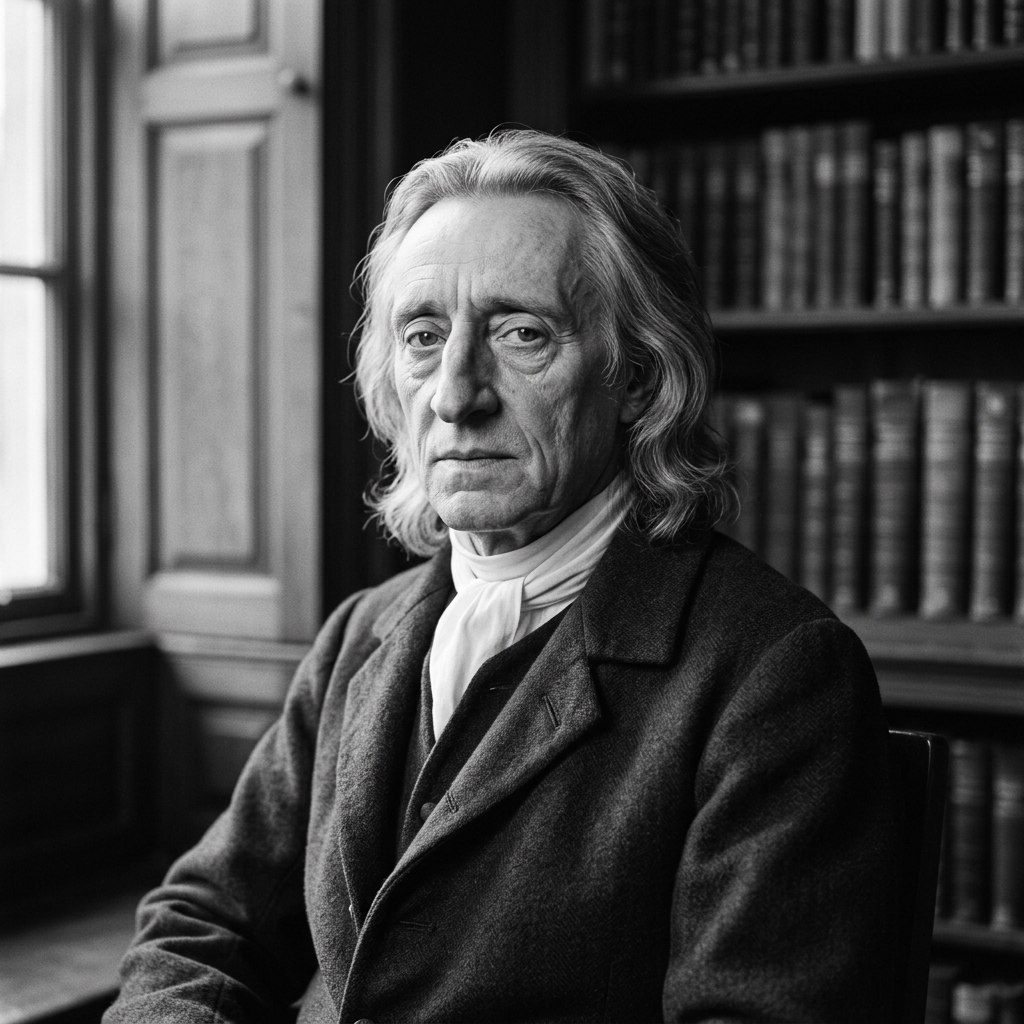
In February 1689 a man of 56 returned from the Netherlands to England, in the company of Princess Mary, who shortly afterward was to ascend the English throne with her husband, William of Orange. He had spent a good five years in exile, at times under a false name, because as a confidant of an opponent of the Catholic heir to the throne he had himself come into danger.
By the end of the year a letter on toleration and two treatises on government had appeared, both without the author’s name, along with a substantial essay on human understanding under his name. The man was John Locke, and the core idea of his political work, that every person belongs first of all to himself, remains one of the foundations of liberalism to this day.
At a glance
- Life: August 29, 1632, in Wrington (Somerset) to October 28, 1704, in Oates (Essex)
- Work: scholar at Oxford, physician and adviser to Anthony Ashley Cooper, later Earl of Shaftesbury, in exile in the Netherlands from 1683 to 1689, member of the Board of Trade from 1696 to 1700
- Major works: A Letter Concerning Toleration (1689), Two Treatises of Government (1689, dated 1690), An Essay Concerning Human Understanding (1690), Some Thoughts Concerning Education (1693), Further Considerations Concerning Raising the Value of Money (1695)
- In one sentence: He argued that the life, liberty, and possessions of the individual are older than any government and that a government is legitimate only insofar as it protects these rights.
A physician in turbulent times
Locke grew up in a Puritan family; his father was a lawyer and served in the Civil War as a captain of cavalry on the side of Parliament. The son attended Westminster School in London and in 1652 went to Christ Church, Oxford, where he taught and turned to medicine.
In 1667 he moved to London to join Lord Ashley as his household physician and adviser. The following year he organized an operation that freed Ashley from a dangerous cyst on the liver, and in doing so cemented a bond that shaped the rest of his life. In Ashley’s service Locke also became secretary to the proprietors of the Carolina colony and helped draft its constitution of 1669, which granted every freeman absolute power over his slaves. How much of it came from his own pen is disputed among historians. He also held shares in an English African trading company that dealt in human beings as well. This side of his life stands in striking tension with what he later wrote.
When Ashley, by then Earl of Shaftesbury, opposed the succession of the Catholic James and finally had to flee, Locke too fell under suspicion. In 1683 he went to the Netherlands and lived there, partly under the name Dr. Van Linden, until the Glorious Revolution. According to the research of the editor Peter Laslett, the Two Treatises of Government had largely been written years earlier, during the struggles over the succession around 1680. In the preface, Locke nevertheless presented them as a justification of the change of power in 1688.
Property in one’s own person
The most famous sentence of the Second Treatise is in section 27 (here, as with all Locke quotations, in Locke’s own words, following the text of 1690). Though the earth and all inferior creatures were given to men in common, Locke writes, “yet every man has a property in his own person: this no body has any right to but himself. The labour of his body, and the work of his hands, we may say, are properly his.”
Whoever mixes his labor with something that nature has provided, by tilling a field or gathering fruit, joins it to something that is his own and so makes it his property. Locke attached a proviso to this: there must be enough, and as good, left for others, and no one may take more than he can use before it spoils.
The point of this doctrine is political. Property arises in the state of nature, through the actions of individuals, before any government exists. Locke also uses the word in a broad sense, gathering under it the lives, liberties, and estates of men, “which I call by the general name, property” (§ 123). So when he speaks of protecting property, he means protecting the whole person.
What governments are for
In the state of nature, according to Locke, people are free and equal, and the law of reason teaches that no one ought to harm another in his life, health, liberty, or possessions (§ 6). What is missing, however, are settled laws and impartial judges. That is why people join together in commonwealths, and according to § 124 the “great and chief end” of this union is “the preservation of their property.”
Clear limits follow from this. The legislative power has only the power that individuals were able to transfer to it, and no one has arbitrary power over his own life or that of another. Its power therefore has “no other end but preservation” and can never have the right to destroy, enslave, or deliberately impoverish the subjects (§ 135). The supreme power, as § 138 puts it, cannot take from any man any part of his property without his own consent, “for I have truly no property in that, which another can by right take from me, when he pleases, against my consent.” Taxes therefore require consent, although Locke considered it given as soon as the majority consents, either itself or through its chosen representatives (§ 140). Libertarian readers of Locke such as Robert Nozick later doubted whether such majority consent is enough.
Locke’s concept of law is also remarkable. For him, law was a condition of liberty: the end of law is “to preserve and enlarge freedom,” for liberty means being free from restraint and violence from others and not being subject to “the arbitrary will of another” (§ 57).
When government breaks its mandate
A government founded in this way can also forfeit its claim. When legislators try to take away the people’s property or to force them under arbitrary power, they put themselves, according to § 222, into a state of war with the people. The people are then absolved from obedience and may establish a new legislature. Locke stressed that people patiently bear many mistakes of their rulers. Only “a long train of abuses, prevarications and artifices,” all tending the same way, justifies resistance (§ 225).
This phrase returns in the American Declaration of Independence of 1776, which speaks of “a long train of abuses and usurpations.” Thomas Jefferson did not, however, adopt Locke’s triad of life, liberty, and property; the Declaration names life, liberty, and the pursuit of happiness. Yet in a letter to Henry Lee in 1825, Jefferson wrote that the Declaration rested on the harmonizing sentiments of the day, as expressed in conversation, in letters, and in published writings, and among the elementary books of public right he named Locke alongside Aristotle, Cicero, and Algernon Sidney.
Faith cannot be forced
Locke wrote the letter on toleration in exile; it appeared in 1689, first in Latin in Gouda and in the same year in the English translation by William Popple. Its central argument is simple: the care of souls is no more committed to the state than to any other person, and the power of the magistrate consists only in outward force. True religion, however, lies in inward persuasion, and “such is the nature of the understanding, that it cannot be compelled to the belief of anything by outward force.” Confiscation, prison, and torture could not change a person’s inner judgment.
Locke drew far-reaching conclusions from this. Neither pagans nor Muslims nor Jews should be excluded from civil rights because of their religion. His toleration did, however, have limits, which he named openly: he would not tolerate communities whose members submit in everything to a foreign prince, which by a common reading was also aimed at Catholics, nor atheists, because promises, covenants, and oaths could not bind them. Later generations applied his argument more consistently than he did himself.
The blank slate
In the Essay Concerning Human Understanding, Locke asked where our knowledge comes from. His answer: we should first imagine the mind as “white paper,” void of all characters and without any ideas (Book II, Chapter 1, § 2), and everything later written on it comes from experience. This makes him one of the founders of British empiricism.
A shilling is a shilling
Less well known is that Locke also weighed in on monetary policy, and thoroughly so. As early as 1668 he had written a memorandum for Ashley against the planned statutory reduction of the maximum interest rate from six to four percent, which he published in expanded form in 1692. An interest rate forced down, he argued, only makes savings and credit scarcer.
By the mid-1690s, England’s silver coins were badly damaged by clipping and wear. In 1695 the Secretary to the Treasury, William Lowndes, proposed recoining them and in the process reducing their silver content by about a quarter. Locke objected in his Further Considerations. The value of a coin, he held, lies solely in the quantity of silver it contains, and anyone who issues less silver under the same name harms, in substance, everyone who has lent money or relied on fixed contracts. One might just as well hope, Locke said, to lengthen a foot by dividing it into fifteen parts instead of twelve and calling them inches. In 1696 Parliament followed his line and had the coins recoined at full weight. Whether this Great Recoinage succeeded economically is still judged differently by historians today. The principle behind it, that a government may not alter the value of money at will, was later expressly praised by defenders of hard money such as Murray Rothbard.
What friends of liberty can learn from Locke
The first lesson lies in the starting point. Whoever begins with a person’s ownership of himself must justify every form of rule before the individual, and not the other way around. From this idea later thinkers drew conclusions that went far beyond Locke, up to Nozick’s question about the limits of the state, and the fact that in doing so they left his own exceptions behind speaks for the strength of his principles.
Just as important is his image of government as a trustee. It administers a power entrusted to it for a specific purpose, and whoever breaks this trust forfeits the claim to obedience. In § 222 Locke describes laws as guards and fences around the property of all members of society, meant at the same time to limit the power of every one of its members.
Finally, his work shows how closely the liberties are connected: whoever regards the individual’s labor as his property will also not accept a government quietly reducing the value of the money he has saved.
A yardstick for every government
John Locke died on October 28, 1704, at the country house of Oates in Essex, in the home of the Masham family, his friends. He had published his political writings without his name, and yet it is precisely these that live on. To this day they provide a yardstick against which every government must be measured. Whoever applies it asks of every law whether it protects your life, your liberty, and your possessions or disposes of them.
Further reading
- John Locke: Zwei Abhandlungen über die Regierung, ed. Walter Euchner, Suhrkamp, Frankfurt am Main (in German)
- John Locke: Ein Brief über Toleranz, bilingual English and German, Meiner, Hamburg (in German)
- John Locke: Two Treatises of Government, ed. Peter Laslett, Cambridge University Press, Cambridge 1960
- Robert Nozick: Anarchie, Staat, Utopia, Olzog, Munich 2006 (in German); English original: Anarchy, State, and Utopia, Basic Books, New York 1974
This article is part of our series on thinkers, doers, and historical figures of liberty.
Sources
- Locke, John: Two Treatises of Government, London 1690 (published December 1689), quoted here from the 1690 text, Project Gutenberg, https://www.gutenberg.org/ebooks/7370 (Second Treatise §§ 4, 6, 27, 57, 119, 123, 124, 135, 138, 140, 222, 225).
- Locke, John: Two Treatises of Government, ed. Peter Laslett, Cambridge University Press, Cambridge 1960.
- Locke, John: Epistola de Tolerantia, Gouda 1689; English: A Letter Concerning Toleration, translated by William Popple, London 1689, https://www.constitution.org/jl/tolerati.htm
- Locke, John: An Essay Concerning Human Understanding, London 1690, Book II, ch. 1, § 2, Project Gutenberg, https://www.gutenberg.org/ebooks/10615
- Locke, John: Some Considerations of the Consequences of the Lowering of Interest and Raising the Value of Money, London 1692.
- Locke, John: Further Considerations Concerning Raising the Value of Money, London 1695, Avalon Project, https://avalon.law.yale.edu/17th_century/locke01.asp
- Locke, John: Zwei Abhandlungen über die Regierung, ed. Walter Euchner, Suhrkamp, Frankfurt am Main (in German).
- Locke, John: Ein Brief über Toleranz, bilingual English and German, Felix Meiner, Hamburg (in German).
- Jefferson, Thomas: letter to Henry Lee, May 8, 1825, Founders Online, https://founders.archives.gov/documents/Jefferson/98-01-02-5212
- Declaration of Independence, July 4, 1776, National Archives transcript, https://www.archives.gov/founding-docs/declaration-transcript
- Uzgalis, William: John Locke, Stanford Encyclopedia of Philosophy, https://plato.stanford.edu/entries/locke/
- Tuckness, Alex: Locke’s Political Philosophy, Stanford Encyclopedia of Philosophy (revised 2020), https://plato.stanford.edu/entries/locke-political/
- Rothbard, Murray N.: John Locke vs. the Mercantilists and Inflationists, Mises Daily, November 4, 2010 (from: Economic Thought Before Adam Smith, 1995), https://mises.org/mises-daily/john-locke-vs-mercantilists-and-inflationists
- Locke versus Lowndes, Cambridge Historical Journal, https://resolve.cambridge.org/core/journals/cambridge-historical-journal/article/iii-locke-versus-lowndes/6DDCB6F809E074C03DF877F0314601DC
- Nozick, Robert: Anarchy, State, and Utopia, Basic Books, New York 1974; German: Anarchie, Staat, Utopia, Olzog, Munich 2006 (in German).
- Wikipedia (en): John Locke, https://en.wikipedia.org/wiki/John_Locke (starting point; dates and offices)
- Wikipedia (en): Two Treatises of Government, https://en.wikipedia.org/wiki/Two_Treatises_of_Government (starting point; dating after Laslett)
- Wikipedia (en): Grand Model for the Province of Carolina, https://en.wikipedia.org/wiki/Grand_Model_for_the_Province_of_Carolina (starting point on the Fundamental Constitutions)
Featured image: John Locke (AI illustration)