On December 16, 2007, the anniversary of the Boston Tea Party, more than 58,000 Americans donated around six million dollars in a single day to a presidential candidate who was far behind in the polls. The campaign headquarters had not planned the event; supporters had organized it on the internet, and the next day the radio network NPR reported a record for a presidential candidate.
The man this money was meant for was 72 years old, an obstetrician from Texas, and known for decades for voting against almost everything in the House of Representatives. Ron Paul called for abolishing the Federal Reserve, America’s central bank, ending the wars in the Middle East, and returning to backed money. He did not win the Republican primary. What he won was something more lasting: many young people who, through him, heard of Ludwig von Mises, Friedrich August von Hayek, and Murray Rothbard for the first time.
At a glance
- Born: August 20, 1935, in Pittsburgh, Pennsylvania
- Profession: Physician specializing in obstetrics and gynecology, flight surgeon in the US Air Force 1963 to 1965
- Offices: Member of the House of Representatives for Texas 1976 to 1977, 1979 to 1985, and 1997 to 2013
- Candidacies: Libertarian Party presidential candidate in 1988, candidate in the Republican primaries in 2008 and 2012
- Major works: The Case for Gold (1982, with Lewis Lehrman), The Revolution. A Manifesto (2008), End the Fed (2009), Liberty Defined (2011)
- Award: Hayek Medal of the Friedrich A. von Hayek Society (2026)
- In one sentence: He showed that with fidelity to principle and patience, an outsider position can be turned into a movement.
A Country Doctor by Conviction
Paul grew up in Pittsburgh, where his father ran a small dairy. He studied biology at Gettysburg College and medicine at Duke University, where he earned his medical degree in 1961. From 1963 to 1965 he served as a flight surgeon in the Air Force, and then until 1968 in the Air National Guard reserve. After his residency in Pittsburgh, he settled with his wife Carol, whom he had married in 1957, as an obstetrician in Brazoria County on the Texas Gulf Coast.
There, according to his biographer Karen Kwiatkowski, he delivered more than 4,000 babies. Already as a doctor he lived by what he would later stand for in Congress: he accepted no payments from the government health programs Medicare and Medicaid, even though representatives of the medical profession pressed him to, and he treated many of the county’s poor patients anyway. A former practice partner recalled, in substance, that they had simply cared for such patients without sending a bill rather than take money from Washington.
The Day the Gold Disappeared
On August 15, 1971, President Richard Nixon announced that foreign central banks could no longer exchange their dollars for gold. With that, the last link between the American currency and gold was gone. Paul, who had read the economists of the Austrian School, saw this as the beginning of an era of unbacked money, in which governments can finance their spending with the printing press. By his own account, that day was what led him into politics.
In April 1976 he won a special election to the House of Representatives, lost the seat in November of the same year by fewer than 300 votes, and won it back in 1978. This period also saw his work on the Gold Commission, which Congress had set up to examine the role of gold in the monetary system. Together with the investor Lewis Lehrman, Paul wrote the minority report, which the Cato Institute published in 1982 as The Case for Gold and which made the case for a return to backed money. After losing a Senate primary in 1984, he left Congress and in 1988 ran as the Libertarian Party’s presidential candidate. He was on the ballot in 46 states and received just over 430,000 votes. In 1997 he returned to the House of Representatives as a Republican and stayed there until 2013.
The Congressman Who Said No
In Congress, colleagues and journalists soon called him Dr. No. The nickname alluded to his doctorate and to his pledge to vote only for laws that the Constitution expressly authorizes. This often put him in the minority, and sometimes he cast his vote entirely alone.
His opposition was not limited to other people’s spending. Paul did not join the congressional pension plan and called it immoral. Year after year he returned unused money from his office budget to the Treasury, more than a million dollars by 2005, according to his office. Sums like that change little in the federal budget, but they explain why even voters who no longer expected anything from politicians believed him.
His stance became clearest after the attacks of September 11, 2001. He was one of only three Republican members of the House to vote against the Patriot Act, which gave the authorities sweeping surveillance powers. When the House of Representatives authorized the president to go to war against Iraq in October 2002, Paul voted against it along with five other Republicans. He warned that military interventions in the Middle East produce precisely the hostility they are supposedly aimed at, and that a country that is constantly at war becomes less free at home.
Who Audits the Fed?
Money remained at the center of his politics. Paul saw the Fed as the cause of inflation and economic crises and as the means by which the state can finance wars and social programs without openly raising taxes on its citizens. In this view, currency debasement works like a hidden tax that no legislature ever votes on. Starting in 1999, he repeatedly introduced bills to abolish the Fed. In his farewell address he summed up the foundation of this thinking in one sentence: “Freedom, private property, and enforceable voluntary contracts generate wealth.”
For a long time this was regarded as an outsider’s pet cause. After the financial crisis of 2008 and the bank bailouts, the mood changed. His book End the Fed entered the New York Times nonfiction bestseller list at number six in the fall of 2009. On July 25, 2012, the House of Representatives passed his bill, which would have subjected the Fed to a comprehensive audit by the Government Accountability Office, Congress’s audit agency, by a vote of 327 to 98. All Republicans but one and 89 Democrats voted in favor. The Senate never brought the bill to a vote, but the demand that the Fed at least open its books had now reached the political mainstream.
A Movement from the Grassroots
The campaigns of 2008 and 2012 were above all an exercise in education. On the campaign trail Paul talked about monetary theory and foreign policy, and in 2012 he won 21 percent of the vote in Iowa, 23 percent in New Hampshire, and 27 percent in Minnesota. On college campuses more than 500 groups formed under the name Students for Ron Paul, and in 2008 they gave rise to the student organization Young Americans for Liberty.
In the 2008 campaign, newsletters that had appeared under his name for years also became an issue, among them the Ron Paul Political Report and the Ron Paul Survival Report from the publisher Ron Paul & Associates. On January 8, 2008, the journalist James Kirchick published excerpts with racist and anti-gay passages in The New Republic. According to the analysis by the magazine Reason, the harshest of them date roughly from 1989 to 1994. For 1993, a tax document showed the company with revenues of $940,000. In 1996 Paul had still defended individual statements as taken out of context; in 2001 he said he had not written them. In 2008 he stated that the remarks were not his and did not reflect what he believed, and that he did not know who had written them. At the same time, in his own words, he took moral responsibility for not having paid closer attention to what was sent out under his name. Six longtime libertarian activists told Reason that Llewellyn Rockwell was the main author; Rockwell denied it.
Still on the Air at Ninety
After leaving Congress in January 2013, Paul founded the Ron Paul Institute for Peace and Prosperity in April of the same year; it is devoted to a foreign policy of nonintervention and invites students to a seminar of its own. Since 2015 he has talked about money, war, and civil liberties with Daniel McAdams on the show Ron Paul Liberty Report. In September 2020 he was briefly hospitalized after having trouble speaking during a live broadcast, and returned soon afterward. He is affiliated with the Ludwig von Mises Institute as a Distinguished Counselor.
When Elon Musk floated his name in 2024 for an agency to cut government spending, Paul declined an official post and remained a critic from the outside. In May 2026 the Friedrich A. von Hayek Society, a German association, awarded him its Hayek Medal at its Hayek Days in Münster, Germany, two years after Javier Milei. The ninety-year-old joined by video and spoke to the more than 200 guests. In July 2026, in an essay, he criticized as corporatism the government stakes in companies that the Trump administration had acquired.
What friends of liberty can learn from him
The first lesson concerns credibility. For decades Paul stood by the same principles, in Congress as in his medical practice, and he asked nothing of others that he was not willing to do himself. That is precisely why people who distrusted politics listened to him.
The second lesson is about substance. Whoever controls money has power over savings and debt, and with that over a large part of state power. Paul explained this insight of the Austrian School to an audience of millions long before the financial crisis brought it home to many people. It includes the idea that the monetary order, peace, and civil liberties are connected, because a state that wages war permanently needs debt, surveillance, and a compliant central bank.
Finally, his path shows how much patience ideas need. Paul lost most votes and never won a presidential election. In his farewell address he acknowledged that the appetite for liberty had been “quite weak” during his time in Congress. In the same breath he pointed to tens of thousands of young people and students who were enthusiastically embracing the message of liberty.
Peace and Prosperity
When Ron Paul bid farewell to the House of Representatives in November 2012, he described his goal in words he could just as well have spoken in 1976: “My goals in 1976 were the same as they are today: promote peace and prosperity by a strict adherence to the principles of individual liberty.” The sentence can be checked against his votes over those 36 years, and it largely holds up to that test. That backed money and a restrained foreign policy are once again being seriously discussed today also has something to do with this persistent doctor from Texas who so often said No alone in Congress.
Further reading
- Ron Paul: End the Fed, Grand Central Publishing, New York 2009
- Ron Paul and Lewis Lehrman: The Case for Gold. A Minority Report of the U.S. Gold Commission, Cato Institute, Washington 1982
- Ron Paul: Liberty Defined. 50 Essential Issues That Affect Our Freedom, Grand Central Publishing, New York 2011
- Ron Paul: Pursue the Cause of Liberty. A Farewell to Congress, Ludwig von Mises Institute, Auburn 2013
This article is part of our series on thinkers, doers, and historical figures of liberty.
Sources
- Paul, Ron; Lehrman, Lewis E.: The Case for Gold. A Minority Report of the U.S. Gold Commission, Cato Institute, Washington 1982 (2nd edition Ludwig von Mises Institute).
- Paul, Ron: The Revolution. A Manifesto, Grand Central Publishing, New York 2008.
- Paul, Ron: End the Fed, Grand Central Publishing, New York 2009.
- Paul, Ron: Liberty Defined. 50 Essential Issues That Affect Our Freedom, Grand Central Publishing, New York 2011.
- Paul, Ron: Farewell address to the House of Representatives, November 14, 2012; as a booklet: Pursue the Cause of Liberty. A Farewell to Congress, Ludwig von Mises Institute, Auburn 2013, https://mises.org/library/book/pursue-cause-liberty-farewell-congress
- U.S. House of Representatives: Vote on H.J.Res. 114 (Iraq resolution), October 10, 2002; vote on H.R. 459 (Federal Reserve Transparency Act), July 25, 2012.
- Office of Ron Paul: press release “Paul Returns Unused 2004 Office Funds,” 2005, https://webarchive.library.unt.edu/eot2008/20081010021321/http://www.house.gov/paul/press/press2005/pr012405.htm
- Ron Paul Institute for Peace and Prosperity: Essays and events 2026, https://ronpaulinstitute.org/
- CNN: Ron Paul Fast Facts (as of August 2024), https://abc17news.com/politics/national-politics/cnn-us-politics/2024/08/14/ron-paul-fast-facts-2/
- NPR: 5 Things You May Not Know About Ron Paul, December 4, 2011, https://www.kunc.org/npr-news/2011-12-04/5-things-you-may-not-know-about-ron-paul
- NPR: Ron Paul’s $6 Million Haul Makes History, December 17, 2007, https://www.npr.org/2007/12/17/17332414/ron-pauls-6-million-haul-makes-history
- Government Executive: House, Senate approve Iraq war resolution, October 2002, https://govexec.com/federal-news/2002/10/house-senate-approve-iraq-war-resolution/12696
- Reason: Ron Paul’s Latest “Audit the Fed” Bill Passes the House, 327-98, July 25, 2012, https://reason.com/2012/07/25/ron-pauls-latest-audit-the-fed-bill-pass/
- Sanchez, Julian; Weigel, David: Who Wrote Ron Paul’s Newsletters?, Reason, January 16, 2008, https://reason.com/2008/01/16/who-wrote-ron-pauls-newsletter/
- Kirchick, James: Angry White Man, The New Republic, January 8, 2008, https://newrepublic.com/article/61771/angry-white-man
- Christian Science Monitor: Ron Paul vs. the Federal Reserve: four epic moments, 2012, https://csmonitor.com/USA/Politics/2012/0718/Ron-Paul-vs.-the-Federal-Reserve-four-epic-moments/Paul-to-Bernanke-Is-gold-money
- Israel, Karl-Friedrich: Ron Paul Wins the Hayek Medal 2026, Mises Institute, May 27, 2026, https://mises.org/power-market/ron-paul-wins-hayek-medal-2026-message-moderate-classical-liberals-and-hardcore-libertarians
- Friedrich A. von Hayek-Gesellschaft: Program of the Hayek Days 2026 (in German), https://hayek.de/wp-content/uploads/2026/05/Programm-Hayek-Tage-2026.pdf
- Ludwig von Mises Institute: Ron Paul profile, https://mises.org/profile/ron-paul
- Wikipedia (en): Ron Paul, https://en.wikipedia.org/wiki/Ron_Paul (overview, election results); Young Americans for Liberty, https://en.wikipedia.org/wiki/Young_Americans_for_Liberty; End the Fed, https://en.wikipedia.org/wiki/End_the_Fed
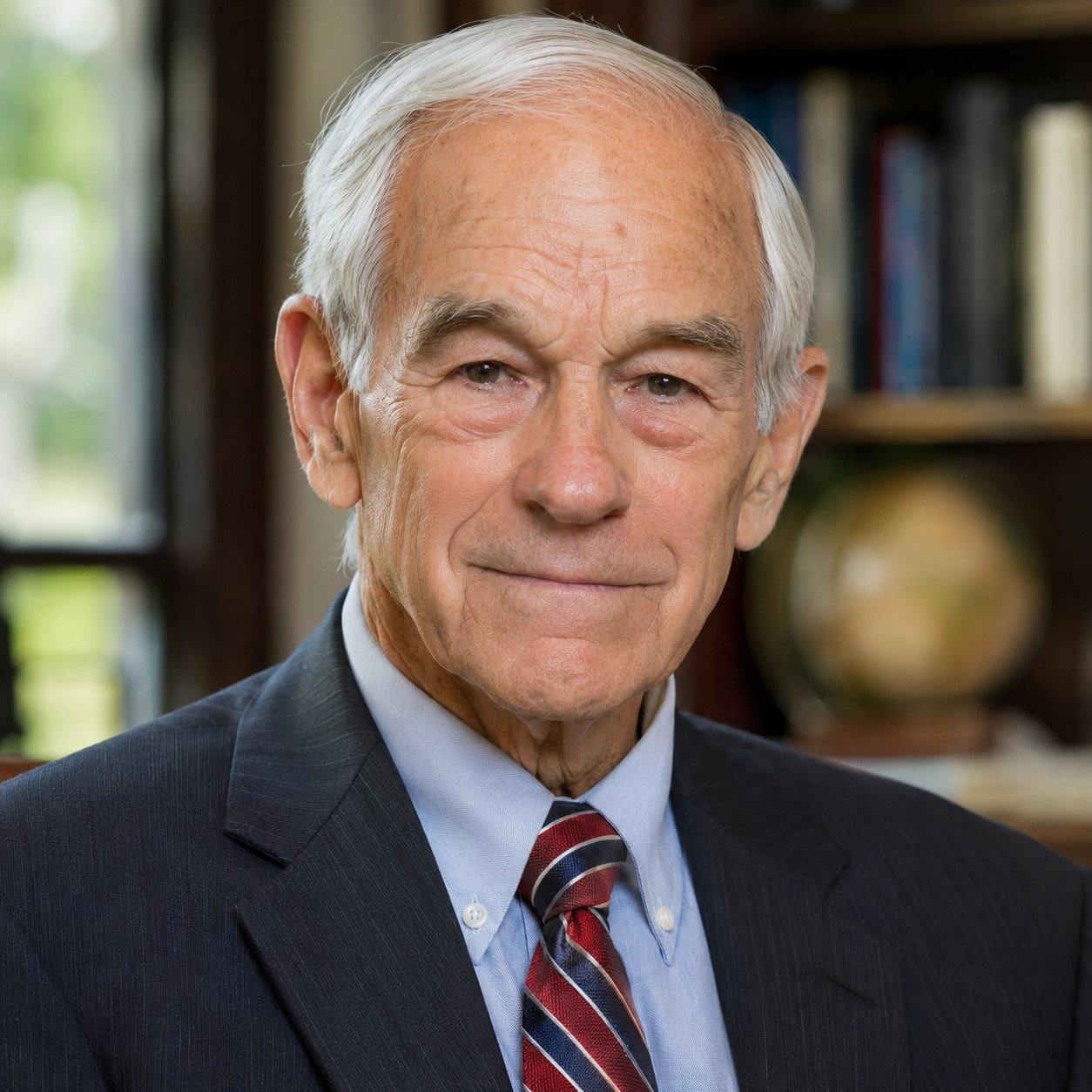
Featured image: Ron Paul (AI illustration)