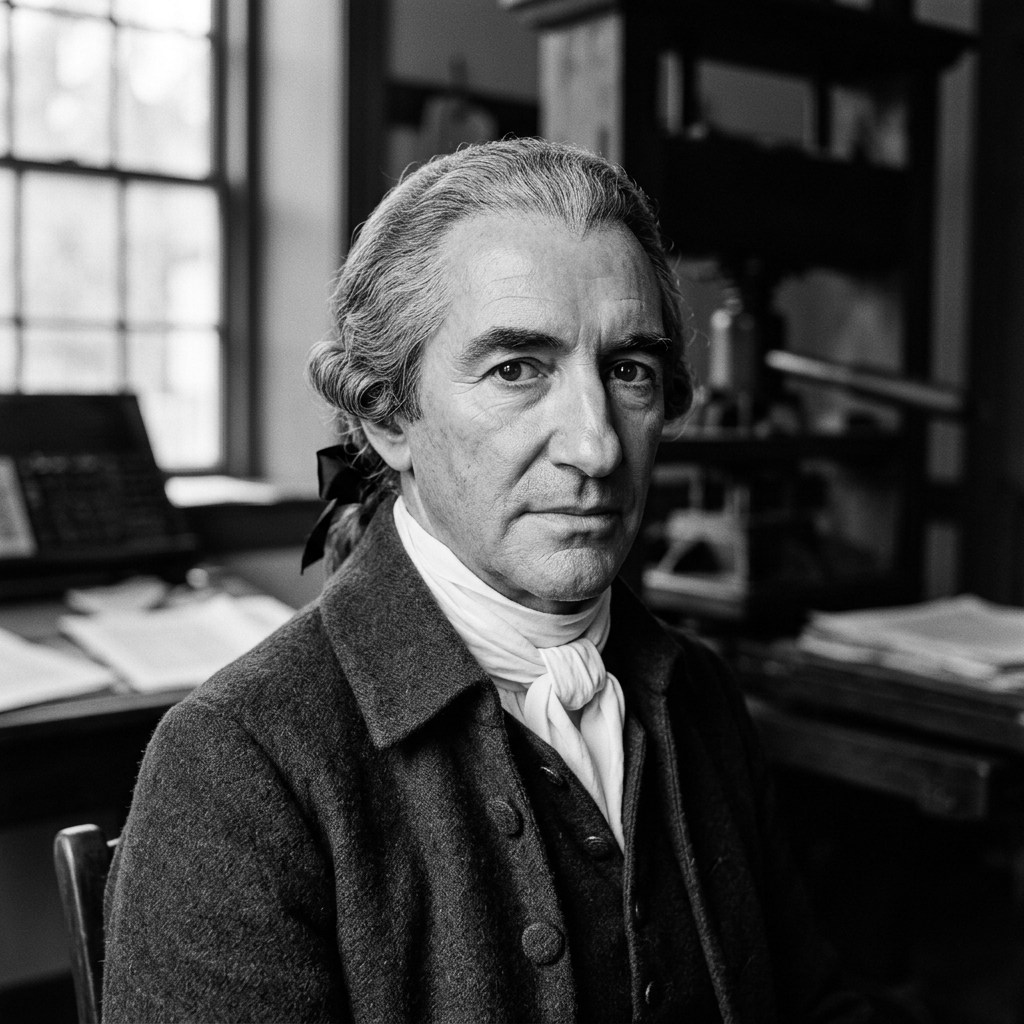
On November 30, 1774, helpers in Philadelphia carried a passenger off a ship. A severe fever had seized him during the crossing from England, so that he could not leave the vessel under his own power. In his pocket he carried a letter of recommendation from Benjamin Franklin; otherwise the thirty-seven-year-old had little to show: two dismissals from the service of the British excise authority and a string of beginnings that had come to nothing.
A little more than thirteen months later, on January 10, 1776, a pamphlet titled Common Sense appeared in Philadelphia, signed only “by an Englishman.” It became the most widely read pamphlet of the American Revolution, and its first pages contain an idea that friends of liberty still invoke today: society and government are two different things, and one should not confuse them. The author was Thomas Paine.
At a glance
- Life: January 29, 1737, in Thetford, Norfolk, to June 8, 1809, in New York
- Work: pamphleteer of the American Revolution, from 1777 to 1779 secretary of the Committee for Foreign Affairs of the Continental Congress, from 1792 a deputy to the French National Convention, imprisoned in Paris from 1793 to 1794
- Major works: Common Sense (1776), The American Crisis (1776 to 1783), Rights of Man (1791 and 1792), The Age of Reason (1794 and 1795), Agrarian Justice (1797)
- In one sentence: He wrote for a broad public what had previously appeared mostly in learned treatises: that rights belong to human beings and that governments must justify themselves before society.
A stay maker from Thetford
Paine’s father, Joseph, was a stay maker (a maker of corsets) and a Quaker; his mother was an Anglican. The son attended the grammar school in Thetford, was apprenticed to his father at thirteen, and at nineteen went to sea for a while on a privateer. Later he became an excise officer, was dismissed in 1765, and was soon reinstated. In 1772 he wrote a pamphlet for his colleagues about their meager pay, The Case of the Officers of Excise, and had some 4,000 copies distributed to members of Parliament. In the spring of 1774 he lost the position for good because he had left his post without permission to campaign for the cause in London.
In London he met Franklin, who gave him a letter of recommendation for America. In Philadelphia Paine became editor of the Pennsylvania Magazine, and after Common Sense came the first number of The American Crisis on December 19, 1776, a few days before George Washington crossed the Delaware with his army. Its opening is still quoted in America today: “These are the times that try men’s souls.” He gave up his office as secretary of the Committee for Foreign Affairs in 1779 after publicly accusing the diplomat Silas Deane of war profiteering.
What holds people together
Common Sense begins with a clarification. Some writers, Paine writes, have so confounded society with government that hardly any distinction remains, although the two have different origins. Society is produced by our wants, government by our wickedness. From this follows the sentence that gives this article its title: “Society in every state is a blessing, but government even in its best state is but a necessary evil; in its worst state an intolerable one.”
Sixteen years later Paine developed this idea in the second part of Rights of Man, and the chapter reads like an early description of what Friedrich August von Hayek later called spontaneous order. A great part of the order among human beings, Paine argues, is not the work of government. It has its origin in the nature of man and in the principles of society; it existed before any government and would continue to exist if the formalities of government were abolished. Society, he writes, performs for itself almost everything that is ascribed to government.
According to Paine, government is needed only for the few cases that society is not equal to, and the more perfect a civilization becomes, the less of it it needs. For the tax practices of his time he found an image that has lost little of its force. Even in the most advanced countries, he writes, one sees the greedy hand of government thrusting itself into every corner and crevice of industry and grasping the spoil of the multitude.
An ass for a lion
The second great idea of Common Sense is directed against hereditary monarchy. Because all men were originally equal, Paine argues, no one can acquire by birth the right to set his family above others for all time. Nature herself ridicules the hereditary right of kings by so frequently giving mankind an ass for a lion. The pamphlet thus openly argued for the break with the Crown, and about half a year after it appeared, the colonies declared their independence.
In 1790 the Whig politician Edmund Burke attacked the French Revolution in his Reflections on the Revolution in France. He understood society as a partnership between the living, the dead, and those yet to be born, and he defended England’s inherited institutions. Paine answered in 1791 and 1792 with the two parts of Rights of Man. No generation, he held, has the right to bind those that follow: “Every age and generation must be as free to act for itself in all cases as the age and generations which preceded it.” He called the wish to govern beyond the grave the most ridiculous and insolent of all tyrannies, and he added a sentence that reaches far beyond the dispute with Burke: man has no property in man. In his conviction, the rights of the individual come before any government, and government arises from society, not the other way around.
In Great Britain the book became the most widely read work of the reform movement of the 1790s. In May 1792 the government brought proceedings against him for seditious writings, and in December he was convicted in absentia. By then Paine was already in France.
Commerce as an order of peace
In the fifth chapter of the second part of Rights of Man, Paine turns to commerce. He had been an advocate of commerce in all his writings, he says, because he was a friend to its effects. Commerce is a peaceful system that disposes people kindly toward one another by making nations, as well as individuals, useful to each other. If it could develop to its full extent, it would extirpate the system of war. In this he stands in a line with Montesquieu before him and with Richard Cobden and Frédéric Bastiat after him, who saw free exchange as the most reliable path to peace.
Liberty for opponents too
In France, Paine, by then an honorary citizen, was elected to the National Convention in September 1792, although he spoke no French. When the Convention deliberated on the fate of Louis XVI, Paine voted for the republic but opposed the execution of the king. He proposed sending Louis into exile in the United States and reminded the deputies that under this king France had helped the Americans in the War of Independence. This earned him the enmity of Marat and the Jacobins. At the end of December 1793 the arrest warrant was issued, and Paine spent eleven months in the Luxembourg prison in Paris until, after the fall of Robespierre, the American minister James Monroe secured his release.
In July 1795, a good half year after his release, he wrote a sentence that ranks among the wisest in his work: “He that would make his own liberty secure, must guard even his enemy from oppression; for if he violates this duty, he establishes a precedent that will reach to himself.” (Dissertation on First Principles of Government)
He showed the same independence in matters of faith. He handed the first part of The Age of Reason to a friend when he was arrested. The book is a deist work, not a rejection of God: Paine believed in a Creator but denied every church the right to dispose of the consciences of others in the name of a revelation. This stance cost him dearly. When he returned to America in 1802 at the invitation of Thomas Jefferson, many of his former admirers shunned him, and only six people came to his funeral in June 1809.
A fund for every adult
In his late pamphlet Agrarian Justice, published in Paris in 1797, Paine took a step on which friends of liberty still disagree today. In its natural state, he argued, the earth was the common property of mankind, and the system of landed property had not compensated those who thereby lost their share. He therefore proposed a national fund that would pay everyone 15 pounds at the age of 21 and everyone aged 50 and over 10 pounds a year, explicitly to the poor and the rich alike, financed by a deduction from inheritances and explicitly without diminishing the property of present owners. What he had in mind, he wrote, was not charity but a right. Advocates of a basic income cite this pamphlet today, while other readers see in it a tension with the liberty-minded ideas with which the second part of Rights of Man begins.
What friends of liberty can learn from him
The first and most important lesson is the distinction with which Common Sense begins. Whoever equates society with the state regards every limit on the state’s tasks as an attack on living together. Whoever keeps them apart sees how much order people create without commands: through exchange, neighborliness, associations, and families.
Just as much can be learned from his language. At the start of the section “Thoughts on the Present State of American Affairs” in Common Sense he promises nothing more than “simple facts, plain arguments, and common sense,” and he kept to that. John Locke’s ideas about natural rights and the limits of government had long been known in learned circles. Paine made them understandable to readers who would never have opened a philosophical treatise.
Finally, his life shows that principles are worth something when they also apply to one’s opponents. Paine attacked the king of England and, a few years later, defended the life of the king of France, even though it earned him the enmity of the Jacobins and eleven months in prison.
The world as his country
Thomas Paine lost offices and, in the end, the favor of the public as well, because he wrote what he believed to be right. In the second part of Rights of Man he described his own attitude: independence was his happiness, and he viewed things as they are, without regard to place or person. “My country is the world, and my religion is to do good.” The failed excise officer who had been carried ashore sick in 1774 had become the man whose distinction between society and government still shapes many debates about the limits of the state. How small a necessary evil can remain depends, in his conviction, on how much society trusts itself to do.
Further reading
- Thomas Paine: Common Sense, Philadelphia 1776 (freely available at Project Gutenberg)
- Thomas Paine: Rights of Man, Parts I and II, London 1791 and 1792
- Thomas Paine: Agrarian Justice, Paris and London 1797
- Mark Philp: “Thomas Paine,” Stanford Encyclopedia of Philosophy
This article is part of our series on thinkers, doers, and historical figures of liberty.
Sources
- Paine, Thomas: Common Sense, Robert Bell, Philadelphia 1776; text: Project Gutenberg no. 147, https://www.gutenberg.org/ebooks/147
- Paine, Thomas: The American Crisis, no. 1, Styner & Cist, Philadelphia, December 19, 1776; in: The Writings of Thomas Paine, ed. Moncure Daniel Conway, Project Gutenberg no. 31270, https://www.gutenberg.org/ebooks/31270
- Paine, Thomas: Rights of Man, Part I (London 1791) and Part II (London 1792); in: The Writings of Thomas Paine, vol. 2, ed. Moncure Daniel Conway, Project Gutenberg no. 3742, https://www.gutenberg.org/ebooks/3742
- Paine, Thomas: The Age of Reason, Part I (1794) and Part II (1795); Project Gutenberg no. 3743, https://www.gutenberg.org/ebooks/3743
- Paine, Thomas: Dissertation on First Principles of Government, Paris, July 1795; in: Conway (ed.), Project Gutenberg no. 31270
- Paine, Thomas: Agrarian Justice, W. Adlard, Paris, and T. Williams, London 1797; in: Conway (ed.), Project Gutenberg no. 31270
- Burke, Edmund: Reflections on the Revolution in France, J. Dodsley, London 1790
- Montesquieu: De l’esprit des lois, Geneva 1748, book XX, ch. 2
- Philp, Mark: “Thomas Paine,” Stanford Encyclopedia of Philosophy, 2013, revised 2025, https://plato.stanford.edu/entries/paine/
- Aldridge, Alfred Owen: “Paine, Thomas (1737–1809),” Encyclopedia of Philosophy, 1967, https://www.encyclopedia.com/humanities/encyclopedias-almanacs-transcripts-and-maps/paine-thomas-1737-1809
- Conner, Jett: “The American Crisis Before Crossing the Delaware?,” Journal of the American Revolution, February 25, 2015, https://allthingsliberty.com/2015/02/american-crisis-before-crossing-the-delaware/
- Conner, Jett: “A Brief Publication History of the ‘Times That Try Men’s Souls,’” Journal of the American Revolution, January 4, 2016, https://allthingsliberty.com/2016/01/a-brief-publication-history-of-the-times-that-try-mens-souls/
- Thomas Paine National Historical Association: Major Milestones, https://thomaspaine.org/major-milestones
- Wikipedia (en): Thomas Paine, https://en.wikipedia.org/wiki/Thomas_Paine (detailed biographical dates, checked against the SEP)
Featured image: Thomas Paine (AI illustration)