In the fall of 1506, Albrecht Dürer wrote several letters from Venice to his friend Willibald Pirckheimer in Nuremberg. He had painted a large altarpiece, the Feast of the Rosary, for the German merchants of the lagoon city, and, as he reported in September, it had earned him much praise and little profit; even the Doge and the Patriarch had come to see it. In October his journey home was approaching. How he would freeze after this sun, he wrote, and right after that comes the famous sentence: “Here I am a gentleman, at home a parasite.”
It should not be taken quite literally, for Dürer was a respected master in Nuremberg, too. But the sentence reveals a claim that could not yet be taken for granted at home: a painter wanted to be recognized as a person and not merely as the man who delivers the panels he has been commissioned to paint. How Dürer made this claim a reality says a great deal about freedom, even though he never developed a doctrine of it anywhere, and he traveled that road above all as an entrepreneur.
At a glance
- Life: May 21, 1471, in Nuremberg to April 6, 1528, in the same city
- Work: painter, draftsman, and printmaker, his own publisher, author of instructional treatises
- Major works: Apocalypse (1498), Self-Portrait with Fur-Trimmed Robe (1500), Feast of the Rosary (1506), Life of the Virgin and Large Passion (book editions 1511), Knight, Death and the Devil (1513), Melencolia I (1514), The Four Apostles (1526), Underweysung der Messung (Instruction in Measurement, 1525)
- In one sentence: He made printmaking an art for the free market and the artist an entrepreneur with a name of his own.
A Goldsmith’s Son in the Imperial City
Dürer’s father, a goldsmith from Hungary, came to Nuremberg in 1455 after many years in the Netherlands. The son first trained under him, but by his own account he was drawn more to painting, and his father, regretting the lost years of apprenticeship, placed him with Michael Wolgemut for three years on November 30, 1486. In Wolgemut’s workshop, which also illustrated books, Dürer learned along the way how printing and publishing worked.
After years as a journeyman that took him to Colmar, Basel, and Strasbourg, among other places, he married Agnes Frey in 1494. Whether he traveled to Venice for the first time right afterward is disputed, because there are no documents for it. What is certain is that from the mid-1490s on he ran a workshop of his own in Nuremberg.
With at least 28,000 inhabitants within its walls, Nuremberg around 1500 was the most populous city of the Holy Roman Empire after Cologne. It was governed by a council drawn from a few patrician families. Since a failed uprising in 1348/49, craftsmen had been forbidden to form guilds; as an estate they had no political voice, and the council supervised their trades. This had little to do with participation in government, but it did mean that no guild watched over a master like Dürer, and he made use of that latitude by working with a few well-trained assistants and in cooperation with other workshops in the city.
Pictures for Buyers He Had Never Seen
The usual way for a painter to make a living at the time was the commission, and Dürer drove a hard bargain. For the altarpiece of the Frankfurt merchant Jakob Heller, 130 guilders had been agreed, but when Dürer realized how much time and ultramarine the careful execution was consuming, he asked for 200, and Heller paid after some protest. In August 1509, in a letter to him, Dürer drew a remarkable conclusion. Ordinary pictures could earn something, he wrote in substance, but painstaking care could not. He therefore meant to stick to his engraving, and had he done so earlier, he would be a thousand guilders richer today.
Woodcut and copper engraving allowed something panel painting did not: one could produce for stock, for buyers one had never seen. In 1498 Dürer published the Apocalypse himself, fifteen large-format woodcuts on the Revelation of John, which made him famous throughout Europe. His range ran from small devotional prints for modest purses to mythological engravings for humanists. Sales took place in his own house, at the Nuremberg market, through publishers, and through a sales agent, Konrad Schweitzer, who was to carry the prints from country to country. While Dürer was in Venice in 1506, his mother and Agnes sold his prints at fairs elsewhere, including Frankfurt.
The business had its risks, and when a dealer died in Rome, Dürer lost a great deal of money. In the end he was among the hundred wealthiest citizens of Nuremberg, and his friend Pirckheimer put the fortune he left at around six thousand guilders.
Two Letters as a Promise
Anyone who produces for stock and for strangers needs a mark by which buyers can tell what they are getting. Dürer found it in his monogram, a large A with a smaller D beneath it. On his prints it became a kind of trademark, and because it had value, it was imitated.
Between about 1506 and 1508, Marcantonio Raimondi of Bologna copied as engravings the woodcuts of the Life of the Virgin that had appeared up to then, monogram and all. Giorgio Vasari relates in his Lives of the Artists of 1568 that Dürer hurried to Venice over this to complain to the Senate, and achieved only that Raimondi was allowed to go on copying the pictures, but without the monogram. The archives of the Venetian Senate, however, contain no trace of such a complaint, and Dürer’s letters mention no lawsuit. Some scholars even consider it possible that Dürer worked together with Raimondi and his publisher to serve the Italian market.
What Dürer did in 1511, on the other hand, is documented. He published the Apocalypse, the Life of the Virgin, and the Large Passion as books, with notices that prohibited reprinting and placed the works under the protection of Emperor Maximilian. The text in the Life of the Virgin begins, in substance, with a woe pronounced on the deceiver and thief of other people’s labor and ideas. No other source confirms whether the imperial charter he invoked actually existed. The idea is remarkable all the same, because it explicitly declares the artistic idea, too, to be worthy of protection. According to a later account, the Nuremberg council in 1512 warned copyists who were fraudulently reproducing Dürer’s mark.
The claim, often repeated, that Dürer thereby won the first copyright is an anachronism. Venice had been granting printing privileges since 1469 as acts of grace for individual beneficiaries, and a general right of every author to his work first appears in the English Statute of Anne of 1710. Whether such protective rights fit into a free order is something classical liberals still argue about today. Dürer himself spoke of theft of his work. But the ban on forging another’s mark also protects buyers from deception, and this part of his concern makes sense even to critics of intellectual property.
A Face That Looks at the Viewer
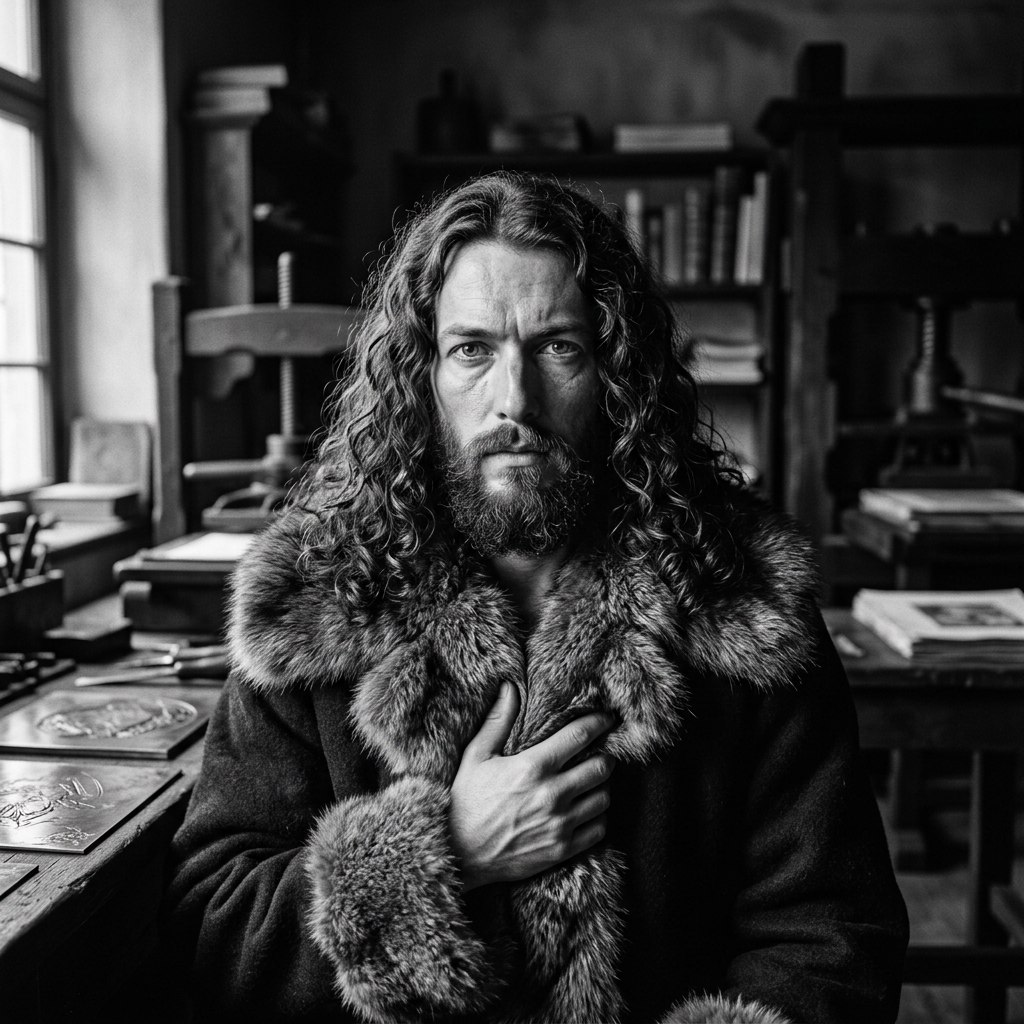
In the self-portrait that Dürer painted on limewood in 1500, which now hangs in the Alte Pinakothek in Munich, he shows himself strictly from the front, with long curls and a fur-trimmed robe, one hand before his chest. The Latin inscription reads, in substance: Thus I, Albrecht Dürer of Nuremberg, painted myself with my own colors at the age of 28.
At the time, such a strict frontal view was known above all from icons of Christ as Savior of the World, and the Pinakothek points out that Dürer took this model as his guide, down to a position of the hand close to the gesture of blessing. No source tells us what was meant by it. A widespread interpretation sees in it an artist who understands his creative gift as a gift from God, and indeed gaze and hand direct attention to seeing and making. Read this way, an individual steps out of the anonymity of the workshop and claims for his own face a dignity that until then had belonged to the sacred. Whether Dürer himself thought that far, we do not know; for a history of liberty it remains an eloquent image.
In the Emperor’s Service, on His Own Account
For all that, Dürer was not independent of the powerful. From 1512 he worked for Emperor Maximilian I, above all on the emperor’s glorifying works in woodcut, the Triumphal Arch and the Triumphal Procession. In December 1512 the emperor asked the Nuremberg council to exempt him from additional levies, citing his own favor and Dürer’s renowned art, and in 1515 he granted him a lifelong annual pension of 100 guilders. After Maximilian’s death, Dürer traveled to the Netherlands for the express purpose of having the payment confirmed by Charles V, which he achieved in November 1520 after great effort.
Here the limits of the independence the market could offer around 1500 become visible. Still, it is telling that Dürer never built his livelihood on the favor of the court alone. The emperor was a customer of particular weight, but one among many.
Between Luther and the Council
In early 1520 Dürer thanked Georg Spalatin, court chaplain to the Elector of Saxony, for writings by Luther and wrote that if God helped him to come to Luther, he would diligently portray him and engrave him in copper. When the false news reached him in Antwerp in May 1521 that Luther had been taken captive, he asked in his diary, in substance, who would explain the Gospel to them so clearly if Luther were dead. He remained well disposed toward the Lutherans but rejected their excesses.
In 1525 Nuremberg became the first imperial city to introduce the Reformation. That the new teaching did not automatically mean more liberty for dissenters was something three young Nuremberg painters, Georg Pencz and the brothers Sebald and Barthel Beham, experienced in January of the same year. The council had the “godless painters” arrested for blasphemy and contempt for the authorities and, after fifteen days in prison, banished them from the city. Only in November were they allowed to return on probation.
In October 1526 Dürer presented the council with two large panels showing the apostles John and Peter, Paul, and the evangelist Mark, known as The Four Apostles. The inscriptions beneath them address the secular rulers and admonish them to hold to the pure word of the Bible and to beware of false prophets. One can see in this the profession of a citizen who had something to say to the authorities over him and said it to them in full public view.
A Beginning for All Who Want to Learn
In his last years Dürer wrote textbooks on geometry, fortification, and the proportions of the human body. In the dedication of the Underweysung der Messung of 1525, he laments that in Germany many talented boys were set to painting without a proper foundation, and he offers a beginning to all who want to learn. He died in April 1528, before his Four Books on Human Proportion could appear.
Dürer left no profession of faith in liberty, but he did leave a way of life that shows what freedom could mean for a craftsman around 1500. Whoever worked for an open market no longer depended on the goodwill of a single patron, but in return had to cultivate his good name and defend it against deception. In Venice Dürer had felt like a gentleman. That he became one in Nuremberg, too, over the years, he owed in a small part to the emperor and in a far larger part to the many people who bought his prints because they were worth something to them.
Further reading
- Albrecht Dürer: Schriftlicher Nachlass, ed. Hans Rupprich, 3 vols., Deutscher Verein für Kunstwissenschaft, Berlin 1956–1969 (in German)
- Larry Silver and Jeffrey Chipps Smith (eds.): The Essential Dürer, University of Pennsylvania Press, Philadelphia 2010
- Erwin Panofsky: Das Leben und die Kunst Albrecht Dürers, Rogner & Bernhard, Munich 1977 (in German; English original: The Life and Art of Albrecht Dürer, Princeton University Press, 1955)
- Rainer Schoch, Matthias Mende, and Anna Scherbaum: Albrecht Dürer. Das druckgraphische Werk, 3 vols., Prestel, Munich 2001–2004 (in German)
This article is part of our series on thinkers, doers, and historical figures of liberty.
Sources
- Dürer, Albrecht: Schriftlicher Nachlass, ed. Hans Rupprich, 3 vols., Deutscher Verein für Kunstwissenschaft, Berlin 1956–1969 (family chronicle, letters to Pirckheimer, Heller, and Spalatin, diary of the journey to the Netherlands), in German.
- Dürer, Albrecht: Records of Journeys to Venice and the Low Countries, translated by Rudolf Tombo, ed. Roger Fry, Merrymount Press, Boston 1913, https://gutenberg.org/cache/epub/3226/pg3226.html
- Silver, Larry; Smith, Jeffrey Chipps (eds.): The Essential Dürer, University of Pennsylvania Press, Philadelphia 2010 (letters to Jakob Heller 1507–1509, dedication of the Underweysung der Messung 1525, Pirckheimer to Johann Tscherte 1530); excerpts: https://www.oneonta.edu/faculty/farberas/arth/ARTH200/artist/durer_primary_docs.html
- Dürer, Albrecht: Underweysung der Messung mit dem Zirckel und Richtscheyt, Nuremberg 1525 (in German).
- Dürer, Albrecht: Self-Portrait with Fur-Trimmed Robe, 1500, Alte Pinakothek Munich, inv. 537, https://www.sammlung.pinakothek.de/en/artwork/Qlx2QpQ4Xq
- Maximilian I: letter to the Nuremberg council of December 12, 1512, https://www.habsburger.net/en/schreiben-maximilians-i-vom-12-dezember-1512-den-nurnberger-rat
- Dürer, Albrecht: Apocalipsis cum figuris, Nuremberg 1511 (with colophon and notice of privilege), Royal Academy, https://royalacademy.org.uk/art-artists/book/apocalipsis-cu-figuris
- Jantzen, Hans: Dürer, Albrecht, in: Neue Deutsche Biographie 4 (1959), https://www.deutsche-biographie.de/gnd11852786X.html (in German)
- Woltmann, Alfred: Dürer, Albrecht, in: Allgemeine Deutsche Biographie 5 (1877), pp. 475–485, https://de.wikisource.org/wiki/ADB:D%C3%BCrer,_Albrecht (in German)
- Diefenbacher, Michael: Nuremberg, Imperial City: Political and social development, Historisches Lexikon Bayerns (2010), https://www.historisches-lexikon-bayerns.de/Lexikon/EN:Nuremberg,_Imperial_City:_Political_and_social_development
- City of Nuremberg: Stadtrecht, Entfaltung der Verfassung, https://www.nuernberg.de/internet/stadtrecht/entfaltung_verfassung.html (in German)
- Schwerdtfeger, Paula: Marke AD. Der unternehmerische Geist Albrecht Dürers, Städel Stories, January 23, 2014, https://stories.staedelmuseum.de/de/marke-ad-der-unternehmerische-geist-albrecht-durers (in German)
- Friehs, Julia Teresa: Ein “neuer Selbstständiger”: Albrecht Dürer, habsburger.net, https://www.habsburger.net/de/kapitel/ein-neuer-selbststaendiger-albrecht-duerer (in German)
- Palmer Museum of Art, Penn State: Marcantonio Raimondi after Albrecht Dürer, Angel Appearing to Joachim, https://exhibitions.psu.edu/s/recent-acquisitions/item/4791
- Donath, Adolph: Wie die Kunstfälscher arbeiten, ch. 4 (Nuremberg council 1512), https://projekt-gutenberg.org/authors/adolph-donath/books/wie-die-kunstfaelscher-arbeiten/chapter/4 (in German)
- Luber, Katherine Crawford: Albrecht Dürer and the Venetian Renaissance, Cambridge University Press, Cambridge 2005; review: https://hnanews.org/hnar/reviews/albrecht-durer-venetian-renaissance/
- Pfisterer, Ulrich: Dürer im Dialog (2013), https://archiv.ub.uni-heidelberg.de/artdok/5730/1/Pfisterer_Duerer_im_Dialog_2013.pdf (in German)
- Deutsche Biographie: Pencz, Georg (NDB 20), https://www.deutsche-biographie.de/sfz94547.html (in German)
- Sonntagsblatt: Die Vier Apostel sind Albrecht Dürers Vermächtnis, https://sonntagsblatt.de/artikel/kultur/die-vier-apostel-sind-albrecht-duerers-vermaechtnis (in German)
- Bridwell Library, Southern Methodist University: Dürer and the Reformation, https://bridwell.omeka.net/exhibits/show/durer/durerreformation/luther
- History of Information: Johannes de Spira and the Venetian printing privilege of 1469, https://www.historyofinformation.com/detail.php?entryid=362
- Patry, William: Copyright Law and Practice (Statute of Anne 1710), https://digital-law-online.info/patry/patry2.html
- Historisches Museum Frankfurt: Heller-Altar, https://www.historisches-museum-frankfurt.de/iart/os-download-object/33617 (in German)
- Panofsky, Erwin: Das Leben und die Kunst Albrecht Dürers, Rogner & Bernhard, Munich 1977 (in German; English original first published 1943, one-volume edition The Life and Art of Albrecht Dürer, Princeton University Press, 1955).
- Schoch, Rainer; Mende, Matthias; Scherbaum, Anna: Albrecht Dürer. Das druckgraphische Werk, 3 vols., Prestel, Munich 2001–2004 (in German).
Featured image: Albrecht Dürer (AI illustration)