In 1948 a young economist at the University of Chicago was searching through the library’s holdings. On the dusty shelves of the old Harper Library he came across a German-language work that hardly anyone in America knew and that had never been translated: the Finanztheoretische Untersuchungen by the Swede Knut Wicksell, published in 1896. In it Wicksell demanded that every tax be decided together with the expenditure it is meant to finance, and that such a decision require the consent of nearly everyone. Only then could no one be served at the expense of others.
The young man’s name was James McGill Buchanan, and he later called this discovery one of the most exciting moments of his career. Wicksell’s principle of just taxation, he said in his Nobel lecture, had given him “a tremendous surge of self-confidence.” He immediately began translating the text into English, and over the following decades he turned Wicksell’s suggestion into a research program of his own. The Swedish Academy awarded him the Nobel Prize in Economic Sciences for it in 1986.
At a glance
- Life: October 3, 1919, in Murfreesboro, Tennessee, to January 9, 2013, in Blacksburg, Virginia
- Work: Professor at the University of Virginia, the Virginia Polytechnic Institute, and George Mason University; co-founder of public choice theory; president of the Mont Pelerin Society from 1984 to 1986
- Award: Nobel Prize in Economic Sciences, 1986
- Major works: The Calculus of Consent (1962, with Gordon Tullock), The Limits of Liberty (1975; German edition Die Grenzen der Freiheit, 1984), Democracy in Deficit (1977, with Richard E. Wagner), The Power to Tax (1980, with Geoffrey Brennan)
- In one sentence: He insisted that politicians and officials are people with interests of their own, and so he looked for rules that limit power.
From the Farmhouse to the Lecture Halls of Chicago
Buchanan grew up the eldest of three children on a farm in Tennessee. The family lived in what he later called genteel poverty, without running water or electricity, but with the library of his grandfather John Price Buchanan, who had been governor of Tennessee from 1891 to 1893 and owed his candidacy to the agrarian movement of the Farmers’ Alliance. The grandson studied at the teachers college in Murfreesboro and at the University of Tennessee. During the Second World War he served as a naval officer on the planning staff of Admiral Chester W. Nimitz in Honolulu.
After the war he went to Chicago with the help of the GI Bill, the education benefit for veterans. He arrived there, as the economist David R. Henderson writes, a “libertarian socialist.” Six weeks with Frank Knight were enough: as he wrote in his memoirs, he “had been converted into a zealous advocate of the market order.” In 1948 he completed his dissertation on fiscal equity in a federal state. From then on, photographs of Knight and Wicksell hung in his office.
After posts in Tennessee and Florida, Buchanan came to the University of Virginia in 1956. Together with G. Warren Nutter he proposed a center for political economy there, which was founded the following year as the Thomas Jefferson Center. In 1969, with Gordon Tullock and Charles Goetz, he built up the Center for Study of Public Choice at the Virginia Polytechnic Institute in Blacksburg, which moved as a whole to George Mason University near Washington in 1983. With Tullock he also founded the journal now called Public Choice. The name of the school of thought, the Virginia School, was coined, as Buchanan recalled, by the economist Mancur Olson.
The Same People on a Different Stage
The economists of his day had a sophisticated theory of how buyers and entrepreneurs make decisions. When it came to the state, however, many of them tacitly assumed that government agencies would correct market failures more or less mechanically, with only the common good in mind. In 1986 the Academy summed up Buchanan’s objection in a single sentence: “Individuals who behave selfishly on markets can hardly behave wholly altruistically in political life.”
In a lecture in Vienna in 1978, Buchanan condensed this view into the formula that has stood for the whole school of thought ever since: politics without romance. Voters, legislators, and officials are the same people who look out for their own advantage at the bakery in the morning. Parties compete for as many votes as possible, agencies for larger budgets, and anyone who takes this into account is less surprised that government programs rarely get smaller.
His colleague Gordon Tullock sharpened this perspective in 1967 with an essay on the welfare losses caused by tariffs, monopolies, and theft. In 1974 the economist Anne Krueger gave the phenomenon the name rent-seeking. It refers to the effort that companies and associations expend to obtain privileges, licenses, or subsidies from the state. This effort creates nothing new; it serves only to redistribute, and so the damage to everyone is greater than the sum that ends up passing from one group to another. In 1980 Buchanan, together with Tullock and Robert Tollison, edited a volume that brought this research together.
Politics as Exchange
Buchanan did not, however, want merely to demystify politics. His real concern was an idea of how it can succeed. In his Nobel lecture he named three building blocks of his approach: the starting point is the individual person, this person pursues his own goals, and politics is an exchange among such people. As in the market, those involved should make themselves better off through cooperation, and the yardstick for this is their consent.
From this follows Wicksell’s unanimity, which Buchanan and Tullock developed further in 1962 in The Calculus of Consent. Complete unanimity cannot be sustained in everyday practice, because every agreement costs time and negotiation. These decision-making costs have to be weighed against the costs an individual bears when a majority decides over his head. The greater the danger that a majority will burden a minority, the higher, by this reasoning, the required level of consent should be.
The distinction between two levels proved especially consequential. On one level the rules are chosen; on the other, decisions are made within those rules, just as one first sets the rules of a game and then plays it. Anyone who wants better outcomes should, in Buchanan’s view, attend above all to the first level. In its citation the Academy gave a vivid example: someone who wants to correct individual tariffs will achieve more by starting with the basic rules of world trade. Buchanan summarized Wicksell’s message in Stockholm like this: “Economists should cease proffering policy advice as if they were employed by a benevolent despot, and they should look to the structure within which political decisions are made.”
A Constitution for the Treasury
This approach became especially clear in fiscal policy. In Democracy in Deficit, Buchanan and Richard E. Wagner argued in 1977 that Keynesian doctrine had dissolved an unwritten rule that had long held: that a state, like a well-run household, does not permanently spend more than it takes in. Once this rule has fallen, politicians have every reason to hand out benefits today and leave the bill to future taxpayers. Discipline could then be regained only through formal limits in the constitution, and Buchanan long campaigned for a constitutional amendment requiring balanced budgets.
In The Power to Tax, he and Geoffrey Brennan went a step further in 1980. They described the state as a Leviathan that expands its revenues as far as it is allowed to, and asked what a fiscal constitution would have to look like that limits its taxing power from the outset. Anyone who thinks of the debt brake, the limit on borrowing that was written into Germany’s constitution, the Basic Law, in 2009, will recognize the underlying idea, even though it does not go back directly to Buchanan.
Between Anarchy and Leviathan
In The Limits of Liberty of 1975, which appeared in German in 1984 as Die Grenzen der Freiheit. Zwischen Anarchie und Leviathan, Buchanan posed the fundamental question of how an order with enforceable rights can emerge from a condition without rules. He begins with a world as Thomas Hobbes described it and reconstructs rights and the state as the outcome of a contract. The ideal society was, in substance, an anarchy for him, one in which no one coerces anyone else. For people as they really are, he nonetheless considered a state necessary, and a large part of his work was devoted to the question of how to bind it so that it protects without ruling. Whether he stood closer to anarchy than he admitted, or used it only as a thought experiment, is a matter his interpreters still argue about today.
On other questions, too, he followed no ready-made program. A certain degree of equality of opportunity belonged, in his view, to a free society, and for this reason he favored taxing inheritances, which drew objections from libertarians, for example from Walter Block. In his later years a different concern occupied him. In the 2005 essay “Afraid to Be Free,” he described how many people seek dependence on the state because the responsibility that comes with freedom frightens them.
What Friends of Liberty Can Learn from Him
The most important lesson is a question that can be put to every call for the state. Anyone who points to a failure of the market must show that politics will do better, and do so with the people and incentives that actually exist there. Since Buchanan, government failure has joined market failure as part of the basic vocabulary of economics.
Just as valuable is his trust in rules. The good intentions of those who govern are no reliable protection; a constitution that limits debt and taxes is. Anyone who wants to secure liberty should therefore spend less energy on bringing the right people to power and more on limiting power itself.
Finally, Buchanan placed the consent of the individual at the center. Wicksell’s idea that a tax is justified only if those affected could agree to it is a quiet but radical standard, because it obliges the state to justify itself to every citizen.
Rules, Not Rescuers
James M. Buchanan died in January 2013 at the age of 93. He left behind a body of work collected in twenty volumes and a school of thought that treats politics the way economists treat the market: without a halo and without contempt. His approach does not require better people, but it does require better rules, and therein lies a sober confidence. The next time you hear that a problem can only be solved by the state, his counterquestion is worth asking: by what rules do the people to whom we entrust this solution make their decisions?
Further reading
- James M. Buchanan and Gordon Tullock: The Calculus of Consent. Logical Foundations of Constitutional Democracy, University of Michigan Press, Ann Arbor 1962
- James M. Buchanan: Die Grenzen der Freiheit. Zwischen Anarchie und Leviathan, J. C. B. Mohr (Paul Siebeck), Tübingen 1984 (in German)
- James M. Buchanan and Richard E. Wagner: Democracy in Deficit. The Political Legacy of Lord Keynes, Academic Press, New York 1977
- James M. Buchanan: “The Constitution of Economic Policy,” Nobel lecture, December 8, 1986, nobelprize.org
This article is part of our series on thinkers, doers, and historical figures of liberty.
Sources
- Buchanan, James M.; Tullock, Gordon: The Calculus of Consent. Logical Foundations of Constitutional Democracy, University of Michigan Press, Ann Arbor 1962.
- Buchanan, James M.: Cost and Choice. An Inquiry in Economic Theory, Markham, Chicago 1969.
- Buchanan, James M.: The Limits of Liberty. Between Anarchy and Leviathan, University of Chicago Press, Chicago 1975; German edition: Die Grenzen der Freiheit. Zwischen Anarchie und Leviathan, J. C. B. Mohr (Paul Siebeck), Tübingen 1984.
- Buchanan, James M.; Wagner, Richard E.: Democracy in Deficit. The Political Legacy of Lord Keynes, Academic Press, New York 1977.
- Brennan, Geoffrey; Buchanan, James M.: The Power to Tax. Analytical Foundations of a Fiscal Constitution, Cambridge University Press, Cambridge 1980.
- Buchanan, James M.; Tollison, Robert D.; Tullock, Gordon (eds.): Toward a Theory of the Rent-Seeking Society, Texas A&M University Press, College Station 1980.
- Buchanan, James M.: “The Constitution of Economic Policy,” Nobel lecture, December 8, 1986, https://www.nobelprize.org/prizes/economic-sciences/1986/buchanan/lecture/
- Buchanan, James M.: Better than Plowing and Other Personal Essays, University of Chicago Press, Chicago 1992.
- Buchanan, James M.: “Public Choice: Politics Without Romance,” in: Policy (Centre for Independent Studies), Spring 2003.
- Buchanan, James M.: “Afraid to Be Free: Dependency as Desideratum,” in: Public Choice 124 (2005), pp. 19–31.
- Tullock, Gordon: “The Welfare Costs of Tariffs, Monopolies, and Theft,” in: Western Economic Journal 5 (1967), no. 3.
- Krueger, Anne O.: “The Political Economy of the Rent-Seeking Society,” in: American Economic Review 64 (1974), no. 3.
- Wicksell, Knut: Finanztheoretische Untersuchungen nebst Darstellung und Kritik des Steuerwesens Schwedens, Gustav Fischer, Jena 1896 (in German).
- Royal Swedish Academy of Sciences: press release on the 1986 Prize in Economic Sciences, October 16, 1986, https://www.nobelprize.org/prizes/economic-sciences/1986/press-release/
- Nobelprize.org: James M. Buchanan Jr., Biographical (Les Prix Nobel 1986), https://www.nobelprize.org/prizes/economic-sciences/1986/buchanan/biographical/
- Henderson, David R.: “James M. Buchanan,” in: The Concise Encyclopedia of Economics, Liberty Fund, https://www.econlib.org/library/Enc/bios/Buchanan.html
- Tennessee Encyclopedia: John Price Buchanan, https://tennesseeencyclopedia.net/entries/john-price-buchanan/
- Block, Walter: “James Buchanan on inheritance: a critique,” in: Journal of Entrepreneurship and Public Policy 1 (2012), no. 2, pp. 159–165, https://ideas.repec.org/a/eme/jepppp/v1y2012i2p159-165.html
- Tabarrok, Alexander: “Equality and the Death Tax,” in: The Free Market, September 1997, https://mises.org/free-market/equality-and-death-tax
- Mohr Siebeck: publisher’s information on Die Grenzen der Freiheit (in German), https://www.mohrsiebeck.com/en/book/die-grenzen-der-freiheit-zwischen-anarchie-und-leviathan-9783161657795
- German Federal Ministry of Finance: Die Schuldenbremse (in German), https://www.bundesfinanzministerium.de/Content/DE/Standardartikel/Themen/Oeffentliche_Finanzen/Schuldenbremse/schuldenbremse.html
- Wikipedia (en): James M. Buchanan, https://en.wikipedia.org/wiki/James_M._Buchanan (overview; biography based on Better than Plowing)
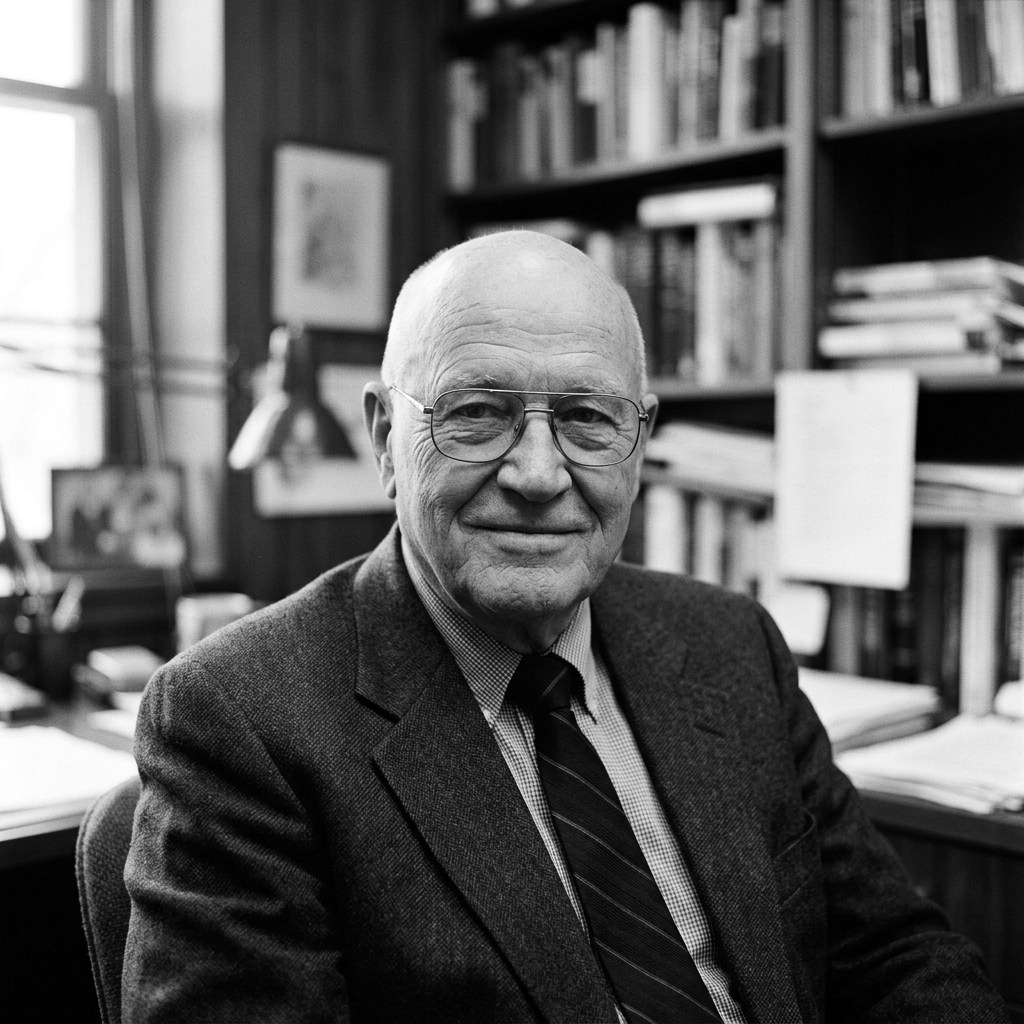
Featured image: James M. Buchanan (AI illustration)