For decades, art historians have argued over a single Dutch word: beweechgelickheijt. Rembrandt wrote it on January 12, 1639, to Constantijn Huygens, secretary to the stadtholder Frederik Hendrik in The Hague, as he apologized for the long wait for two commissioned paintings of the Passion. In them, he wrote, “die meeste ende die naetuereelste beweechgelickheijt” had been observed, roughly the greatest and most natural movement, though it remains open whether he meant outward motion or inner emotion. He left little more than that about his art: only seven letters in his own hand survive, all to Huygens and all about this one commission.
That same year, Rembrandt bought a stately house on the Sint Anthoniesbreestraat for 13,000 guilders. He had earned the money from Amsterdam merchants, preachers, surgeons, and militiamen who had him paint their portraits, and from the buyers of his etchings. His life shows what it meant to work as an artist in one of the most open societies in Europe, with all its opportunities and risks.
At a glance
- Life: July 15, 1606, in Leiden to October 4, 1669, in Amsterdam
- Work: painter, draftsman, and etcher; in Amsterdam from late 1631, a citizen there and a member of the painters’ guild from 1634, teacher in a large workshop
- Major works: The Anatomy Lesson of Dr. Nicolaes Tulp (1632), the Mennonite preacher Cornelis Claesz Anslo and His Wife (1641), The Night Watch (1642), The Conspiracy of Claudius Civilis (1661/62), The Syndics (1662), close to a hundred self-portraits
- In one sentence: He lived from middle-class customers and an open market rather than from a single patron, and he bore the consequences of both his success and his failure himself.
From the mill to the Amstel
Rembrandt Harmenszoon van Rijn was the ninth child of a Leiden miller and a baker’s daughter; his mother was Catholic, his father Reformed. After Latin school, he enrolled at the university at about fourteen, but he became a painter. Some three years with Jacob van Swanenburgh were followed in 1625 by half a year with Pieter Lastman in Amsterdam.
Back in Leiden, he worked side by side with his friend Jan Lievens. Around 1630, Huygens considered the two the most gifted artists of their generation and arranged commissions for Rembrandt from the court in The Hague. At the end of 1631, Rembrandt moved to Amsterdam and took over the workshop of the art dealer Hendrick Uylenburgh, in whose house he also lived. In 1634 he married Uylenburgh’s cousin Saskia, became a citizen of the city that same year, and joined the painters’ guild.
A market with many masters
The Republic of the United Netherlands was at war with Spain until 1648 and at the same time enjoyed an enormous economic boom. There was no splendid royal court, only the comparatively modest court of the stadtholder, and the Reformed Church commissioned no altarpieces. Instead, a mass market for paintings emerged, carried by wealthy citizens and by artists who had immigrated from war-scarred Flanders.
Rembrandt used this market in several ways. For commissioned portraits, Uylenburgh brought him clients, among them several Mennonite families. His etchings, which could be printed and sold in larger numbers, contributed much to his fame. He also trained painters, among them Govaert Flinck, Ferdinand Bol, and Carel Fabritius, and according to the art writer Joachim von Sandrart, teaching alone brought him more than 2,000 guilders a year. The stadtholder’s court paid well too, 3,500 guilders in 1639 and 1646 combined for four paintings of the Passion series, but it remained one client among many. Rembrandt’s livelihood depended on no single customer.
Citizens who sat for their portraits
The large portraits show how middle-class his clientele was. In 1632 he painted The Anatomy Lesson of Dr. Nicolaes Tulp for the Amsterdam surgeons’ guild, and in 1641 the cloth merchant Cornelis Claesz Anslo, a preacher of the Waterlander Mennonites, in conversation with his wife.
His most famous work was made for a civic militia. In 1642, for the great hall of the Kloveniersdoelen, the headquarters of the Amsterdam arquebusiers, he painted the company of District II under Captain Frans Banninck Cocq and Lieutenant Willem van Ruytenburch. Eighteen of the sitters paid an average of about 100 guilders each. What was new was that Rembrandt showed the militiamen in motion, marching out with drum, banner, and muskets. The painting received the name Night Watch only toward the end of the 18th century, when darkened varnish had dimmed the daytime scene.
Twenty years later, in 1662, he painted The Syndics, known in Dutch as the Staalmeesters, the elected sampling officials of the drapers’ guild who checked the quality of the cloth on offer: five men in black and a servant, looking up from the table as if, as many viewers feel, someone had just entered the room.
The legend of the ruined genius
The best-known Rembrandt legend surrounds the Night Watch: the militiamen, it says, were dissatisfied because some of them can hardly be made out in the half-light, and from then on it was all downhill for him. The story was embellished above all in biographies of the early 19th century.
There is hardly any evidence for it. The art historian Walter Liedtke of the Metropolitan Museum points to the commissions Rembrandt continued to receive after 1642 from the city and from respected clients, and Banninck Cocq even had a copy of the painting made for himself. It is true that Rembrandt painted considerably less afterward. More plausible reasons are Saskia’s death in 1642, soon after the birth of their son Titus, and the money troubles of the following years. A few scholars consider a contemporary scandal possible; most regard the story of ruin through the Night Watch as a legend.
Between the synagogue and the Mennonite congregation
The house on the Breestraat stood at the edge of Vlooienburg, the quarter of the art trade and of the Portuguese Jews. The historian of philosophy Steven Nadler has reconstructed the neighborhood: almost all the houses next to and across from his belonged to Jewish families, part of Rembrandt’s cellar was rented to the Pereira brothers, and from the top floor he could see the synagogue. In 1655 Rembrandt made etchings for a book by Rabbi Menasseh ben Israel, who lived in the same quarter.
Many legends have grown up around this neighborhood. Menasseh was not, as is often claimed, his neighbor on the Breestraat, and Nadler considers the popular image of Rembrandt as a special friend of the Jews largely a myth, since most of the contacts were ordinary business. It is precisely this ordinariness that is revealing: Christians and Jews lived side by side and did business without either having to convert or drive out the other.
The same goes for the Mennonites, the descendants of the Anabaptists. Uylenburgh was one of them, and Govaert Flinck came from a Mennonite family. In 1686 the Italian art writer Filippo Baldinucci claimed that Rembrandt himself had been an Anabaptist. Against this is the fact that he had his children baptized in Reformed churches; which congregation he belonged to is unknown.
Toleration had its limits. Jews in Amsterdam remained legally restricted and were never granted full equality, and Catholics could celebrate Mass only in inconspicuous house churches. Even so, in Amsterdam one could live and do business with a different faith, which in large parts of Europe could by no means be taken for granted.
Debts, courts, and a second life
Success tempted Rembrandt into spending he could not sustain. About two thirds of the price of the house had been borrowed, and in the 1640s he stopped making payments. At the same time he bought paintings, prints, and curiosities, for instance about 1,400 guilders for fourteen sheets by Lucas van Leyden. The Leiden legal scholar Bob Wessels, who examined Rembrandt’s legal affairs in 2021, also points to loans taken out in haste in 1653, disputes with clients over prices and delivery dates, and weaker demand for well-paid commissions after 1650.
These years also saw the darkest chapter of his private life. After Saskia’s death he had taken the widow Geertje Dircx into the house as a nurse for Titus, and the two became a couple. When he turned to the young Hendrickje Stoffels, they broke apart. In 1649 Geertje sued him before the city’s commissioners for marital affairs for breach of a promise of marriage, and the commissioners awarded her 200 guilders a year. In the summer of 1650 she was committed to the Spinhuis in Gouda, a house of correction and workhouse for women. Rembrandt took part in this and paid the costs; her brother and neighbors supported his statements. She was sentenced to twelve years and released after about five because a friend intervened on her behalf, and in 1656 she appeared on the list of his principal creditors.
Hendrickje stayed at his side, but under the terms of Saskia’s will he could not marry her without having to hand over half of their joint estate to Titus. In 1654 the Reformed church council barred her from Communion because she lived with him unmarried, and in October their daughter Cornelia was born.
In July 1656 Rembrandt applied for cessio bonorum, the voluntary surrender of his property to the city’s insolvency office. The house and collection were inventoried and auctioned in 1657 and 1658, and the family moved into a rented home on the Rozengracht. Wessels has refuted the old accusation that Rembrandt had signed the house over to Titus beforehand to the detriment of his creditors. So that he could keep working, Hendrickje and Titus founded an art dealership in 1660 that employed Rembrandt.
The late years
This did not make him an outsider. In 1661 he received the commission for The Conspiracy of Claudius Civilis in the town hall, a painting the burgomasters rejected, however, and of which only a quarter survives. Alongside it he painted The Syndics and the merchant Jacob Trip with his wife Margaretha de Geer.
The self-portraits run through every phase of his life, close to a hundred of them, including more than forty paintings, in which he shows himself in costume, swaggering, pensive, and finally aged. Many viewers see in them a self-examination that gives room to the dignity of the individual. That remains an interpretation, for he never wrote down what he intended with these pictures.
Hendrickje died in 1663, Titus in 1668, shortly after his wedding. Rembrandt died on October 4, 1669, and was buried in a rented grave in the Westerkerk.
What his life says about liberty
One looks in vain for a political creed in Rembrandt, and anyone who calls him an early libertarian pulls him out of his century. But his life shows what a civil society with an open market makes possible. Because many people bought pictures, a miller’s son who did not depend on the favor of a single court could become one of the most sought-after painters in his city and paint in his own way, as long as he found buyers. Merchants, guilds, militiamen, and preachers took their place as patrons alongside the princes, and their portraits show people who managed their own affairs.
Failure is just as much a part of this story. No one forced Rembrandt to buy a house that was too expensive or to collect more art than he could pay for, and no one bailed him out. He bore the consequences, settled his debts through a regulated procedure, and kept painting. That Reformed Protestants, Jews, Mennonites, and secret Catholics lived side by side in the same city was due less to grand declarations than to a practice of toleration that served trade and was sustained by it.
In the end, the word from the letter to Huygens remains. Whether beweechgelickheijt means motion or emotion may never be settled. That a painter could take the time to search for it, and found buyers without princely titles for the result, he owed to the city in which he lived.
Further reading
- Constantijn Huygens: Briefwisseling, vol. 2: 1634–1639, ed. J. A. Worp, The Hague 1913 (includes Rembrandt’s letters to Huygens)
- Steven Nadler: Rembrandt’s Jews, University of Chicago Press, Chicago 2003
- Paul Crenshaw: Rembrandt’s Bankruptcy. The Artist, his Patrons, and the Art Market in Seventeenth-Century Netherlands, Cambridge University Press, Cambridge 2006
- Svetlana Alpers: Rembrandt als Unternehmer. Sein Atelier und der Markt, DuMont, Cologne 1989 (in German; original English edition: Rembrandt’s Enterprise: The Studio and the Market, University of Chicago Press, 1988)
This article is part of our series on thinkers, doers, and historical figures of liberty.
Sources
- Rembrandt to Constantijn Huygens, Amsterdam, January 12, 1639, in: Constantijn Huygens: Briefwisseling, Deel 2: 1634–1639, ed. J. A. Worp, The Hague 1913, no. 2020, https://dbnl.org/tekst/huyg001jawo04_01/huyg001jawo04_01_1062.php
- Rijksmuseum Amsterdam: Rembrandt, The Night Watch, Militia Company of District II under the Command of Captain Frans Banninck Cocq, 1642, object SK-C-5, with provenance and documents, https://www.rijksmuseum.nl/en/collection/SK-C-5
- Rijksmuseum Amsterdam: Rembrandt, The Sampling Officials of the Amsterdam Drapers’ Guild, Known as ‘The Syndics’, 1662, object SK-C-6, https://www.rijksmuseum.nl/en/collection/SK-C-6
- Rijksmuseum Amsterdam: catalogue entry RP-T-1947-213 (Passion series for Frederik Hendrik, seven autograph letters), https://www.rijksmuseum.nl/en/collection/RP-T-1947-213/catalogue-entry
- Rembrandt, The Mennonite Preacher Cornelis Claesz Anslo and His Wife Aeltje Gerritsdr Schouten, 1641, Gemäldegalerie, Staatliche Museen zu Berlin
- Piet Bakker: Rembrandt van Rijn, artist biography, The Leiden Collection, 2017, https://www.theleidencollection.com/artists/rembrandt-van-rijn/
- Walter Liedtke: Rembrandt van Rijn (1606–1669): Paintings, Heilbrunn Timeline of Art History, The Metropolitan Museum of Art, 2003, https://www.metmuseum.org/en/essays/rembrandt-van-rijn-1606-1669-paintings
- Encyclopaedia Britannica: Rembrandt van Rijn, section “Night Watch,” https://www.britannica.com/biography/Rembrandt-van-Rijn/Night-Watch
- Steven Nadler: Rembrandt’s Jews, University of Chicago Press, Chicago 2003, https://press.uchicago.edu/Misc/Chicago/567362.html
- Steven Nadler, Victor Tiribás: Rembrandt’s etchings for Menasseh ben Israel’s Piedra gloriosa: A mystery solved?, Kroniek van het Rembrandthuis 2021, https://www.rembrandthuis.nl/wp-content/uploads/2023/02/kroniek-2021-01-nadler-piedra_final_1.pdf
- Paul Crenshaw: Rembrandt’s Bankruptcy. The Artist, his Patrons, and the Art Market in Seventeenth-Century Netherlands, Cambridge University Press, Cambridge 2006
- Bob Wessels: Rembrandt’s Money. The legal and financial life of an artist-entrepreneur in 17th century Holland, Wolters Kluwer, Deventer 2021; news release from Leiden University, https://www.universiteitleiden.nl/en/news/2021/11/rembrandt-made-a-mess-of-his-legal-and-financial-life
- Filip Vermeylen: A mass market for the visual arts: The golden age of Dutch painting during the seventeenth century, in: I. Robertson et al. (eds.): Global Art Markets, Routledge, London 2024, https://pure.eur.nl/en/publications/a-mass-market-for-the-visual-arts-the-golden-age-of-dutch-paintin/
- Svetlana Alpers: Rembrandt als Unternehmer. Sein Atelier und der Markt, DuMont, Cologne 1989, in German (English: Rembrandt’s Enterprise, 1988)
- National Gallery of Art, Washington: artist biography Rembrandt van Rijn, https://www.nga.gov/artists/1822-rembrandt-van-rijn.html
- Wikipedia (English): Rembrandt, https://en.wikipedia.org/wiki/Rembrandt, and Geertje Dircx, https://en.wikipedia.org/wiki/Geertje_Dircx (as a starting point, with references to Crenshaw 2006 and Driessen 2012)
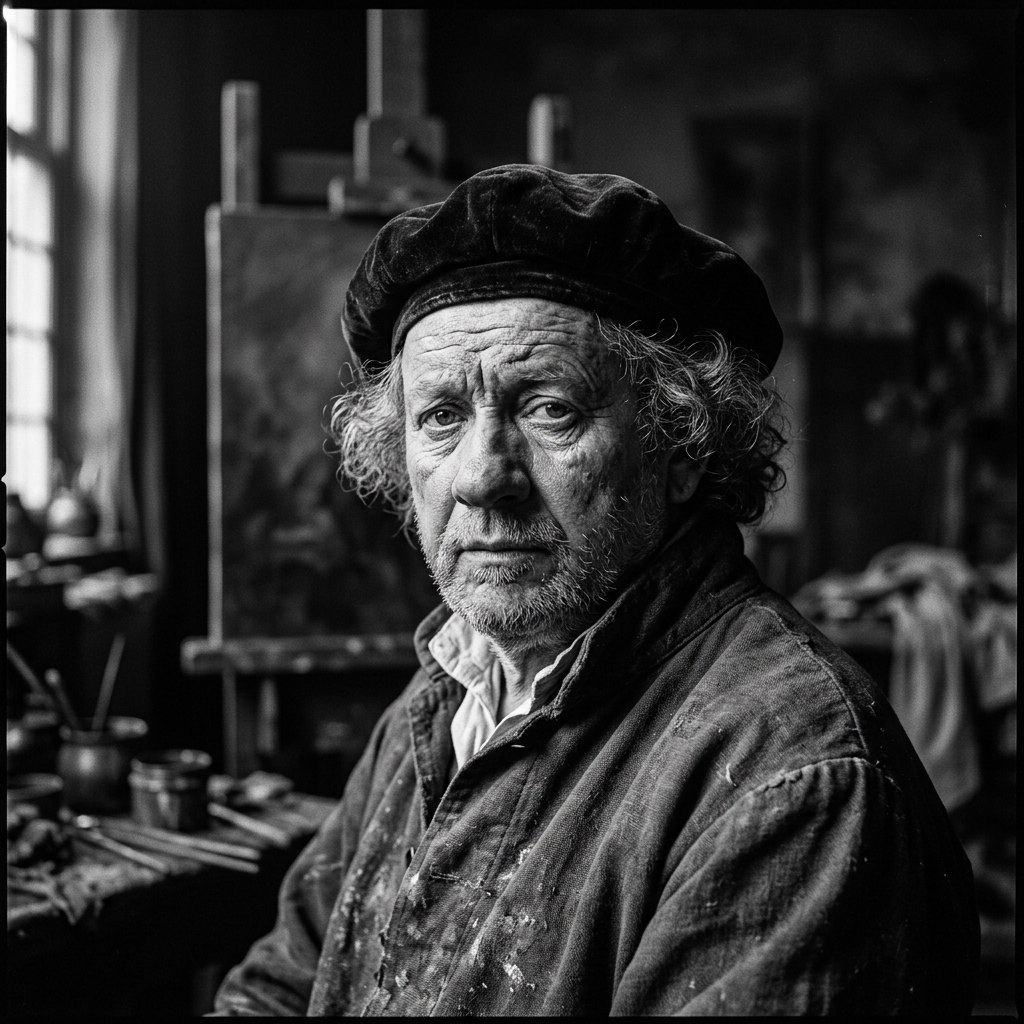
Featured image: Rembrandt van Rijn (AI illustration)