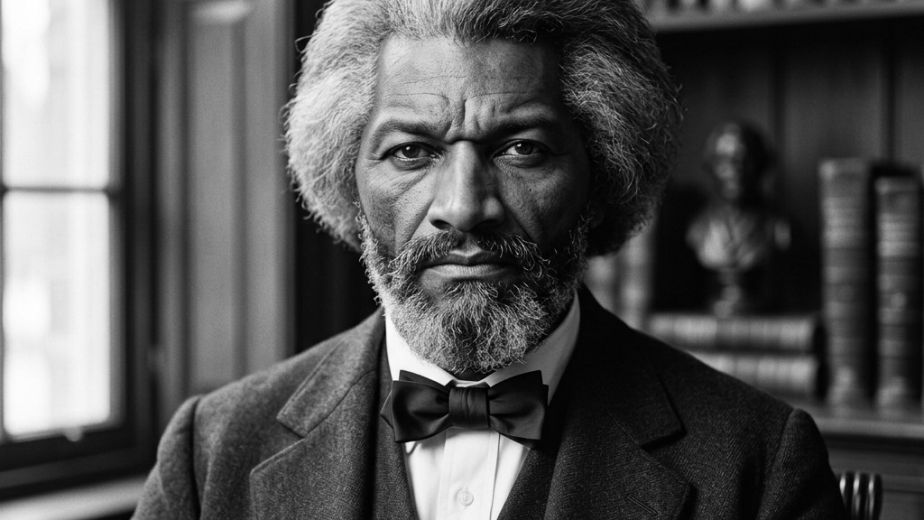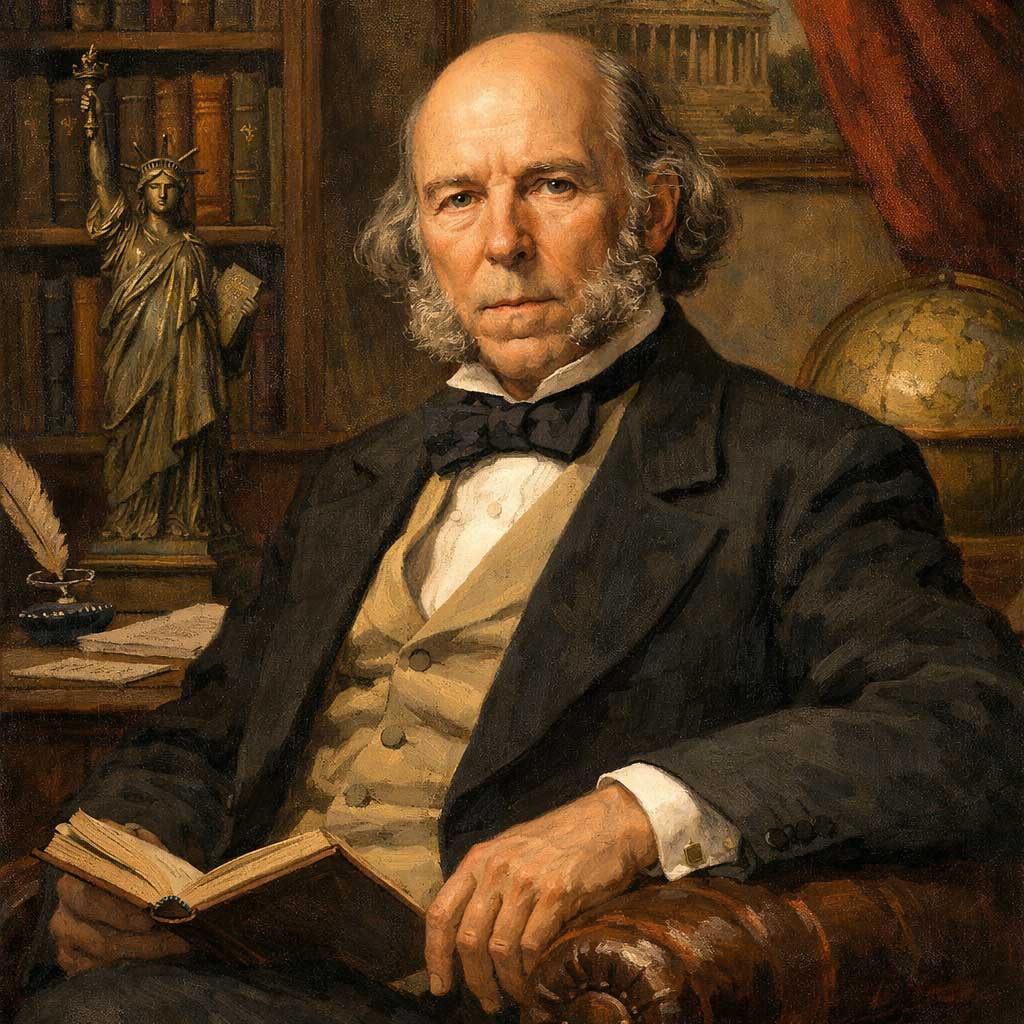
Anyone who visits Karl Marx’s grave in London’s Highgate Cemetery stands facing another thinker without realizing it. On the other side of the path lies Herbert Spencer, far more famous in his lifetime than his neighbor. Around a million copies of his books are said to have been sold, and in 1902 he was nominated for the Nobel Prize in Literature.
The comparison with his neighbor is closer than it seems. Murray Rothbard wrote that Spencer, more than anyone else, was “our Marx,” the Marx of the liberty movement. Rothbard considered his early book Social Statics the best systematic statement of libertarianism ever written. Today many people know the name only as a label, and usually a wrong one.
At a glance
- Life: April 27, 1820, in Derby to December 8, 1903, in Brighton
- Work: railway engineer, editor at the Economist (1848–1853), then independent philosopher and sociologist
- Major works: The Proper Sphere of Government (1842/43), Social Statics (1851), A System of Synthetic Philosophy (1862–1893), The Man versus the State (1884)
- Known for: the law of equal liberty, the distinction between militant and industrial societies, the phrase “survival of the fittest”
- In one sentence: He derived an entire system of rights from a single principle and defended it against conquerors and well-meaning reformers alike.
An Engineer without a Degree
Spencer never attended a university. His father, a teacher in Derby, taught him the natural sciences, and an uncle, the clergyman Thomas Spencer, taught him some mathematics, physics, and Latin. In the late 1830s the young man worked as a civil engineer in railway construction, which was sweeping all of England at the time, and on the side he wrote for radical and nonconformist papers.
In 1842 and 1843 the journal The Nonconformist published his twelve letters under the title The Proper Sphere of Government. In 1848 he joined the Economist, the paper of the free trade movement, as a subeditor. A small inheritance allowed him to give up the position in 1853 and devote himself entirely to writing. He was a friend of the novelist George Eliot and belonged to the X Club around the naturalist Thomas Henry Huxley. From 1862 to 1893 his life’s work, the Synthetic Philosophy, appeared volume by volume; it was meant to explain biology, psychology, sociology, and ethics from a common idea of evolution.
A Single Principle
He laid the foundation as early as 1851 in Social Statics. The sixth chapter contains the sentence that made him famous: “Every man has freedom to do all that he wills, provided he infringes not the equal freedom of any other man.”
What is most remarkable is what Spencer makes of this formula. Chapter by chapter he derives rights from it: the right to life and personal liberty, to property, to property in ideas, to free exchange, to free speech. Each of these rights follows from the equal liberty of all and therefore does not depend on the favor of any government.
He applies the same rigor to the tasks of the state. Already in the letters of 1842 he had written that government exists “not to regulate commerce; not to educate the people; not to teach religion; not to administer charity; not to make roads and railways; but simply to defend the natural rights of man.” In Social Statics he develops this in separate chapters on trade regulation, established churches, poor laws, state schools, state colonization, sanitary supervision, and currency and the postal service.
The Right to Ignore the State
Spencer went furthest in the nineteenth chapter. If everyone has the freedom to do all that does not infringe the equal freedom of others, then, in Spencer’s words, each is also “free to drop connection with the state,” that is, he may give up the state’s protection and refuse to pay for it. Whoever does so attacks no one. But to force him into membership would mean taking his property in the form of taxes against his will. Government appears here as an association for mutual protection, a “mutual-safety confederation” that everyone may join or not.
He later withdrew the idea, because no citizen could avoid benefiting from the order that a government maintains, and he dropped the chapter from later editions. Similarly, in the Principles of Ethics he gave up his early demand for an equal claim of all to the land, much to the annoyance of the land reformer Henry George. Yet it was the first version of Social Statics that became a classic, and it was this version that Rothbard referred to.
Equal Liberty Knows No Sex
How seriously Spencer took his principle is shown by the chapter on the rights of women. It opens with the sentence “Equity knows no difference of sex.” The law of equal liberty, he argued, applies to the whole human race, to women as well as to men. Immediately afterward comes a chapter on the rights of children.
For an Englishman in 1851, this was a bold position. In his later years Spencer became more reserved and opposed women’s suffrage, because he expected an expanded franchise to bring even more legislation.
Traders Instead of Warriors
Among Spencer’s most important ideas is the distinction between two types of society, which he worked out in the Principles of Sociology. In the militant society a rigid hierarchy rules; everything is geared toward command and obedience and ultimately toward war. In the industrial society, by contrast, people cooperate on the basis of voluntary contracts, they value personal liberty and rights, and the state confines itself to protecting them against violence and fraud. Rothbard praised how incisively Spencer developed this contrast.
For Spencer this led to a lifelong opposition to conquest and militarism. Already in Social Statics he mocked the self-righteousness of his countrymen: “we English justify our colonial aggressions by saying that the Creator intends the Anglo-Saxon race to people the world!”
When Britain went to war against the Boer republics in 1899, the old man publicly opposed it, even though it cost him much of his standing and he was accused of a lack of patriotism. In his essay “Patriotism,” published in 1902 in the volume Facts and Comments, he called the slogan “our country, right or wrong” detestable. When a country defends itself, he argued, patriotism is justified, but when it attacks, the slogan demands taking the side of injustice.
The New Tories
In 1884 Spencer collected four essays from the Contemporary Review in the slim volume The Man versus the State. It is aimed at the Liberal Party of his day, which sought to regulate citizens’ lives with ever new laws, from compulsory schooling to welfare provision. The very first essay states the diagnosis that most of those who now call themselves Liberals are “Tories of a new type.” The old liberalism, so his argument ran, had reduced coercion; the new one was reintroducing it in the name of progress.
In the essay “The Coming Slavery,” Spencer asks what actually makes someone a slave. His answer: “he labours under coercion to satisfy another’s desires.” Whoever works this way is unfree, whether the coercion comes from a master or from a government agency, and so Spencer draws the conclusion: “All socialism involves slavery.” At the end of the book he sets out the task he assigns to true liberalism: having once limited the power of kings, it must in the future set “a limit to the powers of Parliaments.” Henry Hazlitt judged in 1969 that Spencer had been proved right in the main thrust of his argument.
The Social Darwinist Label
Spencer coined the phrase “survival of the fittest” in 1864 in the Principles of Biology, and Darwin adopted it in later editions of his On the Origin of Species. Spencer himself, however, understood evolution largely in the sense of Lamarck, who assumed that living beings pass on characteristics acquired during their lifetime. The image of the coldhearted “Social Darwinist” who wanted to leave the weak to their fate was popularized above all by the American historian Richard Hofstadter with his book Social Darwinism in American Thought (1944). The Stanford Encyclopedia of Philosophy considers this reading exaggerated.
At the end of his Principles of Ethics there are extensive chapters on “positive beneficence,” including separate sections on aid to the poor. Spencer rejected state poor relief, but he devoted many pages of his ethics to the voluntary help people give one another. In 2015 the philosopher Matt Zwolinski argued at length that Spencer was not a Social Darwinist, did not reject charitable help, and held a principled libertarian theory of justice.
What friends of liberty can learn from him
First, the power of a clear principle. Spencer showed how far one can go with the single idea of equal liberty: to property, free trade, and free speech, to the rights of women and children, and to the question of whether a person may be forced to belong to a state at all.
Just as instructive is his observation that liberty is often threatened by those who make doing good their banner. The new Tories he described in 1884 wanted to help and in doing so created new dependencies. His definition of unfreedom as labor under coercion to satisfy the desires of others still serves as a yardstick today whenever taxes and levies are debated.
Finally, Spencer combined the defense of the market with a firm rejection of war. For him, trade and conquest belonged to two different worlds, and whoever wants the industrial society must resist the militant one, even when one’s own government takes the field.
A Neighbor Worth Rediscovering
When Spencer died in December 1903, his fame had already faded. Liberalism had turned toward the interventionist state, and the 20th century would bitterly confirm his concern about the militant society. His neighbor in Highgate Cemetery became the prophet of entire states, while he himself became a footnote.
Yet Spencer described earlier and more clearly than most what a free society lives on: people who grant one another equal liberty and settle their affairs by contract rather than by command. Anyone looking for the roots of libertarianism today will find them in this self-taught man from Derby, who believed his readers capable of living without a guardian.
Further reading
- Herbert Spencer: Social Statics, John Chapman, London 1851 (full text in the Online Library of Liberty)
- Herbert Spencer: The Man versus the State. With Six Essays on Government, Society, and Freedom, Liberty Fund, Indianapolis 1981
- Matt Zwolinski: Social Darwinism and Social Justice: Herbert Spencer on Our Duties to the Poor, 2015
- Henry Hazlitt: Man vs. the Welfare State, Arlington House, New Rochelle 1969
This article is part of our series on thinkers, doers, and historical figures of liberty.
Sources
- Spencer, Herbert: The Proper Sphere of Government, letters in The Nonconformist 1842–43, as a pamphlet W. Brittain, London 1843.
- Spencer, Herbert: Social Statics: or, The Conditions essential to Human Happiness specified, and the First of them Developed, John Chapman, London 1851 (Online Library of Liberty).
- Spencer, Herbert: The Principles of Biology, vol. 1, Williams & Norgate, London 1864.
- Spencer, Herbert: The Principles of Sociology, 1876–1896.
- Spencer, Herbert: The Man versus the State, Williams & Norgate, London 1884; new edition The Man versus the State. With Six Essays on Government, Society, and Freedom, Liberty Fund, Indianapolis 1981.
- Spencer, Herbert: The Principles of Ethics, 1879–1893 (part “Positive Beneficence”).
- Spencer, Herbert: “Patriotism,” in Facts and Comments, 1902, https://praxeology.net/HS-FC-20.htm
- Spencer, Herbert: An Autobiography, 1904.
- Stanford Encyclopedia of Philosophy: Herbert Spencer, https://plato.stanford.edu/entries/spencer/
- Internet Encyclopedia of Philosophy: Herbert Spencer, https://iep.utm.edu/spencer/
- Wikipedia (en): Herbert Spencer, https://en.wikipedia.org/wiki/Herbert_Spencer (biography, location of the grave)
- Wikipedia (en): The Man Versus the State, https://en.wikipedia.org/wiki/The_Man_Versus_the_State
- Rothbard, Murray N.: Herbert Spencer: Andreski & Peel (review), https://www.libertarianism.org/essays/herbert-spencer-andreski-peel; excerpt in Jorge Besada, Mises Wire, May 31, 2025, https://mises.org/mises-wire/our-marx-great-herbert-spencer
- Hazlitt, Henry: Spencer’s 1884 and Orwell’s 1984, in Man vs. the Welfare State, Arlington House, New Rochelle 1969, ch. 23; Mises Daily, https://mises.org/library/spencers-1884-orwells-1984
- Zwolinski, Matt: Social Darwinism and Social Justice: Herbert Spencer on Our Duties to the Poor, 2015, https://digital.sandiego.edu/law_philosophy_scholarship/188
- Hofstadter, Richard: Social Darwinism in American Thought, 1944 (revised 1955).
- Popular Science Monthly, vol. 43, August 1893, Literary Notices (on The Principles of Ethics), https://en.wikisource.org/wiki/Popular_Science_Monthly/Volume_43/August_1893/Literary_Notices